AI-Powered Technology, Higher Profits, and the Rise of AI Assistants in IT Companies
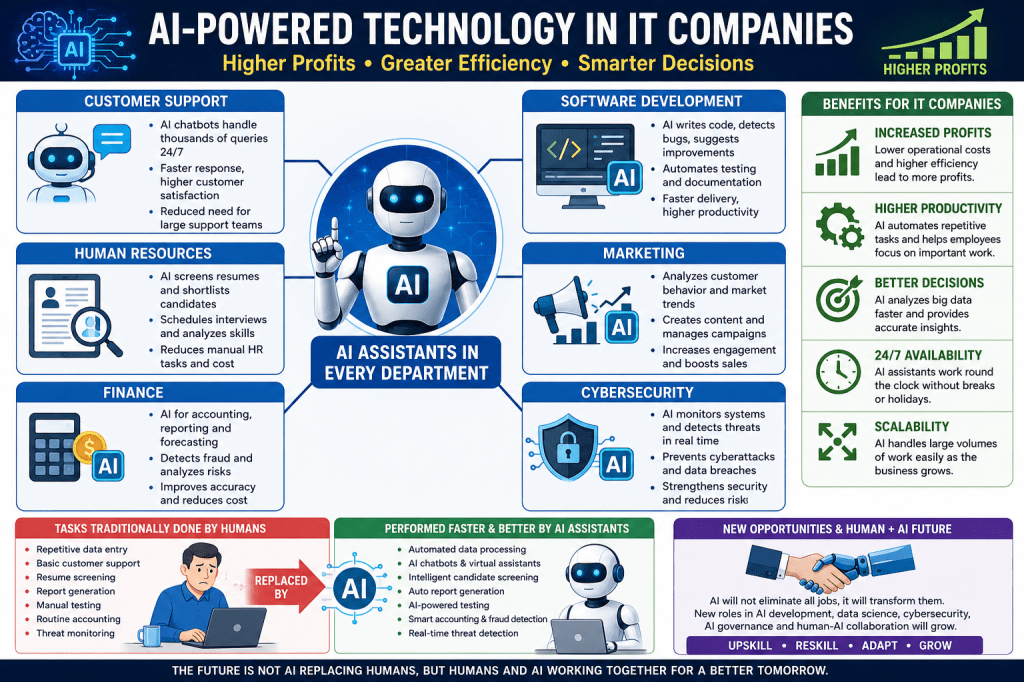
Many IT experts believe that the use of Artificial Intelligence (AI) is increasing profits and transforming how companies operate. One major trend is the deployment of AI assistants in almost every department of an IT company. These AI systems are helping organizations automate routine tasks, improve productivity, reduce costs, and make faster decisions. As a result, some human roles are being reduced or replaced, especially those involving repetitive work.
AI assistants can work 24 hours a day without breaks, holidays, or sick leave. In customer support departments, AI chatbots can answer thousands of customer queries simultaneously. This reduces the need for large customer service teams and helps companies save money while providing faster service.
In software development, AI coding assistants can generate code, detect bugs, suggest improvements, and automate testing. Tasks that once required several developers can now be completed more quickly with AI support. This increases efficiency and allows companies to deliver products faster, improving competitiveness and profitability.
Human Resources departments are also adopting AI. AI tools can screen resumes, schedule interviews, and analyze candidate qualifications. These systems reduce administrative work and help companies recruit employees more efficiently. As a result, fewer staff members may be needed for routine HR tasks.
Marketing teams are using AI to analyze customer behavior, create content, manage advertising campaigns, and predict market trends. AI can process large amounts of data much faster than humans, helping businesses make better decisions and generate higher sales revenue.
Finance departments benefit from AI-powered accounting, fraud detection, risk analysis, and financial forecasting. Automated systems reduce errors and improve accuracy while lowering operational costs. This contributes directly to increased profits.
Cybersecurity teams also rely on AI to detect threats, monitor networks, and respond to cyberattacks in real time. AI can analyze millions of security events quickly, helping organizations protect valuable data more effectively than traditional manual methods.
Despite these advantages, the growing use of AI assistants raises concerns about job displacement. Employees performing repetitive or predictable tasks may find their roles reduced or eliminated. Data entry operators, basic customer support agents, and some administrative workers are particularly vulnerable to automation.
However, many experts argue that AI will not eliminate all jobs. Instead, it will change the nature of work. New opportunities are emerging in AI development, data analysis, cybersecurity, AI governance, machine learning, and human-AI collaboration. Employees who learn new digital and AI-related skills may find better career opportunities in the future.
The challenge for governments, educational institutions, and businesses is to ensure workers are prepared for this transition. Upskilling, reskilling, and continuous learning will become increasingly important in the AI era.
In conclusion, AI-powered technology is helping IT companies increase profits by improving efficiency, reducing costs, and enhancing decision-making. AI assistants are becoming common across departments such as customer support, software development, HR, marketing, finance, and cybersecurity. While some human jobs may be replaced, new roles and opportunities are also being created. The future workforce will likely involve humans and AI working together to achieve greater productivity and innovation.

Leave a comment