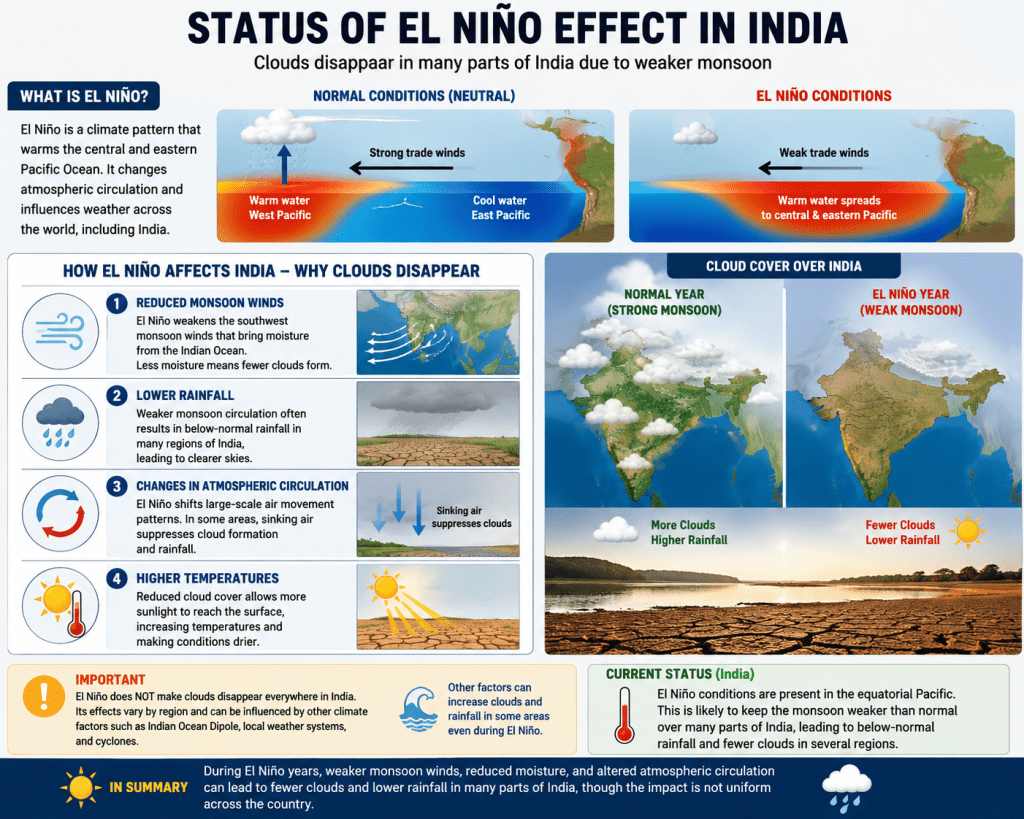
Status of El Niño Effect in India: Why Clouds Sometimes Disappear
El Niño is a natural climate phenomenon that occurs when sea surface temperatures in the central and eastern Pacific Ocean become warmer than normal. Although it originates far from India, El Niño has a significant influence on India’s weather, particularly the southwest monsoon, which provides most of the country’s annual rainfall. During El Niño years, many regions of India may experience fewer clouds, reduced rainfall, and higher temperatures.
One of the main reasons clouds sometimes disappear during El Niño conditions is the weakening of the monsoon circulation. Normally, strong monsoon winds carry moisture from the Arabian Sea and the Bay of Bengal toward the Indian subcontinent. This moisture helps form clouds and rainfall across the country. However, El Niño alters global atmospheric circulation patterns, weakening these moisture-laden winds. As a result, less water vapor reaches India, leading to fewer clouds and reduced precipitation.
Another important factor is the change in air movement. Cloud formation requires warm, moist air to rise into the atmosphere, where it cools and condenses into water droplets. During El Niño events, some parts of India experience increased sinking air rather than rising air. Sinking air suppresses cloud development because it becomes warmer and drier as it descends. This process often results in clearer skies and prolonged dry spells.
The reduction in cloud cover can have several consequences. With fewer clouds blocking sunlight, more solar radiation reaches the Earth’s surface. This causes temperatures to rise, especially during summer months. Higher temperatures can increase evaporation from soil and water bodies, worsening drought conditions in affected regions. Farmers may face challenges due to lower rainfall, reduced water availability, and stress on crops such as rice, sugarcane, and pulses.
However, it is important to understand that El Niño does not affect all parts of India equally. Some regions may experience severe rainfall deficits, while others may receive near-normal rainfall due to local weather systems. Climate factors such as the Indian Ocean Dipole can either strengthen or weaken El Niño’s influence. A positive Indian Ocean Dipole, for example, may partially offset the negative effects of El Niño by increasing moisture availability over India.
In recent years, meteorologists have improved their ability to monitor and predict El Niño events. Better forecasting allows governments, farmers, and water management authorities to prepare for potential impacts such as droughts, heat waves, and reduced agricultural output. Early warning systems help communities take preventive measures and reduce economic losses.
In conclusion, clouds sometimes disappear over parts of India during El Niño years because weakened monsoon winds, reduced moisture transport, and changes in atmospheric circulation suppress cloud formation. While El Niño often leads to lower rainfall and warmer temperatures, its effects vary across regions and can be influenced by other climate systems. Understanding these interactions is essential for managing water resources, agriculture, and climate-related risks in India.

Leave a comment