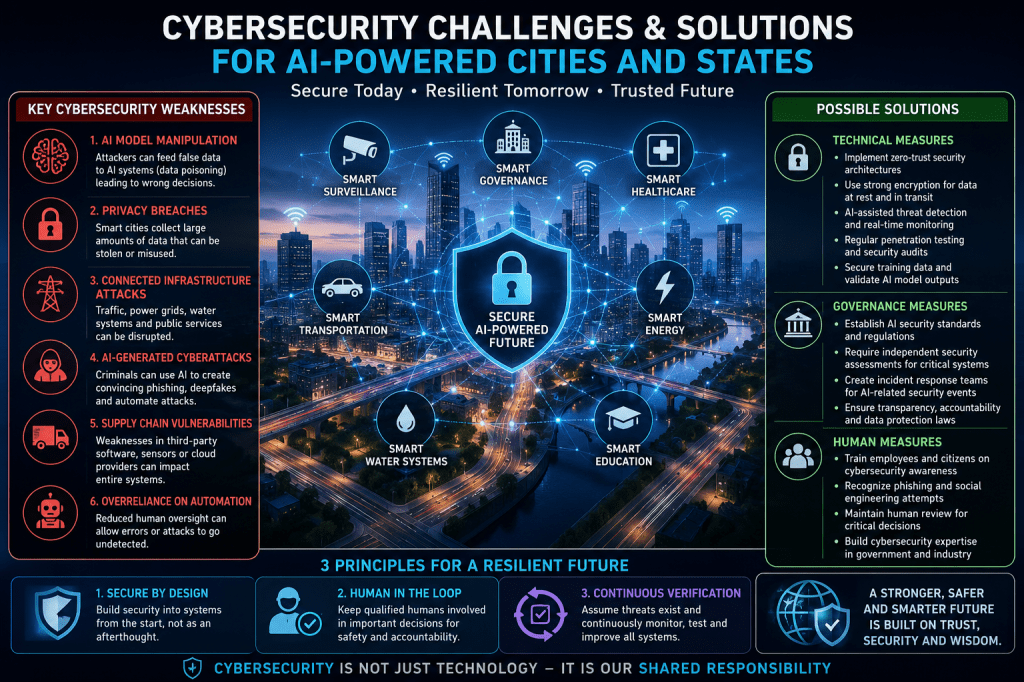
AI-powered technologies, smart cities, and government systems can provide major benefits, but they also introduce new cybersecurity risks. Common weaknesses include:
Key Cybersecurity Weaknesses
AI Model Manipulation
Attackers can feed false data to AI systems (“data poisoning”).
AI may make incorrect decisions if trained on corrupted information.
Privacy Breaches
Smart cities collect large amounts of data from cameras, sensors, and public services.
Unauthorized access can expose citizens’ personal information.
Connected Infrastructure Attacks
Traffic systems, power grids, water systems, and public transportation may be connected to networks.
A cyberattack could disrupt essential services.
AI-Generated Cyberattacks
Criminals can use AI to create convincing phishing emails, fake voices, or fake videos.
Automated attacks can scale much faster than traditional attacks.
Supply Chain Vulnerabilities
Weaknesses in third-party software, sensors, or cloud providers can affect entire systems.
Overreliance on Automation
Human oversight may be reduced, allowing errors or attacks to go unnoticed.
Possible Solutions
Technical Measures
Implement zero-trust security architectures.
Use strong encryption for data at rest and in transit.
Continuously monitor systems with AI-assisted threat detection.
Conduct regular penetration testing and security audits.
Secure AI training data and validate model outputs.
Governance Measures
Establish clear AI security standards and regulations.
Require independent security assessments for critical systems.
Create incident response teams for AI-related security events.
Human Measures
Train employees and citizens to recognize phishing and social engineering.
Maintain human review for critical decisions affecting public safety.
Develop cybersecurity expertise within government and industry.
Future Direction
A resilient AI-powered city or state should follow three principles:
Secure by Design – Build security into systems from the start.
Human in the Loop – Keep qualified humans involved in important decisions.
Continuous Verification – Assume threats exist and continuously validate systems.
The challenge is not only building smarter AI systems but ensuring they remain trustworthy, resilient, and secure against increasingly sophisticated cyber threats.

Leave a comment