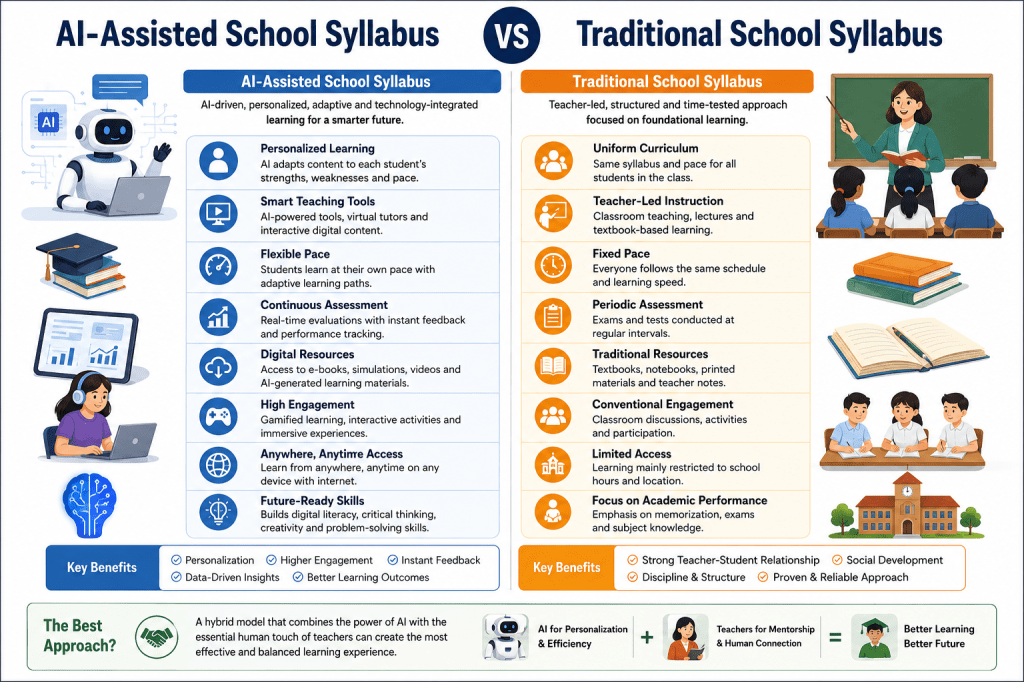
AI-Assisted School Syllabus vs Traditional School Syllabus
Education is one of the most important foundations of human development. For decades, schools around the world have followed traditional syllabi that rely on classroom teaching, textbooks, examinations, and teacher-led instruction. However, the rapid advancement of Artificial Intelligence (AI) is transforming education by introducing AI-assisted learning systems that personalize instruction, automate assessments, and provide students with interactive learning experiences. As schools increasingly adopt digital technologies, a comparison between AI-assisted school syllabi and traditional school syllabi becomes essential to understand the future of education.
Understanding Traditional School Syllabus
A traditional school syllabus is a structured curriculum designed by educational authorities and delivered uniformly to all students. Teachers are the primary source of knowledge, and learning takes place mainly through lectures, textbooks, assignments, and examinations.
The traditional model emphasizes discipline, classroom interaction, and standardized learning outcomes. Students follow the same curriculum, study the same topics, and take the same examinations regardless of their individual learning styles or abilities.
This system has successfully educated generations of students and produced scientists, engineers, doctors, teachers, and leaders. It also encourages social interaction, teamwork, and communication skills through classroom activities and extracurricular programs.
However, traditional education often faces criticism for its one-size-fits-all approach. Students learn at different speeds, but the curriculum generally progresses at a fixed pace. As a result, some students may struggle to keep up, while others may not be sufficiently challenged.
Understanding AI-Assisted School Syllabus
An AI-assisted school syllabus integrates artificial intelligence technologies into teaching, learning, and assessment processes. AI systems can analyze student performance, identify strengths and weaknesses, and adapt learning materials accordingly.
Instead of providing the same content to every student, AI-assisted education offers personalized learning paths. Students receive customized lessons, practice exercises, and recommendations based on their individual needs.
AI-powered educational tools may include intelligent tutoring systems, virtual assistants, adaptive learning platforms, automated grading systems, and interactive simulations. These technologies can support both students and teachers by making learning more efficient and engaging.
The goal of AI-assisted education is not necessarily to replace teachers but to enhance learning experiences and improve educational outcomes.
Key Differences
Skill Development
Traditional syllabi often focus on subject knowledge, examination performance, and memorization.
AI-assisted education emphasizes critical thinking, problem-solving, digital literacy, creativity, and technological competence. These skills are increasingly important in the modern workforce and digital economy.
Advantages of AI-Assisted School Syllabus
AI-assisted education offers several significant benefits:
Personalized learning experiences for every student.
Faster identification of learning gaps.
Instant feedback and performance tracking.
Increased student engagement through interactive content.
Improved accessibility for remote and rural learners.
Better preparation for technology-driven careers.
Reduced administrative workload for teachers through automated grading and reporting.
These advantages can lead to improved academic performance and greater student satisfaction.
Advantages of Traditional School Syllabus
Despite technological advancements, traditional education remains valuable because it provides:
Strong teacher-student relationships.
Face-to-face communication and mentoring.
Social and emotional development.
Teamwork and collaborative learning opportunities.
Structured classroom discipline.
Cultural and ethical education through human interaction.
Teachers play an essential role in inspiring students, developing character, and providing emotional support—areas where AI still has limitations.
Challenges of Both Systems
AI-assisted education faces challenges such as technology costs, internet access limitations, cybersecurity risks, and concerns about data privacy. Excessive screen time may also affect student health and social interaction.
Traditional education faces challenges including limited personalization, slow feedback mechanisms, overcrowded classrooms, and reliance on standardized testing. Some students may struggle because the teaching pace cannot easily adapt to individual needs.
The Future: A Hybrid Model
The future of education will likely combine the strengths of both systems. In a hybrid model, AI can handle routine tasks, provide personalized learning support, and analyze student performance, while teachers focus on mentoring, creativity, ethics, leadership, and emotional development.
Such a balanced approach allows students to benefit from technological innovation without losing the human connection that remains essential to education.
Conclusion
AI-assisted school syllabi and traditional school syllabi each offer unique strengths and limitations. AI-assisted education provides personalization, flexibility, instant feedback, and technology-driven learning experiences. Traditional education offers human interaction, social development, discipline, and mentorship. Rather than replacing traditional education, AI is most effective when used as a supportive tool that enhances teaching and learning. The future of education lies in integrating AI with human expertise to create a more inclusive, adaptive, and effective learning system for students worldwide.
Personalization
One of the biggest differences between the two approaches is personalization.
In traditional education, all students follow the same syllabus and pace. Teachers may try to accommodate different learning styles, but large class sizes often make individual attention difficult.
AI-assisted education, on the other hand, can adapt content to each student’s needs. If a student struggles with mathematics, the system can provide additional exercises and explanations. If a student excels, the system can offer advanced challenges.
Teaching Methods
Traditional classrooms rely heavily on lectures, textbooks, note-taking, and classroom discussions. Learning is primarily teacher-centered.
AI-assisted learning uses digital tools, interactive simulations, videos, virtual laboratories, and intelligent tutoring systems. Students often take a more active role in their learning process.
This interactive approach can increase engagement and improve understanding of complex concepts.
Assessment and Feedback
In traditional systems, assessments typically occur through periodic tests, assignments, and final examinations. Feedback may take days or weeks.
AI-assisted systems provide immediate feedback. Students can instantly identify mistakes and receive explanations for correct answers. This rapid feedback loop helps improve learning efficiency.
Teachers also gain access to detailed performance data, allowing them to identify students who need additional support.
Accessibility
Traditional education is usually limited to classroom hours and physical school environments.
AI-assisted learning can be available anytime and anywhere through computers, tablets, and smartphones. Students can continue learning outside school hours and access educational resources whenever needed.
This flexibility is especially valuable for remote learning and lifelong education.

Leave a comment