AI-Assisted Types of Medical Education vs Traditional Types of Medical Education
The field of medical education is experiencing a significant transformation due to the rapid advancement of Artificial Intelligence (AI). For centuries, traditional medical education has been the foundation for training doctors, nurses, surgeons, and healthcare professionals. However, AI-assisted medical education is introducing innovative learning methods that enhance knowledge acquisition, clinical decision-making, and practical training. While traditional and AI-assisted medical education have distinct characteristics, both aim to produce competent healthcare professionals capable of improving patient outcomes. Understanding their differences helps educators, students, and healthcare institutions prepare for the future of medicine.
Traditional Medical Education
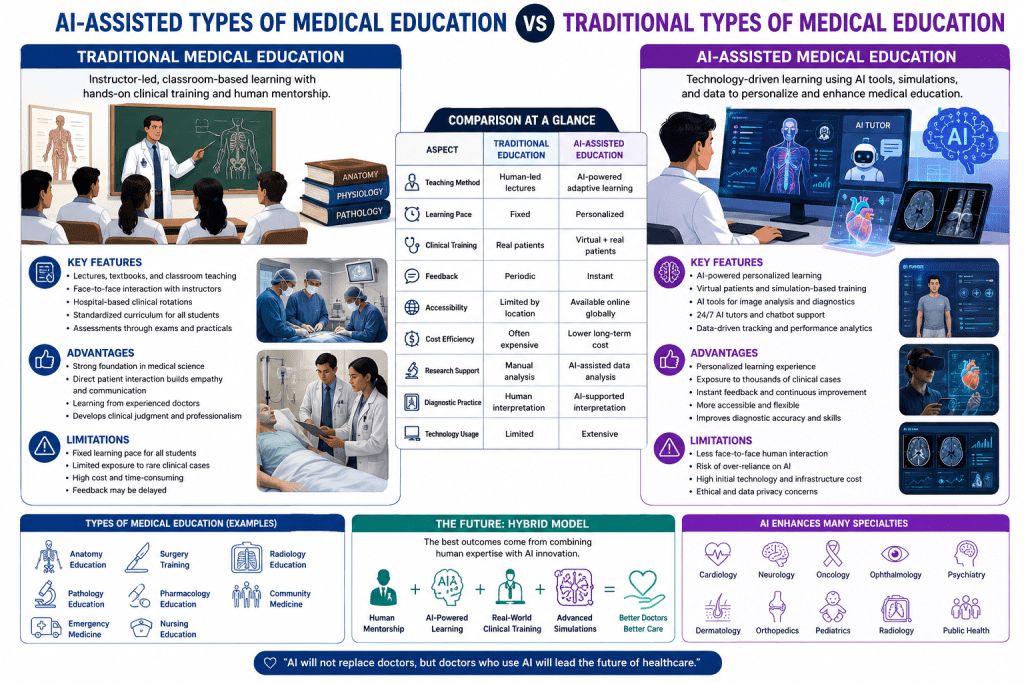
Traditional medical education follows a structured approach centered on classroom instruction, textbooks, laboratory work, clinical rotations, and mentorship from experienced healthcare professionals. This model has been used successfully for generations and remains the cornerstone of medical training worldwide.
In traditional education, students attend lectures delivered by professors and medical experts. They study anatomy, physiology, pathology, pharmacology, and other medical sciences through textbooks and academic resources. Practical knowledge is gained through laboratory sessions, dissections, and clinical placements in hospitals and healthcare centers.
One of the greatest strengths of traditional medical education is direct human interaction. Students learn not only medical knowledge but also communication skills, empathy, professionalism, and ethical decision-making through interactions with patients, instructors, and colleagues. Clinical rotations expose students to real-world healthcare situations, helping them develop diagnostic and treatment skills under professional supervision.
However, traditional medical education has limitations. Learning is often standardized, meaning all students follow the same pace regardless of individual strengths and weaknesses. Access to rare medical cases may be limited, and feedback from instructors can sometimes be delayed. Furthermore, the growing volume of medical knowledge makes it increasingly difficult for students to keep up with new research and developments using conventional learning methods alone.
AI-Assisted Medical Education
AI-assisted medical education integrates artificial intelligence, machine learning, virtual reality, augmented reality, data analytics, and intelligent tutoring systems into the educational process. Rather than replacing educators, AI enhances learning by making education more personalized, efficient, and accessible.
One of the key advantages of AI-assisted education is personalized learning. AI systems can analyze a student’s performance, identify areas of weakness, and recommend customized study materials. Instead of following a fixed curriculum pace, students receive targeted support based on their individual needs.
AI-powered virtual patients and simulations allow learners to practice diagnosing and treating medical conditions in a risk-free environment. Students can encounter thousands of clinical scenarios, including rare diseases that may not be available during traditional clinical training. Virtual reality simulations can replicate surgical procedures, emergency care situations, and patient interactions, providing valuable hands-on experience.
AI also assists in medical image analysis and diagnostic training. Students learning radiology, pathology, or ophthalmology can use AI systems to analyze X-rays, MRI scans, CT scans, and laboratory results. Immediate feedback helps improve accuracy and clinical reasoning skills.
Additionally, AI-powered chatbots and virtual tutors provide round-the-clock learning support. Students can ask questions, review concepts, and receive explanations at any time, increasing flexibility and accessibility.
Despite its advantages, AI-assisted medical education also has challenges. Excessive reliance on technology may reduce opportunities for developing interpersonal skills and empathy. AI systems can occasionally generate inaccurate recommendations, making human oversight essential. Furthermore, implementing advanced AI technologies requires substantial financial investment and reliable technological infrastructure.
Key Differences Between Traditional and AI-Assisted Medical Education
The most significant difference between the two approaches lies in how learning is delivered. Traditional education depends heavily on instructors and physical learning environments, whereas AI-assisted education uses digital tools and intelligent systems to support individualized learning experiences.
Traditional medical education emphasizes direct patient contact and mentorship. Students learn clinical judgment through observation, discussion, and supervised practice. AI-assisted education, in contrast, uses simulations, analytics, and adaptive learning platforms to accelerate knowledge acquisition and skill development.
Feedback mechanisms also differ significantly. In traditional systems, feedback often occurs after examinations or clinical evaluations. AI systems provide instant feedback, allowing students to correct mistakes and reinforce learning immediately.
Another major distinction is accessibility. Traditional medical education often requires attendance at specific institutions and healthcare facilities. AI-assisted platforms can provide educational resources remotely, making medical learning more accessible to students in underserved regions.
The Future of Medical Education
The future of medical education is unlikely to involve a complete replacement of traditional methods by AI. Instead, a hybrid model will emerge that combines the strengths of both approaches.
Human instructors will continue to play a crucial role in teaching ethics, communication, empathy, leadership, and professional responsibility. These human qualities remain essential in healthcare and cannot be fully replicated by AI systems. At the same time, AI will enhance educational efficiency by offering personalized learning paths, advanced simulations, predictive analytics, and real-time feedback.
Medical schools are increasingly incorporating AI literacy into their curricula because future healthcare professionals will need to understand how to work effectively with AI-powered diagnostic and decision-support tools. Students trained in both traditional medical practices and AI technologies will be better prepared for the evolving healthcare landscape.
Conclusion
Traditional medical education has long been the foundation of healthcare training, emphasizing human mentorship, clinical experience, and patient-centered care. AI-assisted medical education introduces powerful new tools that personalize learning, improve simulation-based training, and provide instant feedback. While AI can enhance efficiency and expand access to education, it cannot replace the human qualities that define excellent healthcare professionals.
The most successful future medical education systems will integrate traditional teaching methods with AI-driven innovations. By combining human expertise with technological intelligence, medical institutions can produce healthcare professionals who are both clinically competent and technologically prepared for the future of medicine. This balanced approach will help improve patient care, medical research, and healthcare outcomes worldwide.

Leave a comment