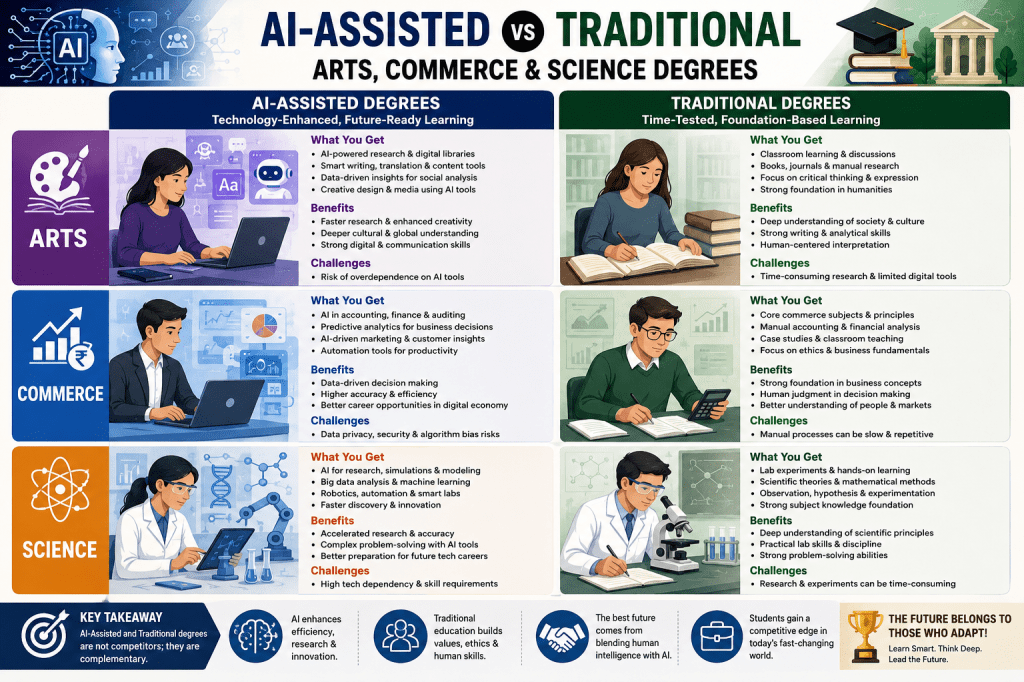
Artificial Intelligence (AI) is transforming education across the world. Universities and colleges are increasingly integrating AI-powered tools into teaching, research, assessment, and career preparation. As a result, a new model of education is emerging: the AI-assisted degree. While traditional Arts, Commerce, and Science degrees continue to provide strong academic foundations, AI-assisted degrees enhance learning through automation, data analysis, intelligent tutoring systems, and advanced digital tools. Understanding the differences between these approaches is important for students preparing for the future workforce.
Arts Degrees: Human Creativity Meets Artificial Intelligence
Traditional Arts degrees focus on subjects such as literature, history, sociology, political science, psychology, philosophy, languages, and fine arts. Students learn through lectures, textbooks, essays, discussions, and independent research. The emphasis is on critical thinking, creativity, communication, cultural understanding, and human interpretation.
Traditional Arts education develops strong analytical and writing skills. Students learn to evaluate historical events, understand social issues, and interpret artistic works from multiple perspectives. Human judgment and originality remain at the center of the learning process.
AI-assisted Arts degrees build upon these foundations by incorporating AI-powered research tools, digital archives, language processing systems, and content creation platforms. Students can use AI to analyze large collections of historical documents, translate texts, generate research summaries, and explore patterns within cultural data.
For example, literature students may use AI tools to compare writing styles across thousands of books, while historians can analyze vast historical records in minutes rather than months. AI can also assist artists and designers by generating concepts, improving visualizations, and supporting creative experimentation.
However, AI-assisted Arts education faces challenges. Excessive dependence on AI may reduce original thinking and critical analysis if students rely too heavily on automated outputs. Therefore, human creativity and ethical judgment remain essential.
Commerce Degrees: Business Education in the Age of Automation
Traditional Commerce degrees include accounting, finance, economics, taxation, banking, marketing, business administration, and management studies. These programs teach students how businesses operate, how financial systems function, and how organizations make decisions.
Traditional Commerce education emphasizes manual financial analysis, business strategy, communication skills, and leadership development. Students learn accounting principles, market analysis, economic theories, and organizational behavior through classroom instruction and practical case studies.
AI-assisted Commerce degrees integrate technologies such as machine learning, predictive analytics, intelligent accounting systems, customer relationship management platforms, and automated business intelligence tools. Students learn not only traditional business concepts but also how AI can improve decision-making and operational efficiency.
In accounting, AI can automate bookkeeping, auditing, and financial reporting tasks. In marketing, AI analyzes customer behavior and predicts purchasing trends. In finance, machine learning models assist with risk assessment and investment forecasting. Business managers can use AI-generated insights to make faster and more informed decisions.
The primary advantage of AI-assisted Commerce education is its alignment with the digital economy. Companies increasingly seek professionals who understand both business fundamentals and technological innovation.
However, AI systems cannot fully replace human leadership, negotiation, emotional intelligence, or ethical decision-making. Commerce graduates must balance technological expertise with interpersonal skills to succeed in modern organizations.
Science Degrees: Accelerating Discovery Through AI
Traditional Science degrees include physics, chemistry, biology, mathematics, environmental science, and related disciplines. Scientific education relies heavily on experimentation, observation, hypothesis testing, laboratory work, and mathematical analysis.
Traditional Science programs teach students the scientific method, enabling them to investigate natural phenomena and solve complex problems systematically. Laboratory experience remains one of the most valuable aspects of science education because it develops practical skills and scientific reasoning.
AI-assisted Science degrees combine traditional scientific knowledge with machine learning, robotics, big data analytics, computer simulations, and intelligent research systems. Scientists increasingly use AI to process massive datasets, identify patterns, and accelerate discoveries.
In biology, AI assists with genetic analysis and drug discovery. In environmental science, AI helps predict climate patterns and monitor ecosystems. In physics and astronomy, AI analyzes enormous volumes of observational data that would be impossible for humans to process manually.
AI-assisted Science education enables students to conduct research more efficiently and solve problems at a scale previously unimaginable. Advanced simulations can model chemical reactions, engineering systems, and environmental changes without requiring costly physical experiments.
Nevertheless, scientific understanding still depends on human curiosity, creativity, and rigorous validation. AI can identify patterns, but scientists must interpret results, design experiments, and ensure research integrity.
Key Differences Between AI-Assisted and Traditional Degrees
The primary difference lies in the role of technology. Traditional degrees focus on human-centered learning, manual research, and direct interaction with teachers and educational resources. AI-assisted degrees augment these methods through intelligent systems that increase efficiency and expand analytical capabilities.
Traditional education emphasizes foundational knowledge, critical thinking, ethical reasoning, and interpersonal communication. AI-assisted education emphasizes data literacy, technological proficiency, automation management, and digital problem-solving.
Traditional graduates may possess stronger manual analytical skills and deeper experience with conventional methods. AI-assisted graduates often have greater exposure to emerging technologies and may adapt more quickly to technology-driven workplaces.
The Future of Higher Education
The future is unlikely to be a choice between AI-assisted education and traditional education. Instead, higher education is moving toward a hybrid model that combines the strengths of both approaches.
Arts students will continue developing creativity and cultural understanding while using AI to enhance research. Commerce students will combine business expertise with advanced analytics. Science students will integrate laboratory skills with AI-powered discovery tools.
Educational institutions that successfully blend human intelligence with artificial intelligence will better prepare students for future careers. Employers increasingly value individuals who can think critically, communicate effectively, solve problems creatively, and use advanced technologies responsibly.
Conclusion
AI-assisted Arts, Commerce, and Science degrees represent the next stage in educational evolution rather than a replacement for traditional learning. Traditional degrees provide the intellectual foundation, ethical awareness, and human-centered skills necessary for success. AI-assisted degrees enhance these capabilities by improving research speed, analytical power, and technological readiness.
The most successful graduates of the future will not be those who rely entirely on AI or entirely on traditional methods. Instead, they will be individuals who combine the strengths of human intelligence, creativity, and judgment with the efficiency and capabilities of artificial intelligence. This balanced approach will define the future of education and professional success in the twenty-first century.

Leave a comment