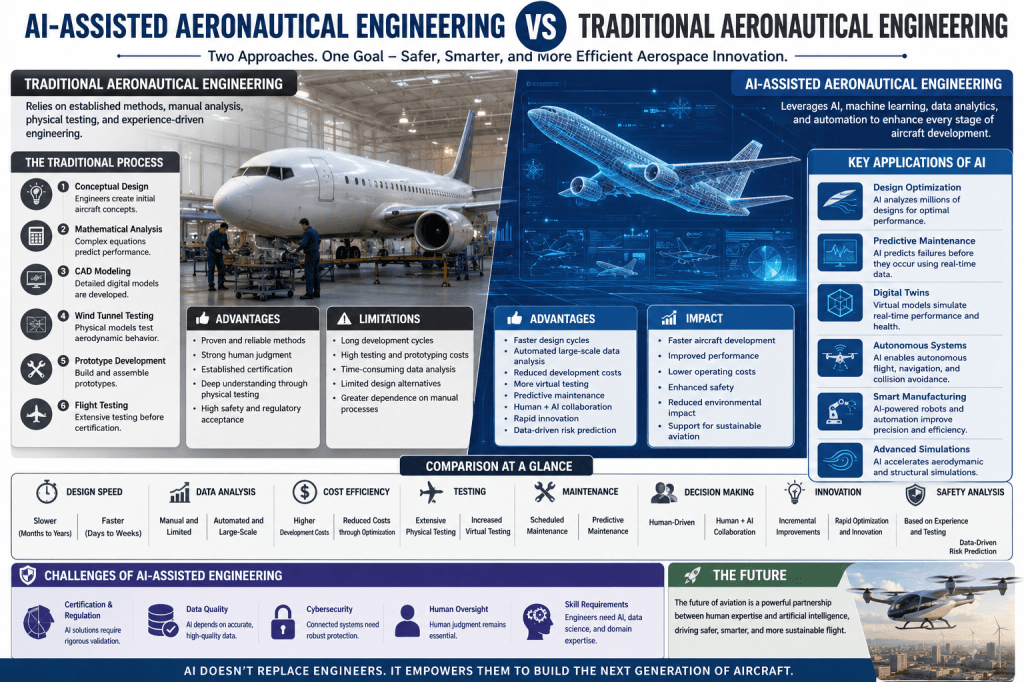
Aeronautical engineering has significantly evolved over the decades, with traditional methodologies paving the way for innovative technologies. Among these innovations, Artificial Intelligence (AI) is transforming the field, providing engineers with tools that enhance productivity, efficiency, and safety. This article will explore the key differences between AI-assisted aeronautical engineering and traditional aeronautical engineering, examining the advantages, challenges, and potential future prospects.
Definition and Scope
Traditional Aeronautical Engineering
Traditional aeronautical engineering consists of time-tested principles and methods developed over many years. This discipline focuses on the design, development, testing, and maintenance of aircraft, satellites, and spacecraft. Engineers in this field rely heavily on established practices, such as fluid mechanics, thermodynamics, structural analysis, and control systems.
AI-Assisted Aeronautical Engineering
AI-assisted aeronautical engineering incorporates advanced algorithms, machine learning, and data analytics into the engineering process. This synergy between traditional engineering practices and cutting-edge technology enhances the capabilities of engineers, allowing them to solve complex problems and make data-driven decisions.
Key Differences
1. Design Process
Traditional Approach: In traditional aeronautical engineering, the design process is often slow and relies heavily on manual calculations, simulations, and human intuition. Engineers use CAD (Computer-Aided Design) software to create models, relying on their expertise and previous experience.
AI-Assisted Approach: AI-assisted engineering streamlines the design process. AI algorithms can analyze vast amounts of data and optimize designs much faster than human capabilities. Machine learning models can predict performance outcomes based on historical data, helping engineers make informed design choices more quickly.
2. Decision Making
Traditional Approach: Decision-making in traditional engineering is frequently based on empirical knowledge and historical data. Engineers must weigh various factors, often leading to longer evaluation times and human biases influencing outcomes.
AI-Assisted Approach: With AI, decision-making is data-driven. Algorithms evaluate multiple variables and scenarios in real-time, providing engineers with insights they may overlook. This enhances the quality of decisions and reduces the time required to reach conclusions.
3. Testing and Simulation
Traditional Approach: Traditional testing methods include wind tunnel experiments and physical prototypes, which can be costly and time-consuming. Iterative testing is often necessary to achieve the desired performance characteristics.
AI-Assisted Approach: AI can simulate various scenarios using advanced computational models, significantly reducing the need for physical testing. Techniques such as digital twin technology allow for real-time monitoring and simulation of aircraft performance, leading to more efficient validation processes and iterations.
4. Maintenance
Traditional Approach: Maintenance schedules are generally based on manufacturer recommendations and historical performance data. Engineers conduct regular checks and inspections, which can lead to unnecessary downtime and costs.
AI-Assisted Approach: Predictive maintenance powered by AI analyzes real-time data from aircraft sensors to identify potential issues before they become critical. This methodology reduces downtime, enhances safety, and extends the lifespan of aircraft components.
Advantages of AI-Assisted Aeronautical Engineering
Enhanced Efficiency
The most notable advantage of AI in aeronautical engineering is the increased efficiency it brings to design, testing, and maintenance. Automation of routine tasks allows engineers to focus on complex issues, fostering innovation.
Improved Safety
AI systems can analyze data from various sources in real-time, allowing for quicker responses to potential problems. This capability improves safety by providing preemptive solutions and reducing human error.
Cost Reduction
By optimizing design and maintenance processes, AI can significantly reduce costs associated with aircraft development and operation. Predictive analytics minimize unnecessary repairs, leading to more cost-effective management of resources.
Challenges of AI-Assisted Aeronautical Engineering
Data Dependency
One of the significant challenges of AI-assisted engineering is the reliance on quality data. Inaccurate or incomplete data can lead to unintended consequences in AI predictions and decision-making.
Integration and Implementation
Integrating AI systems into existing workflows can be complex. Organizations must invest in training personnel, updating infrastructure, and ensuring compliance with safety regulations.
Ethical Considerations
As AI takes on more decision-making roles, ethical considerations arise regarding accountability and transparency. Ensuring that AI systems operate within ethical guidelines is essential for maintaining trust in aeronautical engineering practices.
Future Prospects
The future of aeronautical engineering is likely to be dominated by AI technologies. As the industry embraces digitalization, we can expect AI to play a critical role in the design of next-generation aircraft, improving capabilities such as fuel efficiency, environmental impact, and passenger comfort.
The ongoing research and development in AI will likely yield even more sophisticated systems capable of tackling emerging challenges in the aviation sector. Collaborative frameworks between AI experts and aeronautical engineers will shape an innovative future, merging creativity with technological advancement.
Conclusion
In conclusion, AI-assisted aeronautical engineering represents a significant advancement over traditional engineering methods. While traditional practices have laid the groundwork for the field, incorporating AI provides remarkable efficiencies, enhanced safety, and reduced costs. Nevertheless, the transition to AI-driven processes must be approached carefully, considering data integrity, implementation challenges, and ethical implications. As the industry moves forward, the collaboration between human ingenuity and artificial intelligence will undoubtedly shape the skies of tomorrow.

Leave a comment