Introduction
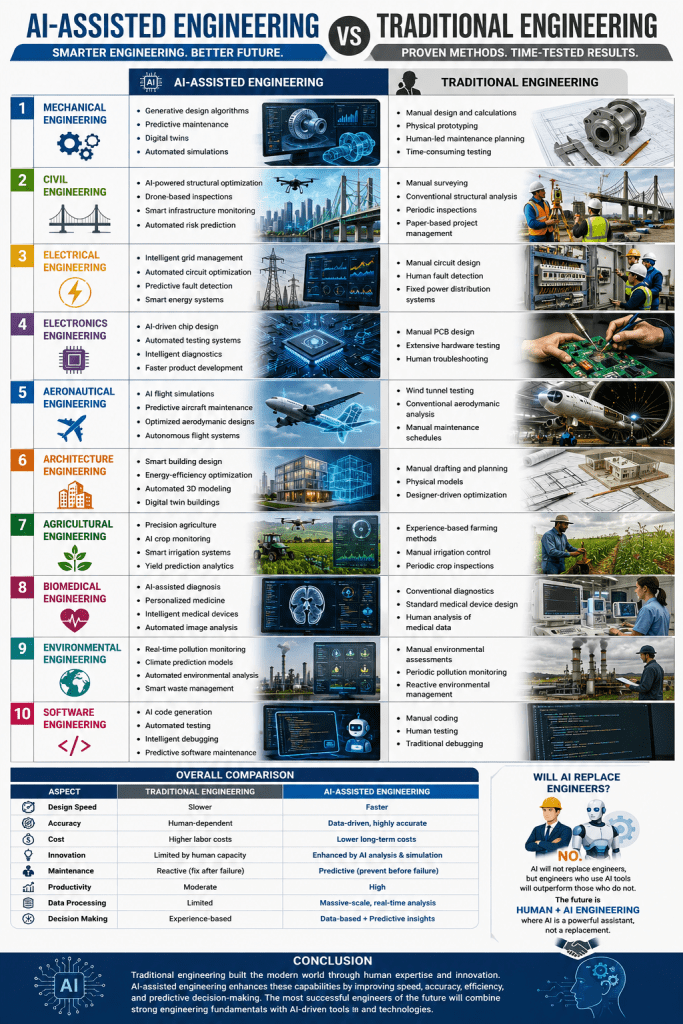
Engineering has long been a profession defined by creativity, problem-solving, and the application of scientific and mathematical principles. With the rapid advances in technology, particularly in artificial intelligence (AI), the landscape of engineering is evolving. AI is not merely a tool; it is transforming how engineers approach design, development, and implementation in various fields. This article explores the differences between AI-assisted engineering and traditional engineering, highlighting the advantages and challenges of integrating AI into engineering practices.
Traditional Engineering
Definition and Characteristics
Traditional engineering refers to methods and practices that have been in place for decades, focusing on structured problem-solving, empirical analysis, and significant human involvement. Characteristics of traditional engineering include:
- Manual Processes: Engineers rely heavily on manual calculations, drafting blueprints, and physical prototypes.
- Sequential Design Process: The design process typically follows a linear path—requirements gathering, design, testing, and implementation, often with significant feedback loops.
- Expertise-Driven: Decisions are based on the individual knowledge and experience of engineers, which can lead to variability in outcomes.
Advantages of Traditional Engineering
- Proven Methods: Many traditional practices have been continuously refined, resulting in reliable methodologies.
- Human Insight: Engineering solutions often benefit from the subjective insights and creativity of human engineers.
- Regulatory Compliance: Traditional engineering practices have established frameworks that align well with industry regulations and standards.
Challenges of Traditional Engineering
- Time-Consuming: The reliance on manual methods can prolong design cycles and increase costs.
- Limited Data Utilization: Traditional engineering often underutilizes vast amounts of data available, limiting innovation.
- Scalability Issues: As projects increase in complexity, traditional methods may struggle to adapt effectively without significant resource investment.
AI-Assisted Engineering
Definition and Characteristics
AI-assisted engineering integrates artificial intelligence technologies into the engineering process, enhancing design, decision-making, and operational efficiency. Some characteristics of AI-assisted engineering include:
- Data-Driven Decisions: AI systems analyze extensive datasets to identify patterns and optimize designs, enabling informed decision-making.
- Automation of Tasks: Routine tasks, such as simulations and calculations, are automated, allowing engineers to focus on more complex problems.
- Real-Time Feedback: AI provides instant feedback during the design process, which helps to identify issues early and incorporate changes on the fly.
Advantages of AI-Assisted Engineering
- Increased Efficiency: Automation of repetitive tasks reduces the engineering time required to complete projects.
- Enhanced Innovation: AI can explore numerous design variations quickly, leading to innovative solutions that a human engineer may not conceive.
- Improved Accuracy: Data analysis reduces human error, leading to more accurate models and outcomes.
- Predictive Analytics: AI can forecast potential issues based on historical data, allowing proactive measures to be taken.
Challenges of AI-Assisted Engineering
- High Initial Costs: Implementing AI technologies may require significant investment in software, hardware, and training.
- Skill Gap: Engineers must learn new skills to work alongside AI, creating a potential skills gap in organizations.
- Data Privacy Concerns: Utilizing large datasets raises concerns about data privacy and ownership.
- Dependence on Technology: Over-reliance on AI could diminish human creativity and critical thinking skills in the engineering field.
Comparative Analysis
To better understand the shift from traditional engineering practices to AI-assisted engineering, a comparative analysis of both systems can be beneficial.
Approach to Problem-Solving
- Traditional Engineering: Follow a structured approach where engineers meticulously analyze each element of a problem sequentially.
- AI-Assisted Engineering: Emphasizes a holistic approach, where the AI system simultaneously considers various factors and suggests optimized solutions.
Speed of Development
- Traditional Engineering: Projects can take months or years, as the design process is iterative with delays often arising from multiple feedback loops.
- AI-Assisted Engineering: Accelerates the development process by automating routine tasks and providing rapid feedback and insights.
Collaboration and Communication
- Traditional Engineering: Faces challenges in collaboration due to the compartmentalized nature of projects where teams work sequentially.
- AI-Assisted Engineering: Enhances communication and collaboration through AI-driven platforms that allow real-time updates and data sharing among team members.
Procurement and Resource Management
- Traditional Engineering: Engineers often find it challenging to balance resources, timelines, and costs manually.
- AI-Assisted Engineering: AI algorithms can analyze resource needs and optimize procurement processes, ensuring that materials and labor align with project timelines and budgets.
Conclusion
The integration of AI into engineering is revolutionizing the field, offering enhanced capabilities and efficiency compared to traditional engineering practices. While AI-assisted engineering presents numerous advantages, it also poses challenges that must be addressed as the technology continues to evolve. The future of engineering will likely see a blend of traditional expertise and AI innovations, creating a new paradigm where human intelligence and machine learning coexist to deliver better solutions. As the industry adapts, engineers must embrace lifelong learning and remain agile in a landscape increasingly characterized by rapid technological change.

Leave a comment