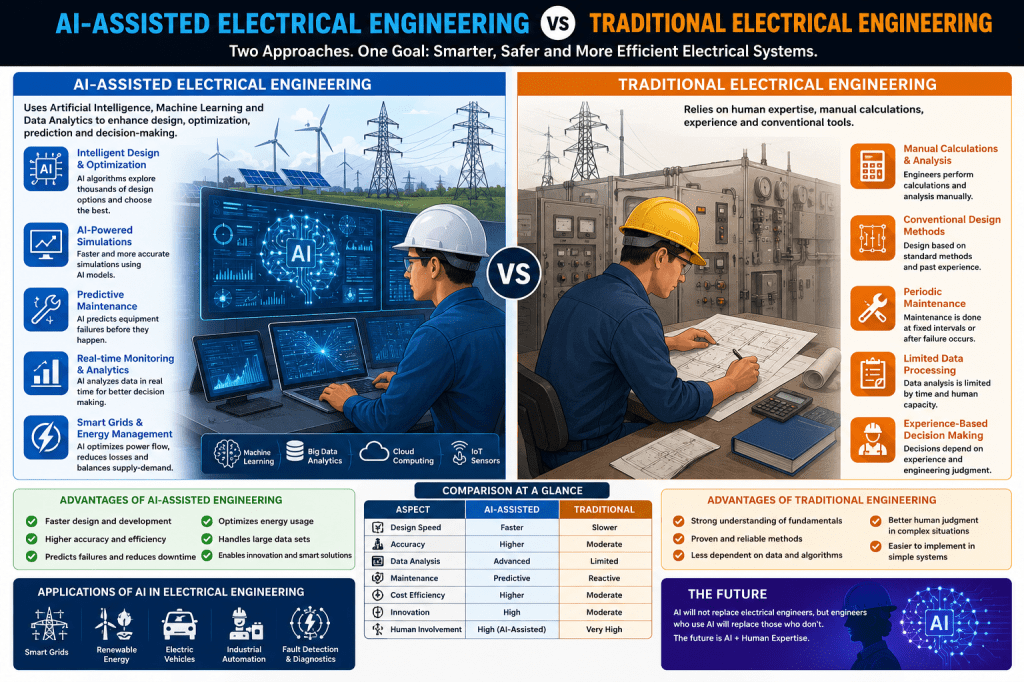
AI-Assisted Electrical Engineering vs Traditional Electrical Engineering
Electrical engineering has been one of the most important branches of engineering since the beginning of the modern industrial age. It has powered homes, industries, transportation systems, telecommunications, and countless technological innovations. Traditionally, electrical engineering relied on human expertise, mathematical analysis, laboratory testing, and practical experience to design and maintain electrical systems. However, the rapid development of Artificial Intelligence (AI) is transforming how electrical engineering is practiced. Today, AI-assisted electrical engineering is emerging as a powerful approach that complements traditional methods by enhancing efficiency, accuracy, and innovation.
Understanding Traditional Electrical Engineering
Traditional electrical engineering focuses on the design, development, operation, and maintenance of electrical and electronic systems. Engineers use established scientific principles, mathematical calculations, simulation software, and practical testing to solve engineering problems.
In a traditional approach, electrical engineers manually analyze circuits, calculate loads, design power systems, and troubleshoot faults. Projects often require extensive testing and multiple design iterations before implementation. Human expertise plays a central role in decision-making, ensuring that systems are safe, reliable, and compliant with industry standards.
Traditional electrical engineering has successfully built modern power grids, communication networks, electrical machinery, and industrial automation systems. Its strength lies in the engineer’s ability to apply judgment, creativity, and experience to complex real-world situations.
However, traditional methods also face limitations. Large-scale electrical systems generate enormous amounts of data that can be difficult for humans to analyze efficiently. Design processes can be time-consuming, and identifying faults in complex systems may require significant effort and expertise.
The Rise of AI-Assisted Electrical Engineering
Artificial Intelligence refers to computer systems capable of performing tasks that normally require human intelligence, such as learning, reasoning, pattern recognition, and decision-making. In electrical engineering, AI is increasingly being integrated into design tools, monitoring systems, predictive maintenance platforms, and energy management solutions.
AI-assisted electrical engineering does not replace engineers. Instead, it enhances their capabilities by automating repetitive tasks, analyzing large datasets, and providing intelligent recommendations. Engineers remain responsible for oversight, validation, and critical decision-making.
Modern AI technologies such as machine learning, neural networks, computer vision, and data analytics are being applied across various electrical engineering domains, including power systems, renewable energy, industrial automation, electric vehicles, and smart infrastructure.
Design and Development
One of the most significant differences between traditional and AI-assisted electrical engineering is the design process.
In traditional engineering, circuit design and system optimization require extensive manual calculations and simulations. Engineers often test multiple design alternatives before selecting the best solution.
AI-assisted systems can rapidly evaluate thousands of design possibilities and identify optimal configurations. Machine learning algorithms can analyze previous designs and recommend improvements based on performance, cost, efficiency, and reliability.
As a result, AI can significantly reduce design time while improving system performance. Engineers can focus more on innovation and strategic decision-making rather than repetitive calculations.
Power System Management
Electrical power systems are becoming increasingly complex due to growing energy demand and the integration of renewable energy sources.
Traditional power system management relies on human operators who monitor grid conditions and respond to changes in supply and demand. While effective, this approach may struggle to handle large amounts of real-time data.
AI-assisted systems can continuously analyze data from sensors, smart meters, and substations. These systems can predict demand fluctuations, optimize power distribution, and detect abnormalities before they cause outages.
Smart grids powered by AI can improve reliability, reduce energy losses, and support the integration of solar and wind energy into the electricity network.
Predictive Maintenance
Maintenance is another area where AI is creating significant advantages.
Traditional maintenance strategies are often reactive or scheduled. Equipment is repaired after failure or serviced at fixed intervals regardless of its actual condition.
AI-assisted predictive maintenance uses sensor data and machine learning algorithms to monitor equipment health in real time. By detecting early warning signs of wear and failure, AI can predict when maintenance is needed.
This approach reduces downtime, lowers maintenance costs, extends equipment life, and improves overall system reliability. Industries operating transformers, motors, generators, and transmission systems are increasingly adopting predictive maintenance technologies.
Renewable Energy Integration
The global transition toward renewable energy presents new challenges for electrical engineers.
Solar and wind energy sources are highly dependent on weather conditions, making power generation less predictable than conventional energy sources.
Traditional engineering methods use forecasting models and operator experience to manage these fluctuations. However, AI-assisted systems can analyze weather data, historical generation patterns, and demand forecasts with much greater accuracy.
AI helps optimize renewable energy generation, energy storage systems, and grid integration. This improves efficiency while supporting sustainability and reducing greenhouse gas emissions.
Industrial Automation
Modern industries increasingly rely on automation to improve productivity and competitiveness.
Traditional industrial control systems depend on predefined rules and programmed responses. While effective, they may have limited adaptability to changing conditions.
AI-assisted automation systems can learn from operational data and continuously improve performance. These systems can identify inefficiencies, optimize energy consumption, and detect potential failures before they disrupt production.
The result is higher productivity, lower operating costs, and improved product quality.
Human Expertise Remains Essential
Despite its advantages, AI cannot fully replace electrical engineers.
Engineering decisions often involve ethical considerations, safety requirements, regulatory compliance, and complex trade-offs that require human judgment. AI systems operate based on available data and algorithms, but they may not fully understand the broader context of engineering projects.
Electrical engineers provide creativity, critical thinking, problem-solving abilities, and accountability that AI cannot replicate. Human expertise remains essential for validating AI recommendations and ensuring safe system operation.
The future workforce will likely consist of engineers who combine traditional engineering knowledge with AI and data science skills.
Challenges of AI-Assisted Engineering
Although AI offers numerous benefits, several challenges remain.
High-quality data is necessary for effective AI performance. Poor or incomplete data can lead to inaccurate predictions and unreliable recommendations.
Cybersecurity is another major concern. As electrical systems become more connected and data-driven, they become potential targets for cyberattacks.
Organizations must also invest in training engineers to understand AI technologies and integrate them effectively into engineering workflows.
Additionally, regulatory frameworks and ethical guidelines must evolve to address the increasing role of AI in critical infrastructure.
Conclusion
AI-assisted electrical engineering represents the next stage in the evolution of the profession. While traditional electrical engineering provides the fundamental principles, practical knowledge, and engineering judgment necessary for safe and reliable systems, AI introduces powerful capabilities for automation, optimization, and intelligent decision-making.
The future is not a competition between AI-assisted and traditional electrical engineering. Instead, it is a partnership in which AI enhances human capabilities while engineers provide oversight, creativity, and responsibility. Organizations that successfully combine traditional engineering expertise with advanced AI technologies will be better positioned to develop smarter power systems, improve industrial efficiency, integrate renewable energy, and build the resilient electrical infrastructure needed for the future.

Leave a comment