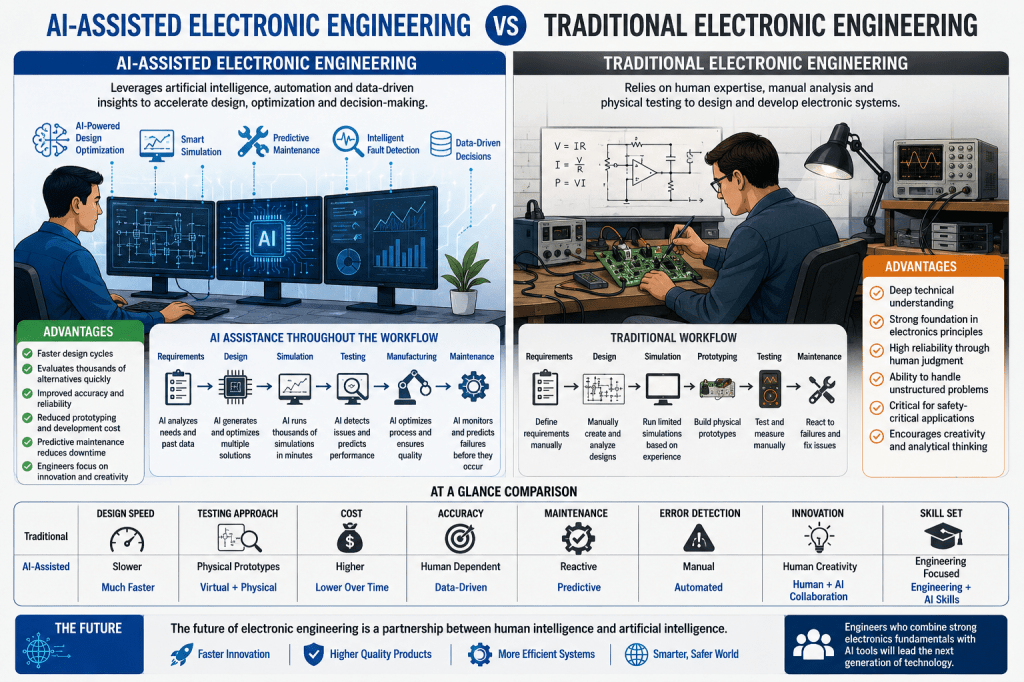
AI-Assisted Electronic Engineering vs Traditional Electronic Engineering
Introduction
Electronic engineering has been one of the most important disciplines driving technological progress over the last century. From radios and televisions to smartphones, satellites, medical devices, and advanced computing systems, electronic engineers have played a critical role in shaping modern society. Traditionally, electronic engineering has relied on human expertise, mathematical analysis, laboratory testing, and practical experience to design and develop electronic systems. However, the rapid advancement of Artificial Intelligence (AI) is transforming the field, creating a new paradigm known as AI-assisted electronic engineering.
AI-assisted electronic engineering combines traditional engineering principles with machine learning, automation, data analytics, and intelligent software tools. Rather than replacing engineers, AI enhances their capabilities by automating repetitive tasks, improving design optimization, and enabling faster decision-making. Comparing AI-assisted electronic engineering with traditional electronic engineering helps us understand how the profession is evolving and what skills future engineers will need.
Traditional Electronic Engineering
Traditional electronic engineering is based on the application of scientific and mathematical principles to design, analyze, manufacture, and maintain electronic devices and systems. Engineers use established theories of electronics, circuit analysis, signal processing, electromagnetics, and semiconductor physics to solve problems.
In a traditional engineering workflow, engineers manually create circuit designs, perform calculations, simulate circuit behavior, build prototypes, and conduct extensive testing. Every stage of the process relies heavily on human knowledge and judgment. Engineers must understand component characteristics, electrical behavior, manufacturing constraints, and safety requirements.
One of the major strengths of traditional electronic engineering is the deep technical understanding it develops. Engineers gain a strong foundation in electronics and learn how systems function at a fundamental level. This knowledge allows them to troubleshoot complex problems and make informed decisions when unexpected issues arise.
Traditional engineering is also highly reliable in safety-critical applications such as aerospace, defense, medical devices, and industrial control systems. Human engineers can evaluate design decisions carefully and consider factors that automated systems may overlook.
However, traditional methods also have limitations. Designing complex electronic systems can be time-consuming and expensive. Engineers may spend weeks or months evaluating multiple design alternatives. Physical prototyping and testing often require significant resources, and human errors can occur during calculations, design reviews, or manufacturing processes.
AI-Assisted Electronic Engineering
AI-assisted electronic engineering integrates artificial intelligence technologies into engineering workflows. AI systems can analyze large datasets, identify patterns, automate repetitive tasks, and generate optimized solutions more quickly than traditional methods.
Modern electronic engineers increasingly use AI-powered software for circuit design, simulation, fault detection, predictive maintenance, manufacturing optimization, and system monitoring. Machine learning algorithms can analyze performance data from electronic devices and recommend design improvements.
For example, AI can automatically optimize printed circuit board (PCB) layouts by minimizing signal interference and reducing power consumption. Instead of manually evaluating hundreds of possible configurations, engineers can use AI tools to explore thousands of alternatives within minutes.
AI-assisted systems can also improve semiconductor design. The complexity of modern integrated circuits has reached levels that are difficult for humans to manage without intelligent software assistance. AI helps engineers optimize chip architecture, reduce energy consumption, and improve manufacturing yields.
In manufacturing environments, AI-powered quality control systems can detect defects more accurately and consistently than traditional inspection methods. Cameras combined with machine learning algorithms can identify microscopic flaws in electronic components before products reach customers.
Predictive maintenance is another major advantage of AI-assisted engineering. By continuously monitoring equipment performance, AI can predict potential failures and recommend maintenance actions before breakdowns occur. This reduces downtime, maintenance costs, and operational risks.
Comparison of Design Processes
One of the most significant differences between traditional and AI-assisted electronic engineering lies in the design process.
Traditional engineering typically involves sequential steps: requirements analysis, manual design, simulation, prototyping, testing, and refinement. Each stage requires substantial human effort and time.
AI-assisted engineering introduces automation and intelligent optimization throughout the workflow. AI can generate design alternatives, simulate performance, identify potential issues, and recommend improvements automatically. As a result, development cycles become shorter and more efficient.
For example, a traditional engineer designing a communication circuit may manually evaluate several configurations. An AI-assisted system can evaluate thousands of configurations and identify the most efficient design based on predefined objectives such as cost, performance, and energy efficiency.
Impact on Engineering Skills
The rise of AI is changing the skill requirements for electronic engineers. Traditional engineering emphasizes mathematics, physics, circuit theory, and hands-on laboratory skills. These foundations remain essential because engineers must understand the principles behind electronic systems.
However, AI-assisted engineering also requires knowledge of machine learning, data science, programming, and automation technologies. Engineers increasingly need to understand how AI algorithms operate and how to interpret their outputs.
Future electronic engineers will likely need a combination of traditional engineering expertise and AI-related competencies. Rather than replacing engineering knowledge, AI expands the range of skills required in the profession.
Cost and Efficiency
Traditional engineering projects often involve multiple design iterations, extensive testing, and significant labor costs. Complex projects may require large teams of engineers working over extended periods.
AI-assisted engineering can reduce costs by automating routine tasks and improving decision-making efficiency. Automated simulations reduce the need for physical prototypes, while predictive analytics help prevent costly failures.
Additionally, AI enables organizations to bring products to market more quickly. Faster development cycles provide a competitive advantage in industries where technology evolves rapidly.
Challenges of AI-Assisted Engineering
Despite its advantages, AI-assisted electronic engineering faces several challenges.
First, AI systems depend heavily on high-quality data. Poor or biased data can produce inaccurate recommendations and unreliable predictions.
Second, implementing AI technologies often requires significant investment in software, hardware, and workforce training. Smaller organizations may struggle to adopt advanced AI tools.
Third, cybersecurity concerns become increasingly important as electronic systems become more connected and data-driven. AI-assisted systems must be protected against cyberattacks and unauthorized access.
Finally, excessive reliance on AI may reduce opportunities for engineers to develop fundamental problem-solving skills. Human oversight remains essential to ensure safety, reliability, and ethical decision-making.
Future Outlook
The future of electronic engineering will likely involve close collaboration between human engineers and artificial intelligence. AI will continue to automate repetitive tasks, optimize designs, and analyze complex datasets. Meanwhile, human engineers will focus on innovation, creativity, strategic thinking, and ethical considerations.
Emerging technologies such as autonomous vehicles, smart cities, industrial automation, robotics, renewable energy systems, and the Internet of Things (IoT) will further increase demand for AI-assisted engineering solutions. Engineers who can effectively combine traditional electronic engineering knowledge with AI expertise will be well positioned for future career opportunities.
Conclusion
AI-assisted electronic engineering represents a significant evolution of the traditional engineering profession. Traditional electronic engineering provides the essential scientific and technical foundation required to understand and design electronic systems. AI-assisted engineering builds upon this foundation by introducing intelligent tools that improve efficiency, accuracy, and innovation.
Rather than viewing AI and traditional engineering as competitors, they should be seen as complementary approaches. Traditional engineering offers human judgment, creativity, and deep technical understanding, while AI contributes speed, automation, and advanced analytical capabilities. Together, they create a powerful partnership capable of addressing the increasingly complex technological challenges of the modern world. As AI continues to advance, the future of electronic engineering will depend on successfully integrating human expertise with intelligent technologies.

Leave a comment