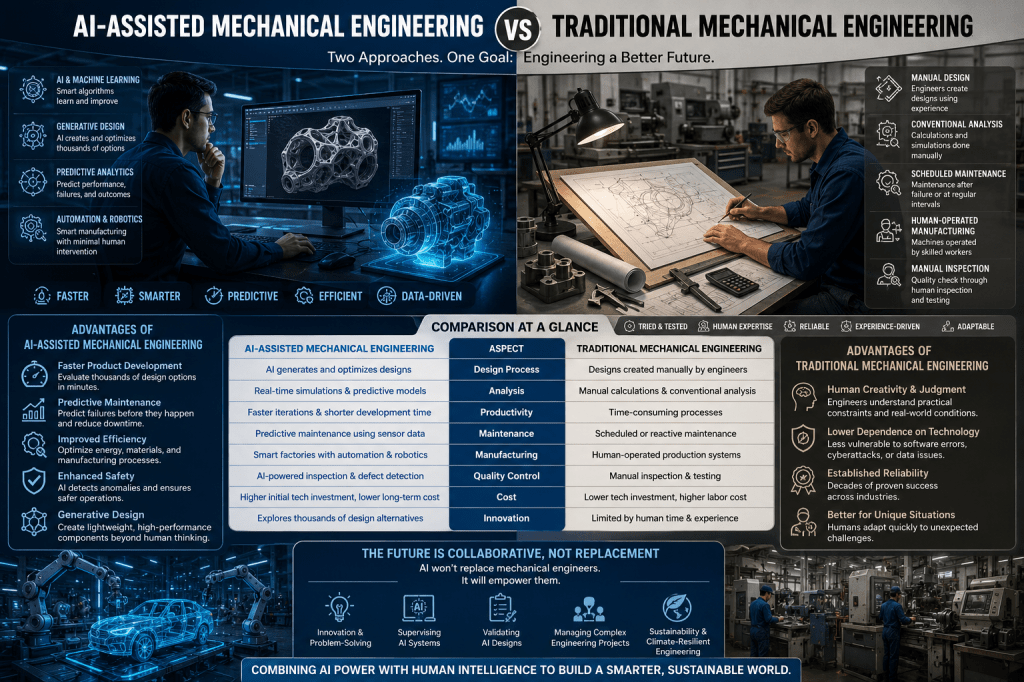
AI-Assisted Mechanical Engineering vs Traditional Mechanical Engineering
Mechanical engineering is evolving rapidly with the integration of Artificial Intelligence (AI). While traditional mechanical engineering relies heavily on human expertise, calculations, and manual design processes, AI-assisted mechanical engineering uses machine learning, simulation, automation, and data analytics to improve efficiency and decision-making.
Aspect
AI-Assisted Mechanical Engineering
Traditional Mechanical Engineering
Design Process
AI generates and optimizes designs automatically
Engineers create designs manually
Analysis
Real-time simulations and predictive models
Manual calculations and conventional software analysis
Productivity
Faster design iterations and development
More time-consuming processes
Maintenance
Predictive maintenance using sensor data
Scheduled or reactive maintenance
Manufacturing
Smart factories with automation and robotics
Human-operated production systems
Quality Control
AI-powered inspection and defect detection
Manual inspection and testing
Cost
Higher initial technology investment
Lower technology investment but higher labor costs
Innovation
Can explore thousands of design alternatives
Limited by human time and experience
Advantages of AI-Assisted Mechanical Engineering
Faster Product Development
AI can evaluate thousands of design options within minutes.
Reduces development cycles for automobiles, aircraft, and industrial equipment.
Predictive Maintenance
Sensors and AI algorithms can predict equipment failures before they occur.
Reduces downtime and maintenance costs.
Improved Efficiency
AI optimizes energy consumption, material usage, and manufacturing processes.
Enhanced Safety
AI monitors machinery and detects abnormal operating conditions.
Generative Design
AI creates lightweight and high-performance components that may not be obvious to human designers.
Advantages of Traditional Mechanical Engineering
Human Creativity and Judgment
Engineers understand practical constraints and real-world conditions.
Critical decisions still require human expertise.
Lower Dependence on Technology
Less vulnerable to software errors, cyberattacks, or data issues.
Established Reliability
Traditional methods have decades of proven success in industries.
Better for Unique Situations
Human engineers can adapt quickly when facing unexpected challenges.
Will AI Replace Traditional Mechanical Engineers?
AI is unlikely to completely replace mechanical engineers. Instead, it will transform their role. Engineers will increasingly focus on:
Innovation and problem-solving
Supervising AI systems
Validating AI-generated designs
Managing complex engineering projects
Sustainability and climate-resilient engineering
The future is likely to be a combination of AI and human expertise, where engineers use AI as a powerful tool rather than a replacement.
Conclusion
AI-assisted mechanical engineering offers greater speed, efficiency, predictive capabilities, and optimization, while traditional mechanical engineering provides human judgment, creativity, and practical experience. The most successful organizations will combine both approaches, creating smarter products, more efficient factories, and sustainable engineering solutions for the future.

Leave a comment