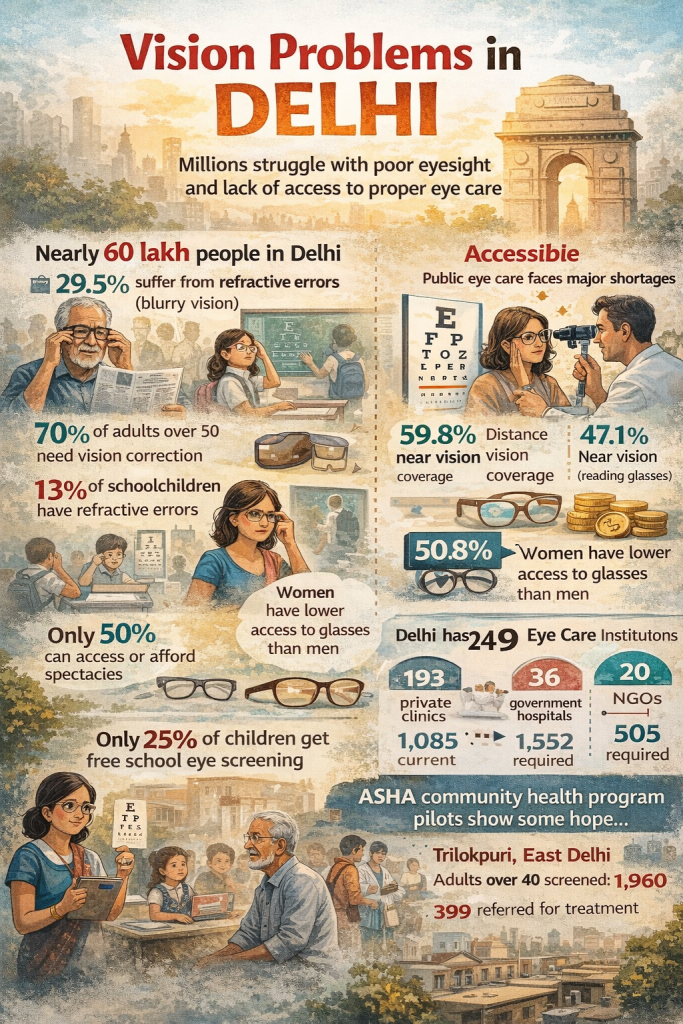
The image shows a report from All India Institute of Medical Sciences (AIIMS) about vision problems in Delhi. It explains that many people in the city have poor eyesight but do not get proper eye care. Here is a simple explanation of each part.
- Vision problem is growing in Delhi
29.5% of Delhi’s population (about 60 lakh people) have vision problems like:
Refractive error – blurry vision that needs glasses.
Presbyopia – difficulty reading close objects (common after age 40–50).
70% of people above 50 years need vision correction (glasses).
13.1% of school children also have refractive errors, which is the main cause of poor vision in children.
👉 This means eye problems are common in both children and older people. - Access to spectacles (glasses) is still low
Even if people need glasses, many do not have them.
Only 59.8% of people needing distance glasses have them.
Only 47.1% needing reading glasses have them.
Women get fewer spectacles than men.
👉 So many people continue living with blurry vision because they cannot access or afford glasses. - Eye care institutions in Delhi
Delhi has 249 eye care institutions:
193 private hospitals/clinics (77.5%)
36 government hospitals (14.5%)
20 NGO centres (8%)
👉 Most services are private, which can be expensive for poor people. - Shortage of trained eye-care workers
There are not enough specialists.
1,085 ophthalmologists (eye doctors)
489 optometrists / technicians
👉 For such a large population, more trained staff are needed. - Primary eye-care gap
Delhi has only 50 functional vision centres.
But 269 centres are needed in the government system.
👉 This shows large gaps in basic eye care services. - School screening problem
Only 25% of children receive free spectacles through public health programs.
👉 Many children cannot see the board clearly in school, which affects learning.
Pilot program in East Delhi
A health program was tested in Trilokpuri using ASHA health workers.
Results:
2,085 households covered
7,001 people screened
1,960 adults above 40 screened
25.8% had presbyopia
401 people referred for further treatment
👉 Community health workers can help detect eye problems early.
✅ Main conclusion:
A large number of people in Delhi have poor eyesight, but due to lack of awareness, limited access to glasses, and shortage of public eye-care services, many remain untreated.
💡 Why this matters:
Simple solutions like cheap spectacles and regular eye screening could improve education, work productivity, and quality of life for millions.

Leave a comment