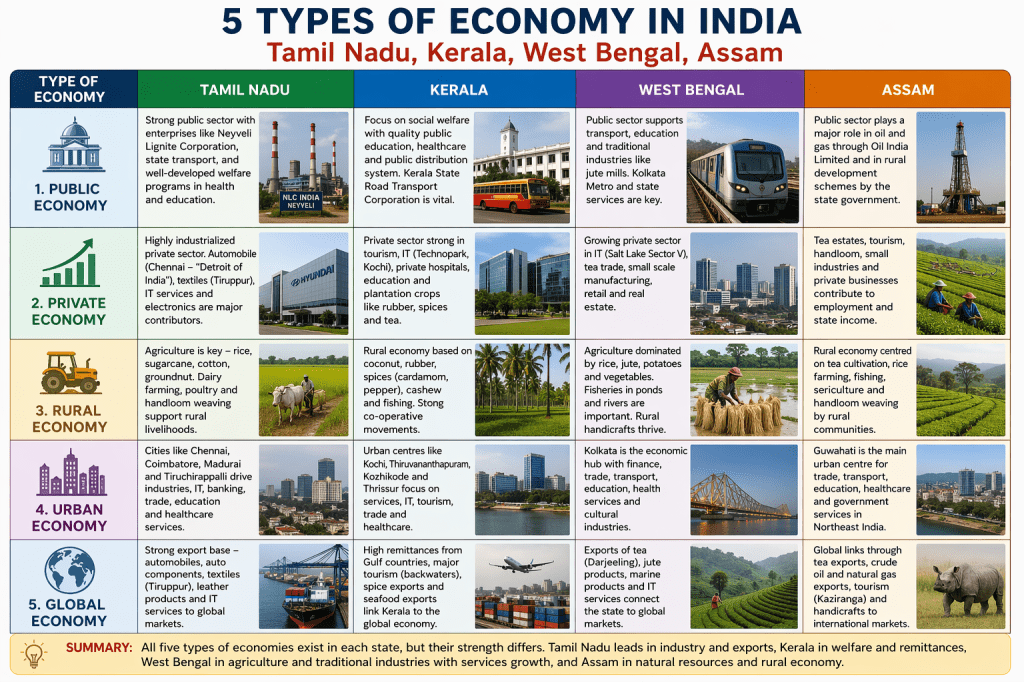
Here an exam-ready explanation of the five types of economy—Public, Private, Rural, Urban, and Global—across Tamil Nadu, Kerala, West Bengal, and Assam.
India’s economy is a mixed and diverse system where multiple economic structures coexist. These five types of economies operate differently across states depending on resources, geography, and policy frameworks.
In Tamil Nadu, the public economy plays a major role through government enterprises and welfare programs. Institutions like Neyveli Lignite Corporation contribute to energy production and employment, while public transport and healthcare systems are well developed. The private economy is highly advanced, with industries such as automobiles, textiles, and IT. Chennai is a major industrial hub, hosting companies like Hyundai Motor India. The rural economy is based on agriculture, including rice, sugarcane, and cotton farming, along with traditional weaving. The urban economy is strong, driven by cities like Chennai and Coimbatore, where services, IT, and finance dominate. Tamil Nadu also has a strong global economy, exporting automobiles, textiles (especially from Tiruppur), and IT services.
In Kerala, the public economy is notable for its strong focus on social welfare, including education, healthcare, and public distribution systems. The private economy is centered on tourism, IT, and plantation agriculture. The presence of IT hubs like Technopark reflects growing private investment. The rural economy includes coconut farming, rubber plantations, fishing, and spice cultivation. The urban economy is service-oriented, with cities like Kochi emerging as commercial and IT centers. Kerala’s global economy is unique due to large remittances from expatriates working in Gulf countries, along with international tourism and spice exports.
In West Bengal, the public economy includes state-managed transport, education, and traditional industries like jute mills. The private economy is expanding, particularly in IT sectors located in Kolkata’s Salt Lake area, as well as in tea trading and small-scale manufacturing. The rural economy is agriculture-driven, focusing on rice, jute, and fisheries. The urban economy revolves around Kolkata, which functions as a financial, cultural, and transport hub. West Bengal’s global economy includes exports of Darjeeling tea, jute products, and emerging IT services.
In Assam, the public economy is significant due to natural resources. Companies like Oil India Limited play a key role in oil and gas production. The private economy includes tea estates, tourism, and small businesses. The rural economy is dominant, with agriculture such as rice farming, tea cultivation, fishing, and handloom weaving. The urban economy is centered in Guwahati, which serves as a commercial and transport hub for Northeast India. Assam’s global economy connects through tea exports, oil production, and tourism, particularly through attractions like Kaziranga National Park.
Overall, while all five economic types exist in each state, their importance varies. Tamil Nadu leads in industrial and global trade, Kerala in welfare and remittances, West Bengal in agriculture and traditional industries, and Assam in natural resources and rural economy. Together, they reflect India’s economic diversity and regional specialization.

Leave a comment