India’s economic structure is not monolithic; it is a layered system where public, private, rural, urban, and global economies coexist and interact differently across states. Understanding these five types helps explain regional disparities and growth trajectories.
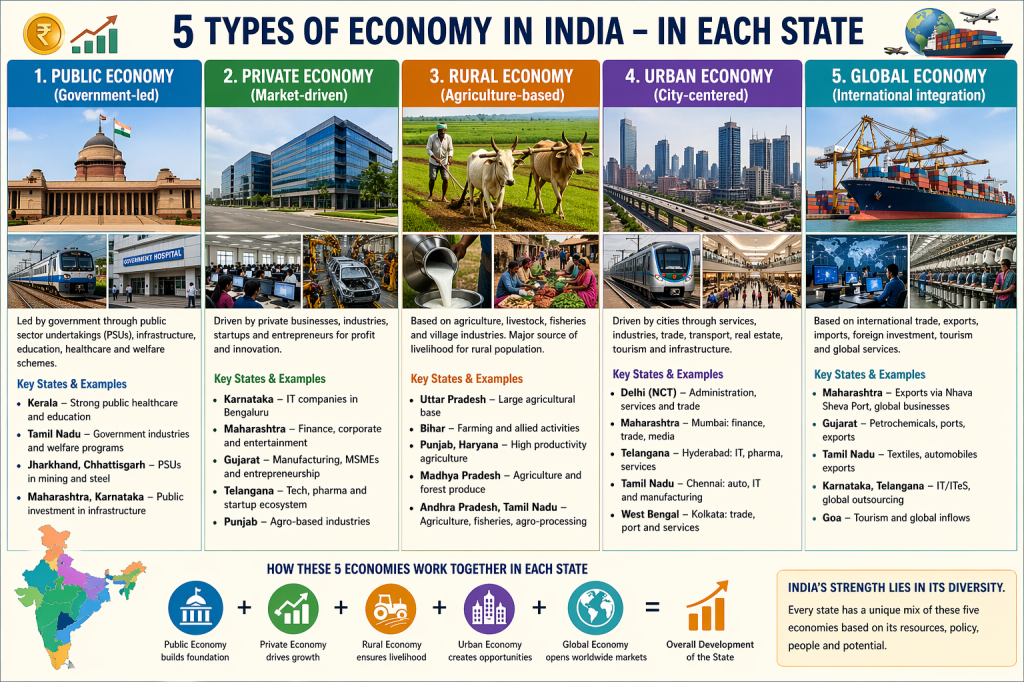
- Public Economy (Government-led)
The public economy includes activities led by the government—public sector undertakings (PSUs), welfare programs, infrastructure, and subsidies. In states like Kerala and Tamil Nadu, strong public systems in healthcare and education drive human development. Resource-rich states like Jharkhand and Chhattisgarh rely heavily on public mining enterprises. Meanwhile, Karnataka and Maharashtra use public investment to support infrastructure that fuels private growth. - Private Economy (Market-driven)
The private economy consists of businesses, startups, and industries driven by profit and innovation. Bengaluru in Karnataka is India’s IT hub, while Mumbai anchors finance and corporate sectors. Gujarat excels in manufacturing and entrepreneurship, and Telangana has rapidly grown through tech and pharmaceutical industries. Northern states like Punjab also show strong private participation in agro-industries. - Rural Economy (Agriculture-based)
The rural economy revolves around agriculture, livestock, and village-based industries. States such as Uttar Pradesh, Bihar, and Madhya Pradesh depend heavily on farming. Punjab and Haryana are known for high agricultural productivity due to irrigation and mechanization. Southern states like Andhra Pradesh and Tamil Nadu combine agriculture with fisheries and agro-processing. - Urban Economy (City-centered)
Urban economies are driven by cities, services, industries, and infrastructure. Delhi (NCT) is a hub for administration and services. Hyderabad and Chennai specialize in IT and manufacturing, while Kolkata serves as a trade gateway to eastern India. Urban economies are strongest in highly industrialized states like Maharashtra and Tamil Nadu. - Global Economy (International integration)
The global economy reflects India’s integration with international trade, investment, and services. Maharashtra (via Jawaharlal Nehru Port) leads in exports and imports. Tamil Nadu (textiles, automobiles) and Gujarat (petrochemicals, ports) are export powerhouses. Karnataka and Telangana connect globally through IT and pharmaceuticals. Smaller states like Goa benefit from tourism-driven global inflows.
Conclusion
Across India’s states, these five economic types overlap rather than exist separately. For example, Karnataka combines a strong private IT sector, urban growth in Bengaluru, rural agriculture, public infrastructure, and global outsourcing links. Similarly, Punjab blends rural strength with private agro-business and export markets. This multi-layered structure is what makes India a mixed and regionally diverse economy, with each state emphasizing different combinations based on resources, policy, and development stage.


Leave a comment