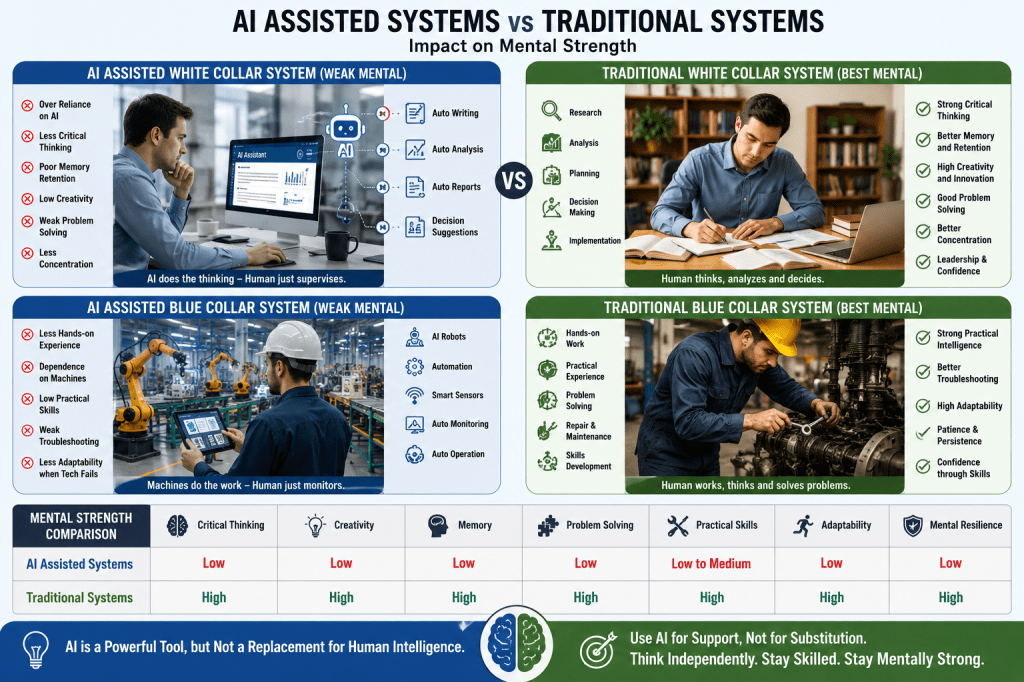
AI-Assisted White-Collar and Blue-Collar Systems vs Traditional Systems: Impact on Mental Strength
Artificial Intelligence (AI) is rapidly transforming both white-collar and blue-collar jobs. AI-assisted systems help workers perform tasks faster and more efficiently by using automation, machine learning, robotics, and smart software. While these technologies provide many benefits, some people believe that excessive dependence on AI can weaken important mental abilities. In contrast, traditional work systems often encourage stronger thinking skills, problem-solving abilities, and mental resilience.
White-collar jobs include office-based professions such as teachers, accountants, managers, engineers, and lawyers. AI-assisted white-collar systems use tools like automated report generation, virtual assistants, and predictive analytics. These technologies save time and reduce repetitive work. However, workers who rely heavily on AI may gradually use less critical thinking and creativity. Since AI can provide instant answers and recommendations, employees may become less skilled at independent analysis and decision-making.
Traditional white-collar systems require workers to conduct research, evaluate information, solve problems, and make decisions themselves. This process strengthens memory, concentration, communication, and analytical thinking. Employees learn through experience and develop confidence in their own judgment. As a result, traditional office work often promotes stronger mental engagement and intellectual growth.
Blue-collar jobs include occupations such as mechanics, electricians, factory workers, construction workers, and technicians. AI-assisted blue-collar systems use robots, automated machinery, sensors, and intelligent monitoring systems. These technologies improve workplace safety, reduce physical strain, and increase productivity. Dangerous or repetitive tasks can be performed by machines, protecting workers from injuries.
However, heavy dependence on automation may reduce opportunities for hands-on learning and practical problem-solving. Workers may become machine operators rather than skilled craftsmen. If machines fail, workers who lack traditional experience may struggle to diagnose and solve problems independently. This can reduce practical intelligence and adaptability.
Traditional blue-collar systems emphasize direct experience, manual skills, observation, and craftsmanship. Workers learn by doing, troubleshooting equipment, and adapting to changing situations. These experiences strengthen practical reasoning, patience, persistence, and confidence. A traditional mechanic, for example, develops diagnostic skills through observation and experience rather than relying entirely on computerized systems.
The comparison between AI-assisted and traditional systems does not mean AI is harmful. AI is a powerful tool that improves efficiency, safety, and productivity. The concern arises only when people become overly dependent on technology and stop exercising their own mental abilities.
The best approach is to combine the strengths of both systems. AI should support human workers rather than replace human thinking. Workers should continue developing critical thinking, creativity, practical skills, and decision-making abilities while using AI to handle repetitive tasks.
In conclusion, AI-assisted white-collar and blue-collar systems offer significant advantages, but excessive reliance on automation may weaken certain mental skills. Traditional systems often help build stronger cognitive abilities, practical intelligence, and resilience because they require active human participation. The ideal future workplace combines AI technology with human judgment, ensuring both productivity and mental strength remain strong.

Leave a comment