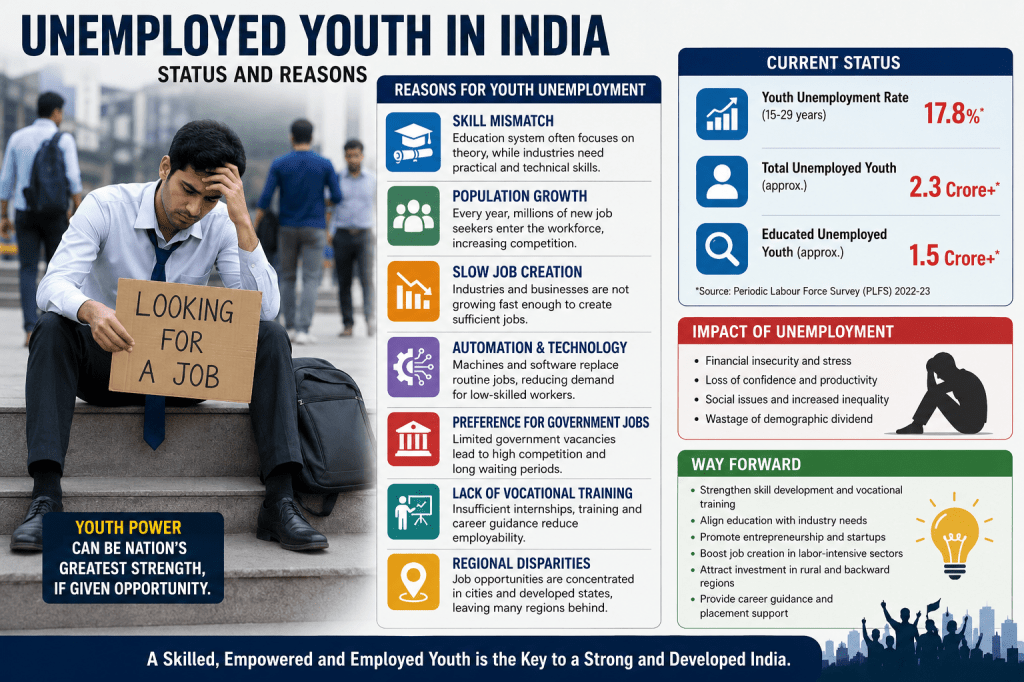
Status of Unemployed Indian Youth: Reasons and Challenges
Youth unemployment is one of the major socio-economic challenges facing India today. India has a large youth population, which is often considered a demographic advantage. However, when a significant number of young people remain unemployed, this advantage can become a burden on the economy and society. Despite improvements in education and economic growth, many Indian youths struggle to find suitable employment opportunities.
One of the primary reasons for youth unemployment in India is the mismatch between education and industry requirements. Many students graduate from schools, colleges, and universities with theoretical knowledge but lack practical skills demanded by employers. As a result, companies often find it difficult to recruit candidates who are job-ready.
Another important reason is the rapid growth of the youth population. Every year, millions of young people enter the labor market, but the number of jobs created is not sufficient to absorb them. This creates intense competition for available positions and leaves many qualified candidates unemployed.
The slow pace of job creation in key sectors also contributes to unemployment. Industries such as manufacturing, construction, and small-scale enterprises have not expanded enough to provide employment opportunities for the growing workforce. Economic slowdowns and market uncertainties further reduce hiring by businesses.
Technological advancements and automation have also affected employment patterns. Many routine and low-skilled jobs are increasingly being performed by machines and software. While technology creates new opportunities, it also reduces the demand for certain types of labor, especially among less-skilled youth.
A significant number of young people prefer government jobs because they offer job security, benefits, and social prestige. However, government vacancies are limited compared to the number of applicants. Consequently, many youths spend years preparing for competitive examinations and remain unemployed while waiting for suitable opportunities.
The lack of vocational training and career guidance is another major issue. Many students are unaware of emerging career options and do not receive adequate training in technical or professional skills. This limits their employability and reduces their chances of finding meaningful work.
Regional disparities also play a role in youth unemployment. Employment opportunities are concentrated in major urban centers, while rural and backward regions often lack industries and investment. As a result, many young people migrate to cities in search of work, where they may still face unemployment or underemployment.
Youth unemployment has several negative consequences. It leads to financial insecurity, frustration, loss of confidence, and social problems. Prolonged unemployment can also affect mental well-being and reduce productivity. At the national level, unemployment results in underutilization of human resources and slows economic development.
To address this issue, India needs stronger skill-development programs, better alignment between education and industry needs, promotion of entrepreneurship, expansion of labor-intensive industries, and increased investment in vocational training. Creating more employment opportunities and improving the quality of education can help young people contribute effectively to the nation’s growth.
In conclusion, youth unemployment in India is a complex issue caused by multiple factors such as skill gaps, inadequate job creation, population growth, automation, and regional inequalities. Addressing these challenges is essential for ensuring a prosperous future for India’s youth and the country as a whole.

Leave a comment