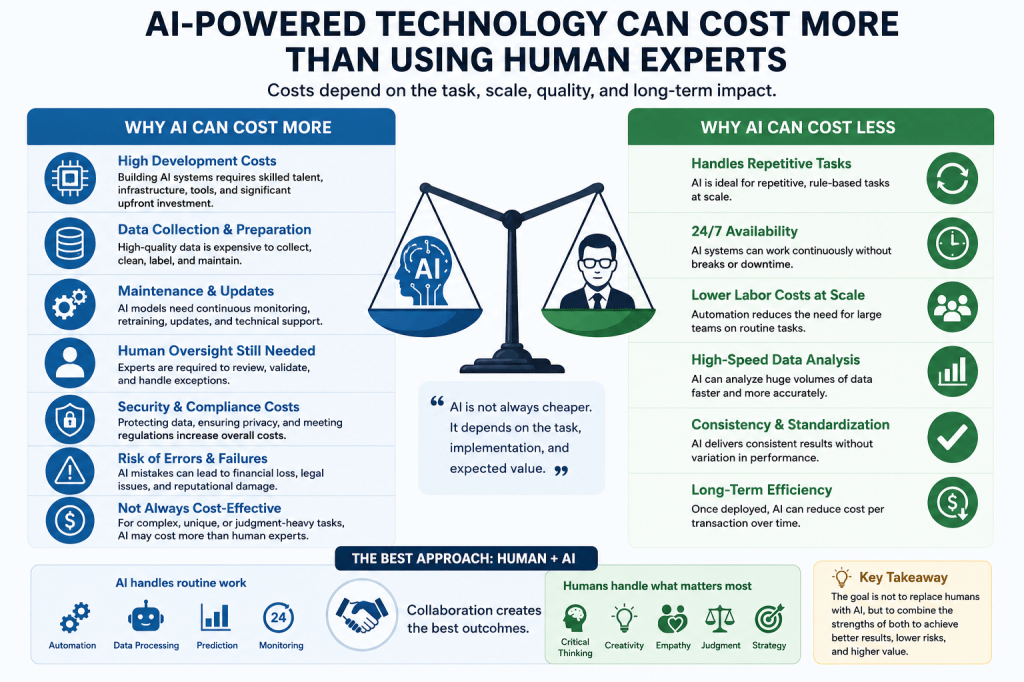
In recent years, artificial intelligence (AI) has rapidly transformed numerous industries, promising increased efficiency and reduced costs. However, some top professionals argue that the implementation of AI-powered technology can, in fact, be more expensive than employing human experts. In this discussion, we will explore several key factors that contribute to this assertion and consider the implications for businesses.
Initial Investment and Development Costs
One of the most significant barriers to AI adoption is the initial investment required for technology development. Organizations must allocate substantial finances to research and development, as well as to acquire the necessary hardware and software. Additionally, the costs associated with implementing AI systems—such as data migration, integration with existing processes, and training personnel—can add up quickly.
Unlike hiring human experts, where salaries might be more predictable and manageable, AI implementation often requires ongoing investments that can stretch budgets. Businesses need to weigh these upfront costs against potential long-term savings carefully.
Maintenance and Upkeep
AI systems are not set-and-forget solutions. They require continuous maintenance, updates, and fine-tuning to ensure optimal performance. As algorithms evolve and new technologies emerge, organizations must remain committed to investing in their AI systems. This is in stark contrast to human workers, who may need occasional training but do not demand extensive adjustments to their skill sets frequently.
Moreover, the complexity of AI systems necessitates hiring specialized personnel who can manage, maintain, and improve these technologies. The salaries for such experts can be significantly higher than those for traditional employees, further driving up costs.
Data Acquisition and Management
AI thrives on large volumes of quality data. Collecting, cleaning, and managing this data is a labor-intensive process that can be expensive and time-consuming. Often, organizations must employ additional staff or consult data scientists, which can increase operational expenses.
The necessity of maintaining data privacy and security can also impose costs. Organizations must invest in secure storage solutions and abide by regulations that can require additional resources. By comparison, human expertise may offer a more straightforward approach to managing information needs while being less reliant on expansive datasets.
The Human Element
While AI can analyze data and identify trends with remarkable speed, it lacks the human intuition and creativity necessary for complex decision-making. Many industries rely heavily on interpersonal skills, emotional intelligence, and subjective judgment—traits that AI cannot replicate.
Consider sectors such as healthcare, education, and creative industries, where human intuition plays a crucial role. In these fields, the cost of replacing human experts with AI could exceed the financial savings offered by automation. Additionally, customers and clients often prefer the personal interaction and understanding that only a human can provide, making the intangible benefits of human expertise difficult to measure against the cold calculations of AI.
Limitations and Errors
AI systems are fallible and can produce errors, particularly when presented with new scenarios outside their training data. Even the most advanced algorithms can result in biased outcomes or misinterpretations, which could have significant financial and reputational repercussions for an organization.
Unlike human experts, who can adapt and learn from mistakes in real time, AI systems require retraining and recalibration. Addressing these issues can lead to unforeseen costs that may outweigh the expected savings from automation.
The Skill Gap
As AI continues to advance, the demand for professionals who can bridge the gap between technology and human expertise is growing. Organizations may find themselves in competition for a limited talent pool, driving up salaries for qualified professionals capable of managing AI systems.
This skill gap can result in increased costs for organizations that must not only invest in technology but also in the training and development of their workforce. The need for continuous education in this rapidly evolving field puts added financial strain on companies eager to stay ahead of the curve.
Conclusion
While AI has the potential to revolutionize industries and streamline operations, the costs associated with its implementation and maintenance can sometimes outweigh the benefits of human expertise. The initial investment, ongoing maintenance, data acquisition, and the irreplaceable human element all contribute to a complex financial landscape.
Organizations must carefully evaluate their AI strategies and consider whether the ROI justifies the switch from human expertise to automation. Ultimately, striking the right balance between AI and human talent may be the key to sustainable growth and success in the future. Businesses should embrace a hybrid approach that leverages the strengths of both AI technology and skilled professionals, ensuring they remain competitive while also safeguarding the invaluable human touch that defines many successful enterprises.

Leave a comment