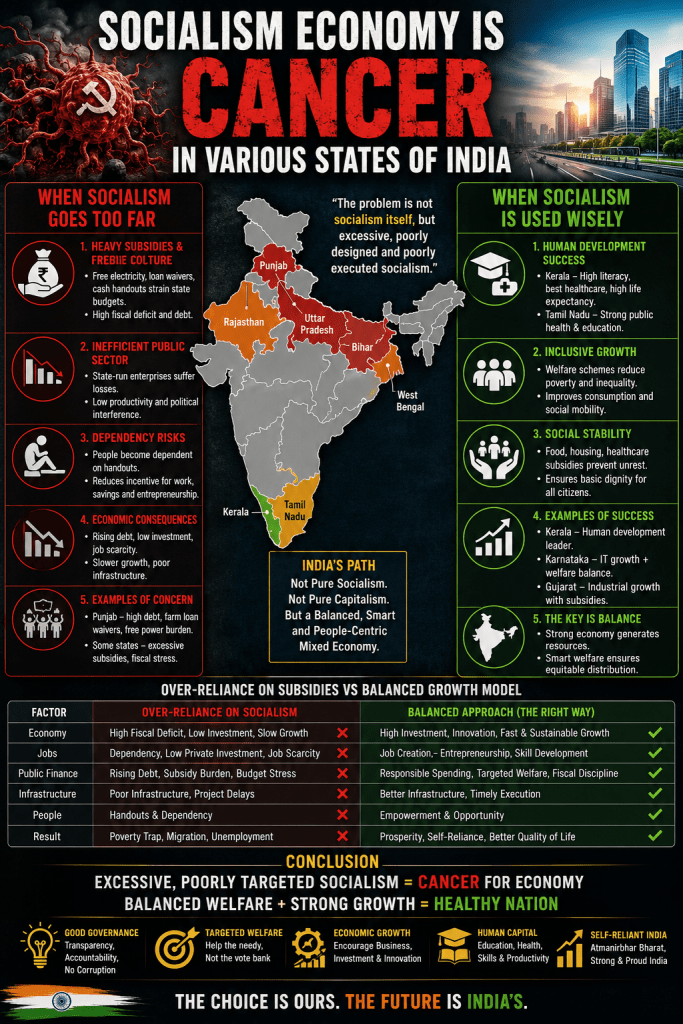
Calling socialism a “cancer” in Indian states is rhetorically strong, but analytically it doesn’t hold up. India’s economic structure is not purely socialist—it’s a mixed economy, combining market-driven growth with state-led welfare and regulation. So outcomes vary widely depending on policy design, execution, and local governance, not ideology alone.
- What “socialism” actually means in India
India’s framework—shaped post-independence under leaders like Jawaharlal Nehru—emphasized:
Public sector dominance in key industries
Redistribution via subsidies and welfare schemes
State intervention in pricing, land, and labor
But since the 1991 Economic Liberalization, India shifted toward markets while retaining welfare programs. - Where criticism of “socialist-style policies” comes from
There are real concerns in some states:
a) Fiscal stress & freebie culture
Heavy subsidies (free electricity, loan waivers, cash transfers) strain budgets
Example debates often involve states like Punjab or Tamil Nadu
b) Inefficiency in public sector
State-run enterprises sometimes suffer from low productivity and political interference
c) Dependency risks
Poorly targeted welfare can reduce incentives for employment or entrepreneurship - Where “socialist elements” actually work well
It’s not one-sided. Some states use welfare effectively:
a) Human development success
Kerala: Strong public health and education → high literacy, life expectancy
Tamil Nadu: Public distribution system + healthcare schemes
b) Inclusive growth
Welfare helps stabilize consumption in poorer regions
Reduces extreme poverty and inequality
c) Social stability
Subsidies in food, housing, and healthcare prevent social unrest - The real issue: execution, not ideology
The difference across states is less about “socialism vs capitalism” and more about:
Governance quality
Corruption levels
Targeting efficiency of schemes
Balance between welfare and economic growth
For example:
Karnataka mixes IT-driven capitalism (Bangalore economy) with welfare schemes
Gujarat emphasizes industrial growth but still runs subsidies - A more precise conclusion
Instead of “socialism is cancer,” a more accurate framing would be:
Excessive, poorly targeted welfare + weak governance = economic strain
Balanced welfare + strong growth policies = sustainable development
India’s trajectory shows neither pure socialism nor pure capitalism works alone. The effective model is hybrid, with:
Market-led growth (jobs, innovation, tax revenue)
Smart welfare (health, education, safety nets)

Leave a comment