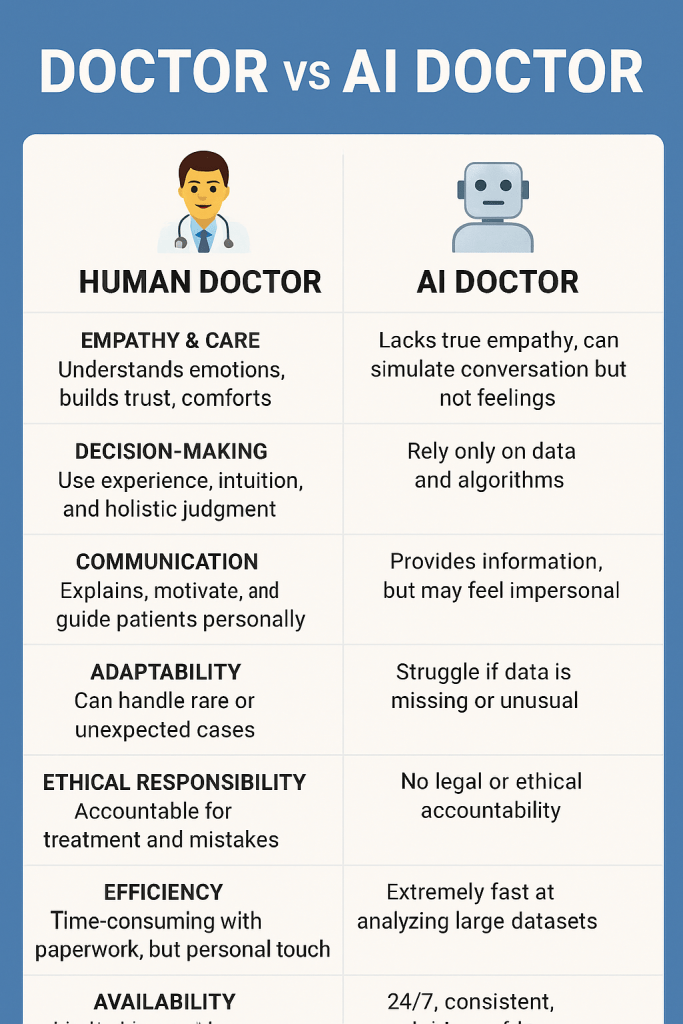
Doctors and AI both have strengths, but they serve different roles in healthcare:
Why human doctors are better suited:
Empathy & Trust → Doctors can comfort, understand emotions, and make patients feel heard.
Holistic judgment → They consider family history, lifestyle, cultural context, and subtle body language that AI often misses.
Ethical responsibility → Doctors are accountable for their decisions, while AI is only a tool.
Adaptability → Doctors can handle rare, complex, or unexpected conditions where AI lacks enough data.
Communication → They explain in simple language, motivate patients, and build long-term care relationships.
Where AI can help doctors:
Diagnostics support → AI scans medical images, lab reports, and patterns faster than humans.
Data handling → Helps analyze large patient histories, genetic data, or population-level health trends.
Accessibility → Provides basic medical guidance in remote or under-served areas.
Efficiency → Reduces paperwork, reminders, and routine monitoring so doctors spend more time with patients.
👉 In short: AI is a powerful assistant, but doctors remain the decision-makers and caregivers.


Leave a reply to Raffaello Palandri Cancel reply