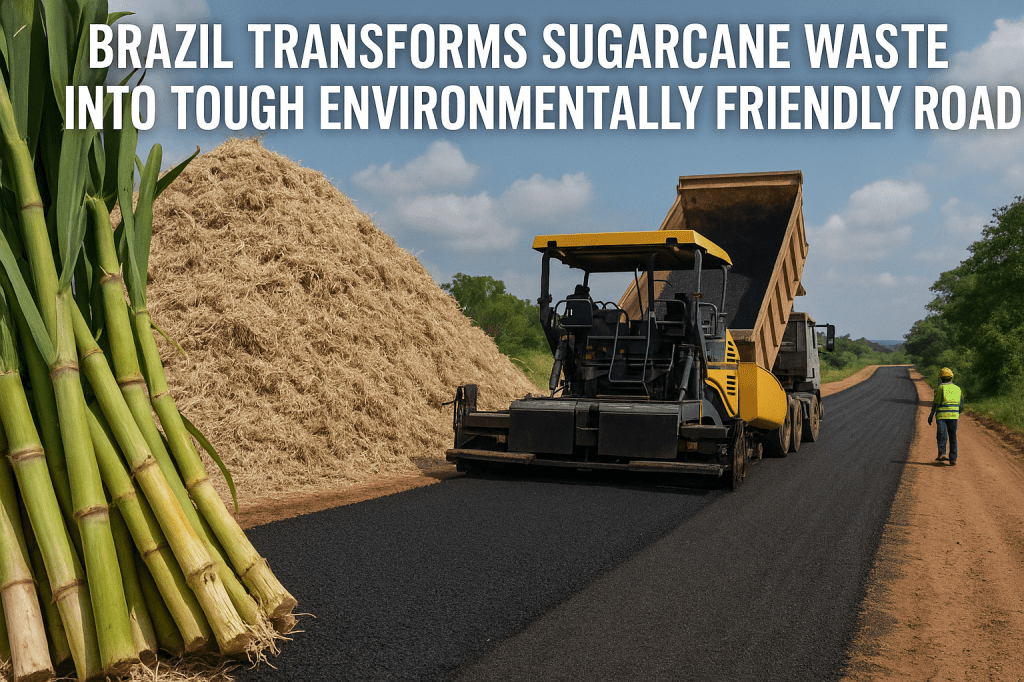
Brazil has developed a groundbreaking eco-friendly asphalt using sugarcane bagasse ash—a byproduct from sugar and ethanol production—to partly replace conventional stone dust in asphalt mixtures.
Here’s why it’s a huge innovation:—
🚛 Stronger, More Durable Roads**~40% increase in Marshall stability** (resistance to deformation) and significant tensile strength gains in lab tests
Field results: 73% less rutting, ~28% lower permanent deformation under heavy traffic Trials on highways (e.g., BR‑158 in Paraná)
show the ash-enhanced asphalt outperforms traditional mixes —
♻️ Environmental & Economic Benefits
Waste valorization: Turns millions of tonnes of sugarcane bagasse ash into a valuable resource instead of landfill waste Reduced resource extraction: Less need for quarried stone, lowering carbon footprint from mining and transport
Cost savings: Ash is cheaper than stone dust; using it lowers production costs while boosting performance —
🌱 Sustainability & Circular Economy It aligns with circular economy principles—agro-industrial waste becomes infrastructure material Brazil produces over 3 million tonnes of bagasse ash annually—enough to support large-scale adoption —
✅ Research & Implementation
Led by Dr. Vinícius Hipólito at State University of Maringá, with publication in Scientific Reports (A1 journal) Tested successfully on actual highways (e.g. BR-158), involving partnerships between academia and companies like Conasa Infraestrutura Other studies explore using this ash in rigid concrete slabs, showing 7% stronger compressive strength and 33–36% higher load capacity when combined with synthetic fibers —
💬 What Others Are SayingOn Reddit, people appreciated the innovative reuse of waste:>
“Sugarcrete a low cost, low carbon construction material upcycling sugarcane by-products…” Although some caution it’s one part of broader sustainability efforts—for example:> “Its a good way of recycling but there is absolutely nothing ‘eco-friendly’ about sugarcane farming.” –
Brazil is pioneering the transformation of sugarcane waste—specifically sugarcane bagasse ash—into a high-performance, environmentally friendly material for road construction. Sugarcane bagasse ash is the fine, silica-rich residue produced when bagasse (the fibrous leftover after extracting juice from sugarcane) is burned, typically for energy in sugar mills.
How it works:
- Substitution in Asphalt: Brazilian researchers have found that sugarcane bagasse ash can successfully replace stone dust (mineral filler) in asphalt mixes—typically up to about 5–30% of the aggregate content.
- Mechanical Advantages: Pavement using bagasse ash shows markedly improved performance—laboratory and highway trials demonstrate about 40% greater Marshall stability (strength), up to 73% enhanced resistance to deformation under heavy loads, and increased durability against weathering, rutting, and cracking.
- Cost and Sustainability: This innovation cuts down on the need to mine and transport mineral aggregates, reducing both construction costs and environmental impact. It also provides a sustainable use for millions of tonnes of ash that would otherwise be discarded or landfilled, making road building both greener and cheaper.
Environmental and economic impact:
- Lower carbon footprint: Replacing quarried stone with agricultural waste reduces emissions associated with extraction and transportation of conventional materials.
- Waste valorization: The approach integrates agricultural and construction sectors into a circular economy—sugarcane is processed for food and fuel, and its ash is repurposed to build longer-lasting roads.
- Practical applications: Successful tests on Brazilian highways confirm these roads are tougher, longer-lasting, and suited to heavy agricultural transport needs, especially in regions like Mato Grosso, where farming logistics are crucial.
In summary, Brazil’s method turns a common agricultural by-product into a valuable construction resource, resulting in stronger, more eco-friendly, and cost-effective roads, and exemplifies large-scale circular economy practices in infrastructure


Leave a reply to Knowok Cancel reply