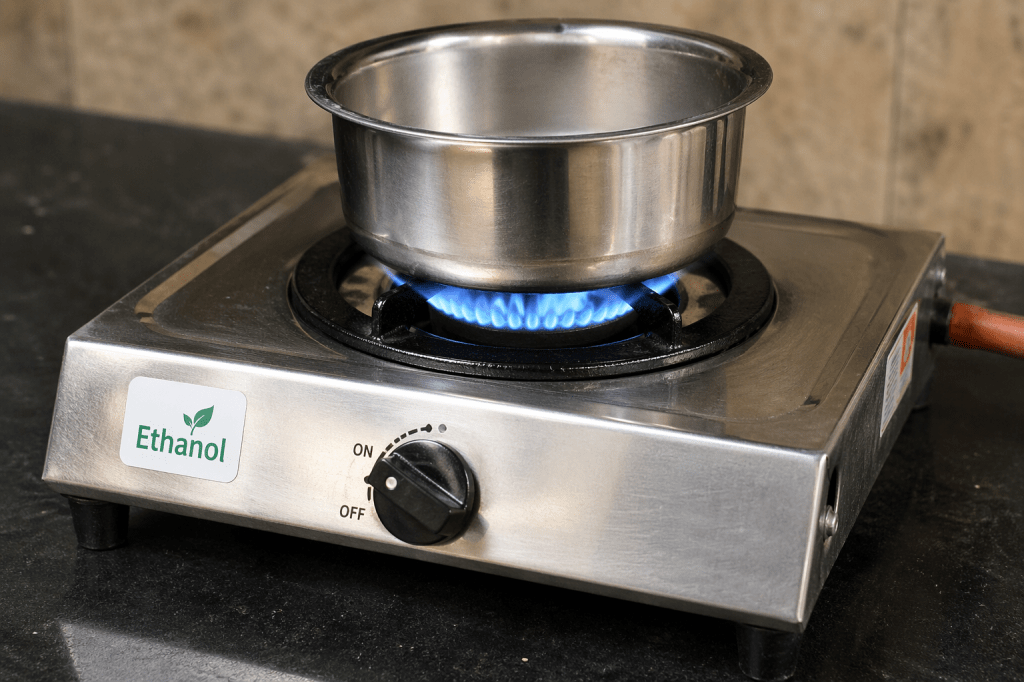
The push for ethanol as a clean cooking fuel sits at the intersection of energy security, agricultural policy, and public health. In countries like India, where dependence on imported Liquefied Petroleum Gas (LPG) and crude oil creates fiscal pressure, ethanol offers a domestically producible alternative derived from sugarcane molasses, damaged food grains, or surplus crops. This aligns with broader biofuel strategies already seen in transport blending programs.
Ethanol (ethyl alcohol) burns with a relatively clean, blue flame and produces significantly lower particulate matter and carbon monoxide compared to traditional biomass fuels like wood or charcoal. From a household energy perspective, this directly addresses indoor air pollution—a major contributor to respiratory diseases in rural and peri-urban populations. Compared to LPG, ethanol combustion can be similarly clean when stoves are well-designed, though energy density is lower, meaning more frequent refueling may be required.
Modern ethanol cookstoves are engineered for efficiency and safety. Research institutes, including bodies like Indian Institute of Technology, have been testing pressurized and non-pressurized burner designs. These stoves often use vaporizing burners that convert liquid ethanol into gas before combustion, improving flame stability and thermal efficiency. Some designs incorporate wicking systems (using absorbent material) to prevent spillage and reduce explosion risk. Thermal efficiencies of 50–65% have been reported in laboratory settings, which is competitive with LPG stoves under controlled conditions.
A key driver behind ethanol stove promotion is macroeconomic: reducing LPG subsidies and import bills. India imports a substantial portion of its LPG, and price volatility in global energy markets affects both government expenditure and household affordability. By contrast, ethanol production can be scaled domestically, supporting farmers and agro-industries. The integration of ethanol into cooking energy thus creates a circular rural economy—farm output feeds fuel production, which in turn reduces fossil fuel imports.
However, scalability presents several constraints. First is feedstock availability. Diverting food grains to fuel raises food security concerns, particularly in years of poor harvest. Second is supply chain infrastructure: ethanol must be denatured (to prevent consumption), transported, and stored safely, requiring new distribution networks distinct from LPG cylinders. Third is cost competitiveness. While ethanol can be subsidized or priced attractively, its lower calorific value means households may perceive it as less economical unless stove efficiency is high and supply is reliable.
User adoption is another critical variable. LPG has already achieved deep penetration through initiatives like Pradhan Mantri Ujjwala Yojana, which normalized cylinder-based cooking. Ethanol stoves must therefore match LPG in convenience—instant ignition, controllable flame, minimal maintenance—to gain acceptance. Pilot programs indicate that urban and semi-urban households are more receptive, especially where liquid fuel distribution is already established.
Environmental outcomes depend on lifecycle analysis. If ethanol is produced from waste biomass or surplus crops, its carbon footprint is relatively low. However, intensive sugarcane cultivation can strain water resources and lead to land-use changes. Thus, sustainability hinges on feedstock selection and agricultural practices.
In summary, ethanol cookstoves represent a technically viable and policy-relevant alternative to LPG, with strong potential benefits in emissions reduction, rural income generation, and energy security. Their long-term success will depend on resolving supply chain logistics, ensuring cost competitiveness, and delivering stove designs that meet user expectations at scale.

Leave a comment