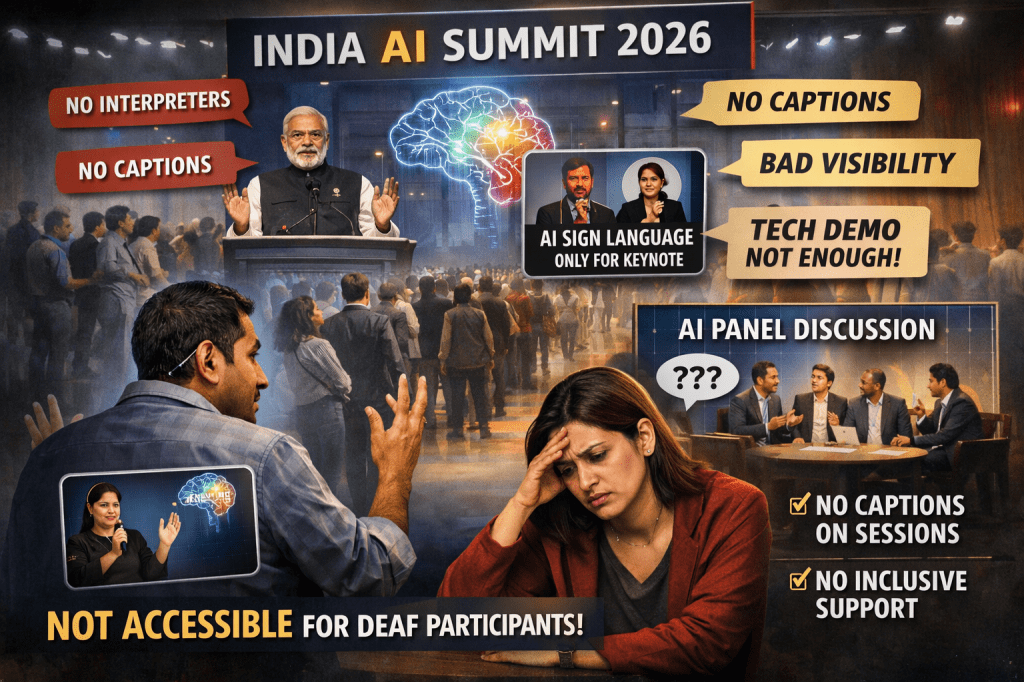
Here’s a balanced analysis of the India AI Summit (formally the India AI Impact Summit 2026) and its accessibility — especially for people who are deaf or hard of hearing — based on available reports and statements:
📌 1. Official Accessibility Measures at the Summit
AI-powered Sign Language Interpretation
The Government of India highlighted that real-time sign language translation was provided during Prime Minister Narendra Modi’s keynote speech at the summit using AI technology, and this was presented as a step toward inclusion for persons with disabilities. �
✔️ Positive intent: Using AI for sign language interpretation shows an official effort to include the deaf community in at least some parts of the summit proceedings.
➡️ However: A single instance of sign language translation during one speech does not necessarily mean that the entire event — including panels, discussions, and all sessions — was fully accessible to deaf participants.
📌 2. Accessibility in Practice: Gaps & Limitations
Despite the official emphasis:
Not widely reported or visible
Independent reports and attendee complaints about the summit have focused on logistics, long queues and organisational issues, but not on detailed accessibility arrangements for deaf or hard-of-hearing people. �
There’s no broad evidence that full sign language interpretation, captioning, assistive tech translation services, or inclusion strategies across all sessions were systematically deployed.
Technical Accessibility ≠ Full Human Access
Even if AI interprets speech into sign language:
Deaf attendees may need qualified on-site interpreters, large clear screens, captioning for every session, and pre-event communication accessibility — not just AI demonstrations.
Real-time AI translation tools require high accuracy, and AI-only sign language interpretation still struggles with complex dialogue, cultural context, idioms and gestures unless rigorously tested and human-supervised.
➡️ Providing a technology demonstration is not the same as ensuring comprehensive accessibility for all sessions and for every attendee.
📌 3. Broader Accessibility Ecosystem
Inclusion Initiatives Exist but May Not Be Integrated
India’s AI ecosystem has initiatives promoting accessibility — like inclusion working groups and calls for AI to improve access for persons with disabilities. �
Policy Support
India has legal mandates such as the Rights of Persons with Disabilities Act, 2016, which require equal access to information and public events, including conferences. �
➡️ But having a law and having on-ground implementation at global tech summits are not the same.
📌 4. What This Means for Deaf Accessibility at AI Summit
Strengths
Official efforts included AI sign language translation in at least one speech.
Public statements emphasized inclusion and accessibility.
Weaknesses
There is no evidence of systematic, event-wide accessibility for deaf attendees across all sessions (e.g., full sign interpretation, real-time captions, accessible materials).
Available reports focused more on organisational challenges than on disability-focused accessibility measures.
AI translation demonstrations can raise awareness, but they do not automatically guarantee usability and comprehensive access for people who are deaf in all contexts.
📌 Summary
Aspect
Reality at India AI Summit 2026 Official statements on accessibility
✔️ Publicised AI sign-language translation in parts of the event
Comprehensive accessibility for deaf participants
❌ Not clearly implemented or documented
Consistency of accessibility measures throughout the summit
❌ Likely limited
Alignment with inclusion law and disability rights
🟡 Not fully reflected in practice
📌 Conclusion
While the India AI Summit made some efforts to include deaf participants — such as AI-enabled sign language interpretation during certain speeches — these seem symbolic rather than comprehensive accessibility solutions across the entire event.
To truly be accessible, a global event must integrate multiple human-centered accommodations (professional interpreters, clear captioning, accessible materials, sign-friendly seating, etc.), not just single demonstrations of AI tech.
In that sense, the summit reflected good intentions but significant gaps — highlighting that accessibility for deaf people in major tech events still needs stronger implementation, planning and accountability.


Leave a comment