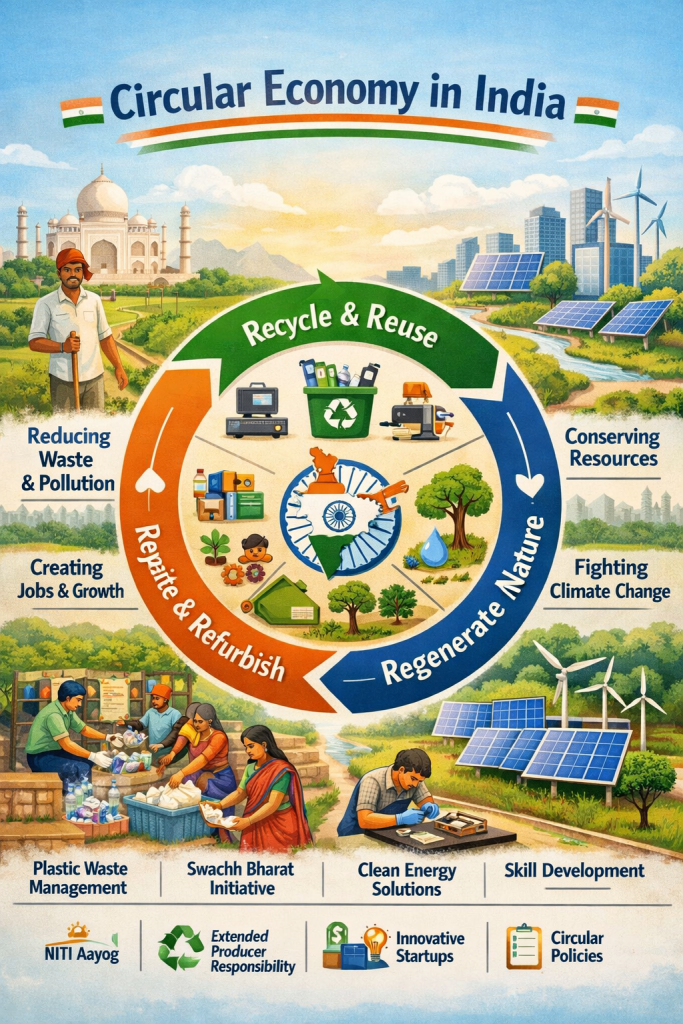
Here’s a comprehensive overview of the circular economy in India — what it is, why it matters, how India is approaching it, current initiatives, key examples, opportunities, and challenges:
🔄 What Is a Circular Economy?
A circular economy is an economic model that aims to eliminate waste and pollution and keep products, components, and materials in use for as long as possible — through reuse, repair, refurbishment, remanufacturing, recycling, and regeneration of natural systems. It replaces the traditional linear model of “take-make-dispose” with one that minimizes resource extraction and maximizes resource efficiency. �
Core principles include:
Eliminate waste and pollution
Keep products and materials in circulation
Regenerate natural systems �
🇮🇳 Why the Circular Economy Matters for India
India’s rapid economic growth and population expansion have increased resource demand and waste generation, making circularity crucial for long-term sustainability:
It can help reduce environmental damage such as landfill pressure, air and water pollution.
Supports net-zero and climate goals by lowering greenhouse gas emissions.
Boosts the economy by creating jobs and new markets.
According to the government, India’s circular economy could generate a market value of over $2 trillion and create nearly 10 million jobs by 2050. �
🧭 Government Policy & Institutional Support
India has taken several policy and strategic steps toward circularity:
🏛 Government Initiatives
NITI Aayog Circular Economy Cell
Established to coordinate action across ministries/departments on circular economy strategies. �
Extended Producer Responsibility (EPR)
Requires producers to take responsibility for post-consumer waste — especially plastics and e-waste — to boost recycling and material recovery. �
Waste Management Rules & Policies
Rules on waste segregation, processing, composting, and reuse (e.g., Swachh Bharat Mission and Plastic Waste Management Rules) support the transition. �
🏙 State-Level Actions
Maharashtra approved a policy to treat and reuse wastewater and sewage across urban bodies as part of its circular economy strategy. �
🌱 Circular Economy in Practice — Indian Examples
Businesses, cities, and innovators in India are already implementing circular principles:
♻️ Industrial & Startup
Examples
RaceEcoChain — Digital platform connecting waste generators, recyclers, and manufacturers for efficient traceability and recycling.
Banyan Nation (Hyderabad) — Uses data analytics to improve plastic recycling at scale. �
Goonj — Reuses urban surplus materials and redistributes them to rural areas, turning waste into socially beneficial resources. �
Graviky Labs — Captures air pollution (soot) and converts it into commercially usable “Air Ink.” �
🏙 City-Level Models
Hyderabad’s waste management system exemplifies circular practices by converting organic waste into compost and using waste-to-energy technologies. �
👩🌾 Community & Social Initiatives
In Pune, the Swach cooperative model has formalized waste collection work, dramatically increasing recycling and reducing landfill disposal — while creating livelihoods. �
In Assam, local innovators convert food waste into animal feed — illustrating circular practices in rural economies. �
📈 Benefits of Adopting Circular Practices
A shift to a circular economy offers multiple benefits:
Environmental: Less waste, lower pollution, reduced resource extraction, and support for climate goals Economic: New business models, cost savings through material reuse, and job creation.
Social: Better livelihoods in recycling, repair sectors, and more equitable economic participation. �
⚠️ Challenges Ahead
While progress is underway, implementation still faces hurdles:
Infrastructure gaps, especially in waste collection and recycling systems.
Informal sector complexities — many valuable waste handlers remain unregistered and lack support.
Consumer behavior — sustainable practices require education and behaviour change.
Regulatory complexity — coordination across levels of government can be difficult. �
🔭 The Future of Circular Economy in India
India’s circular economy journey is accelerating with policy support, innovation, and growing private-sector engagement. The focus is expanding beyond just waste management to product design, industrial symbiosis, and new materials innovation. Scaling digital platforms, improving recycling infrastructure, and fostering public‐private partnerships will be key to unlocking the full potential of circularity.
Overall, India’s transition is not only about environment protection — it’s about building a sustainable, resilient, and inclusive economy for the future. �

Leave a comment