Here’s a clear and up-to-date overview of the Blue Economy in India — what it is, why it matters, key sectors, policy direction, and current developments:
🌊 What Is the Blue Economy?
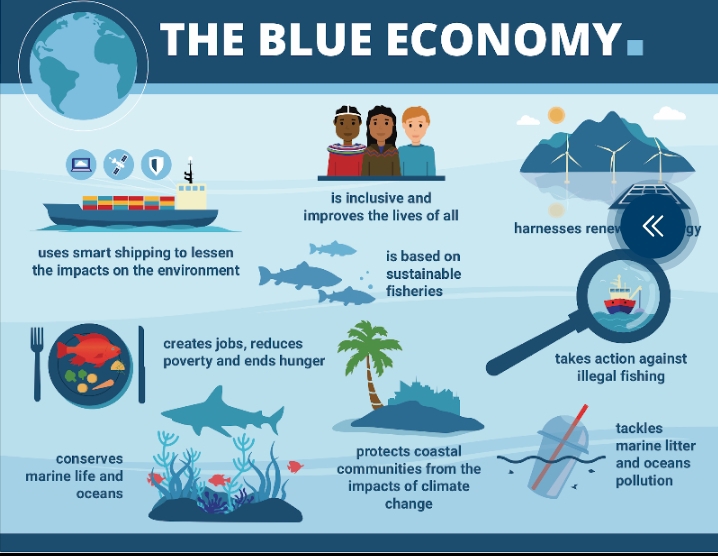
The Blue Economy refers to the sustainable use of ocean, sea and coastal resources for economic growth, improved livelihoods, and jobs — while preserving the health of marine and coastal ecosystems. It goes beyond traditional maritime activities to include emerging sectors like marine renewable energy, biotechnology and deep-sea resources. �
In India, this concept includes all economic activities linked to oceans, seas, and coasts pursued in ways that are environmentally sustainable, socially inclusive, and climate-resilient. �
📊 India’s Strategic Position
7,500+ km coastline, spanning nine states and four Union Territories. �
Large Exclusive Economic Zone (EEZ) of about 2.2 million sq km with rich living and non-living resources. �
Maritime trade handles more than 95 % of India’s trade by volume. �
The blue economy accounts for around ~4 % of national GDP, with significant potential to grow. �
⚙️ Key Sectors of India’s Blue Economy
India’s blue economy spans both traditional and emerging sectors:
🐟 Fisheries & Aquaculture
Fishing and fish processing are core to coastal livelihoods.
India is among the world’s largest fish-producing countries. �
Recent budget reforms aim to expand deep-sea fishing and boost exports. �
⚓ Ports, Shipping & Maritime Logistics
India’s extensive port network underpins international trade and connectivity. �
KPMG
🌴 Coastal & Marine Tourism
Cruise terminals, beach tourism, and cultural experiences boost local economies and jobs. �
⚡ Marine Renewable Energy
Offshore wind and tidal energy are emerging opportunities aligned with climate goals. �
🧬 Marine Biotechnology & Innovation
Exploring marine biodiversity for applications in health, industry and sustainability. �
🛠️ Shipbuilding, Repair & Ports Infrastructure
Focus on building efficient ports and vessel maintenance facilities (e.g., Kochi slipway cradle). �
🪨 Deep-Sea Resources
Exploration of seabed minerals and resources in offshore waters. �
🧭 Government Policy & Initiatives
India’s blue economy is shaped by multiple policy moves:
📌 Draft Blue Economy Policy Framework
The government has prepared a policy framework for using marine resources (living and non-living), tourism, energy and technology in a sustainable, sea-centric economy. �
📌 Blue Economy 2.0
Introduced in recent budget discussions, focusing on climate-resilient coastal development, ecosystem restoration, and sustainable aquaculture. �
📌 Deep Ocean Mission
A flagship science-and-innovation effort to explore deep sea resources and technologies.
📌 NITI Aayog Strategic Roadmap
Outlines reforms and investments to modernise fishing fleets and expand exports — part of boosting India’s blue economy footprint. �
📢 Recent Developments in India
Here’s what’s been happening recently:
🗞️ Marine exports & fisheries likely to grow under new trade agreements benefiting coastal communities and employment. �
🗞️ Seafood processing policy eased to improve global competitiveness. �
🗞️ Major marina development planned off South Mumbai, boosting marine tourism infrastructure. �
🗞️ Budget reforms expand deep-sea fishing opportunities for coastal states like Andhra Pradesh. �
🗞️ Regional cooperation (e.g., BIMSTEC) emphasises deeper collaboration in blue economy sectors. �
🧩 Key Challenges
While promising, India’s blue economy also faces hurdles:
Climate change impacts, coastal ecosystem degradation. �
Policy gaps and need for coordinated implementation. �
Sustainable management of marine resources without overexploitation. �
moes.gov.in
📌 Why It Matters
The blue economy offers India a pathway to:
✔ Boost economic growth
✔ Create livelihoods, especially in coastal regions
✔ Enhance maritime trade and global competitiveness
✔ Promote sustainable ocean conservation
✔ Contribute to climate adaptation strategies

Leave a comment