Here’s a clear, balanced summary explaining why quality jobs feel limited in India, while they appear more abundant in China and the USA 👇
🌍 Quality of Jobs: India vs China vs USA
🇮🇳 India: Quantity High, Quality Limited
Job growth is skewed toward low-quality work: informal, contract-based, low-pay, low-security jobs dominate.
Education–industry mismatch: many graduates lack job-ready skills for high-value roles.
Slow manufacturing expansion compared to population growth.
Limited R&D and deep-tech jobs, restricting innovation-led employment.
High competition for few quality jobs, leading to underemployment and brain drain.
Result: Plenty of work, but fewer dignified, stable, high-paying careers.
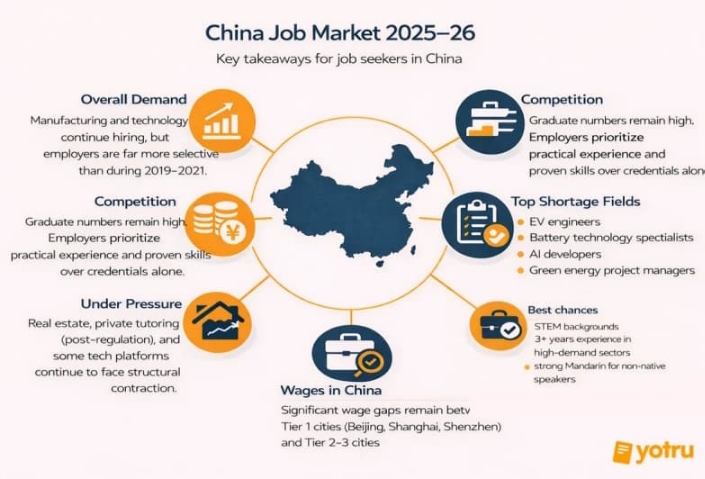
🇨🇳 China: Manufacturing + Technology at Scale
Strong manufacturing ecosystem supports millions of skilled jobs.
State-backed industrial policy creates demand in EVs, AI, semiconductors, and infrastructure.
Rapid upskilling aligned with industry needs.
Export-driven economy generates continuous demand for quality labor.
Result: Large-scale creation of mid- to high-quality jobs across sectors.
🇺🇸 USA: Innovation-Led Quality Employment
High investment in R&D, startups, and advanced services.
Strong university–industry collaboration.
Global talent attraction fuels innovation.
Diverse high-paying sectors: tech, healthcare, finance, defense, clean energy.
Result: Fewer people than India, but unlimited-quality job creation through innovation.
🔑 Core Difference (In One Line)
India → Job-seeking economy
China → Job-producing industrial economy
USA → Job-creating innovation economy
📌 Bottom Line
India’s challenge is not lack of talent, but lack of systems that convert talent into high-quality jobs.
China and the USA focus on industrial depth, innovation, and skill alignment, making quality jobs feel “unlimited.”

Leave a comment