Here’s a comprehensive, up-to-date analysis of the rise (and outlook) of buying land or flats in India — suitable if you’re considering this as an investment or a home purchase: �
Address Advisors +4
📈 Current Market Trend (2025–26)
- Property Prices Are Rising (Overall)
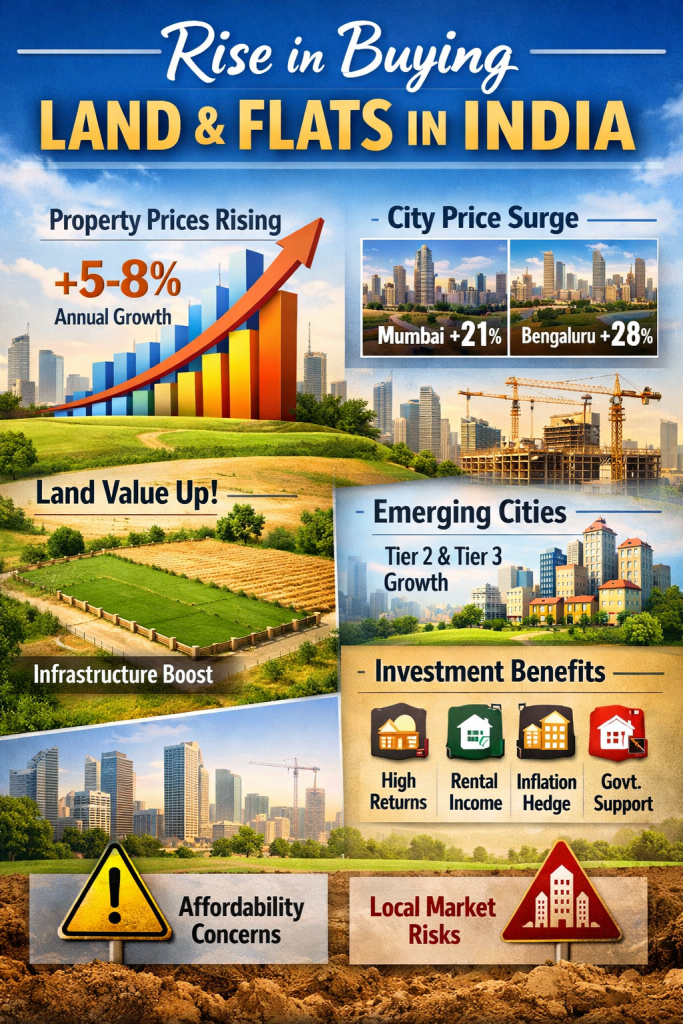
Experts forecast ongoing price growth rather than decline across most Indian housing markets. Price appreciation of roughly 5–8% annually (and potentially higher in select micro-markets) is expected in 2025 and 2026. �
The Times of India +1
Developers (≈70%) expect more than a 5% rise in home prices in 2026 due to sustained demand. �
The Times of India - Residential Prices Have Already Appreciated
Major cities like Mumbai, Bengaluru, etc., have seen strong price rises in recent years — e.g., Bengaluru up ~28% and Mumbai ~21% YoY in Q4 2024. �
Puravankara - Land Can Appreciate Strongly
Land near key infrastructure (expressways, metro, industrial corridors) is appreciating rapidly — in some corridors, land prices have multiplied over recent years. �
LinkedIn
Unlike built structures, land itself doesn’t deteriorate and often retains long-term value especially near development nodes. �
AaraSpace - Broader Growth Drivers
Several macro-factors support real estate growth:
Strong economic growth & urbanization
Rising incomes, especially in tech & services hubs
Infrastructure improvements (roads, metros, smart cities, industrial corridors)
Policy support & transparency (RERA, land digitization, tax incentives) �
Colliers +2
🏙️ City & Segment Dynamics: Where Growth Is Strongest
Metros & Major Cities
Premium and core urban markets continue to see steady price appreciation.
Ultra-luxury segments (e.g., Mumbai’s central areas) have shown striking growth, especially among wealthier buyers. �
The Times of India
Emerging Growth in Tier-2 & Tier-3
Smaller cities and developing urban centers are gaining investor interest as they offer higher future growth potential and better affordability. �
Realty Today
Local Variations Matter
Some metros (e.g., Chennai) buck broader slowdowns with rising sales, mainly in mid-size and affordable segments. �
The Times of India
🧠 What This Means for Buyers & Investors
👍 Advantages of Buying Now
✔ Appreciation Potential: Long-term property prices in growing cities are likely to rise, especially where infrastructure upgrades are underway. �
✔ Rental Demand: Residential properties still offer rental income opportunities in fast-growing job hubs. �
✔ Inflation Hedge: Historically, real estate in India has acted as a hedge against inflation over the long run. �
✔ Government Support: Policies improving transparency and buyer confidence continue to support the sector. �
Puravankara
Puravankara
Puravankara
Reuters
⚠ Risks & Cautions
🚩 Affordability Issues: Rising prices and land costs make it harder for first-time buyers, especially in prime markets. �
🚩 Slowdown Pockets: Some segments (particularly lower-priced affordable housing in select cities) face slower growth or temporary stagnation. �
🚩 Locality Matters: Price trends can vary widely even within a city, depending on connectivity, amenities, job centers, etc. �
Reuters
Global Property Guide
Trade Brains
📊 Strategic Takeaways (2025–26)
Best Case for Buying
Long-term horizon (5–10+ years): Most analysts suggest that real estate remains solid for long-term investors. �
https://www.kaavyaratna.com/
Land near upcoming infrastructure: High upside if properly researched. �
LinkedIn
Growth cities (tech hubs & Tier-2): Often outperform over long term. �
https://www.kaavyaratna.com/
When to Be Cautious
Short-term speculation: Market cycles are slowing price acceleration in some segments. �
Global Property Guide
Overbuilt or low-demand micro-markets: Can underperform. �
Future Property
📌 Final Assessment
✅ Strong structural growth basis — driven by demand, economics, and policy support. �
✅ Expect continued moderate price appreciation in most markets. �
✅ Land remains a reliable long-term value store especially near development zones. �
⚠ Local and segment-specific research is crucial — conditions vary widely by city, neighborhood, and connectivity. �

Leave a comment