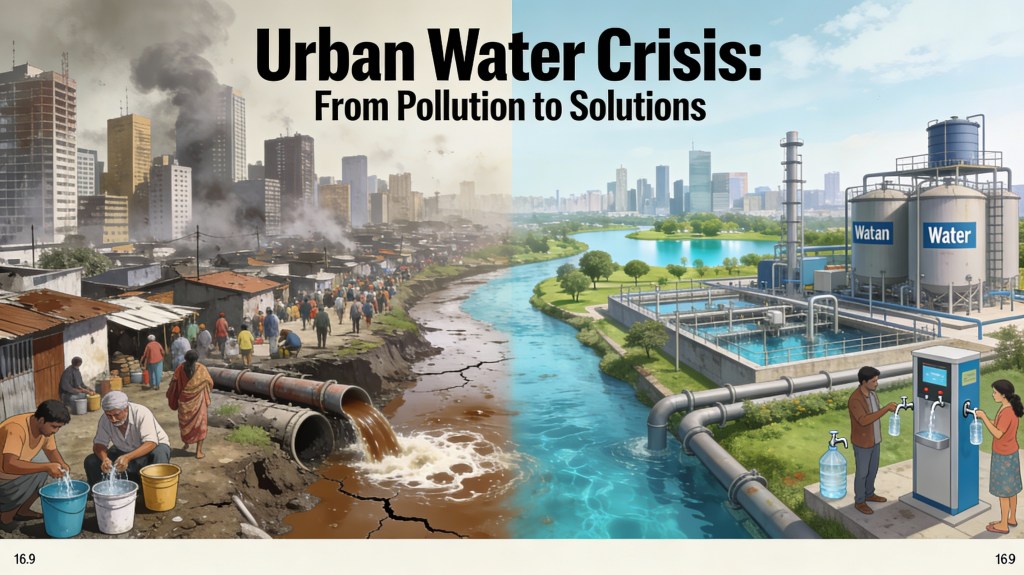
India’s major cities face poor water quality due to a combination of sewage discharge, industrial pollution, weak treatment infrastructure, and leaky distribution systems, and solving this needs simultaneous action at policy, city, and household levels.��� The situation is worst for the urban poor, who often depend on highly contaminated informal sources.�
How bad is city water?Studies show that only about 28–31% of urban wastewater is treated; the rest is discharged as raw sewage into rivers and lakes that supply cities.��
A BIS assessment found that in a sample of 21 Indian cities, almost all failed on one or more drinking water parameters; Mumbai performed best, while Delhi’s samples failed on 19 parameters including turbidity, coliform bacteria, nitrates, and aluminium.��
Research on urban groundwater and surface water indicates contamination by pathogens (E. coli, coliform), high TDS, industrial chemicals, pesticides, and heavy metals like lead, mercury, and arsenic.��
Key causes of poor water quality. Untreated sewage: Rapid urbanisation has outpaced sewerage networks and treatment plants; tens of millions of litres of sewage daily are released untreated into water bodies.��
Industrial effluents: Weak enforcement allows many industries to discharge inadequately treated or untreated effluents, adding heavy metals and toxic organics into rivers and groundwater near cities.��
Over-extraction of groundwater: Cities like Delhi, Bengaluru, Hyderabad and Chennai have heavily depleted aquifers, concentrating natural contaminants like fluoride/arsenic and drawing in polluted shallow groundwater.��
Aging, leaky distribution networks: Intermittent supply and low-pressure, leaky pipes allow contaminated water to be sucked into the system, especially in dense informal settlements.�
Climate and urbanisation pressures: Heatwaves, erratic rainfall and flooding intensify pollution loads and dilute treatment capacity, while paved surfaces reduce natural recharge.��
Health and social impacts Contaminated urban water is linked to diarrhoeal diseases, hepatitis, and other gastrointestinal infections, with the poorest communities bearing the highest burden.��
Long-term exposure to heavy metals and nitrates can cause neurological problems, kidney damage, and “blue baby syndrome” in infants.��
Time and money spent on fetching and treating water reduce productivity and deepen urban poverty, with women and children particularly affected.��
System-level solutions for citiesExpand and upgrade sewage treatment:Build both centralized and decentralized sewage treatment plants (STPs), including smaller plants for colonies and housing societies.��
Mandate reuse of treated wastewater by industries, construction, and landscaping, reducing pollution and pressure on fresh water sources.��
Stronger regulation of industrial pollution:Strict monitoring of effluent discharge norms with continuous online monitoring and heavy penalties for violations.��
Promote zero-liquid-discharge and cleaner production technologies in industrial clusters around cities.��
Protect and restore local water bodies: Demarcate and legally protect lakes, wetlands, and river floodplains; stop encroachment and dumping.��
Invest in lake and river rejuvenation projects that integrate sewer interception, desilting, and constructed wetlands for natural treatment.��
Improve urban water supply infrastructure:Replace old, leaky pipelines and move towards continuous (24×7) pressurised supply to reduce contamination ingress.��
Deploy smart meters, pressure management, and leakage detection systems using IoT and AI.��
Rainwater harvesting and groundwater recharge: Make rooftop rainwater harvesting and recharge wells mandatory in large buildings and layouts, backed by enforcement and incentives.��
Encourage community recharge parks and percolation ponds to revive urban aquifers.��
Community and household-level actions At household level, use certified point-of-use treatment (RO + UV/UF + activated carbon as appropriate to local TDS and contamination profile) and ensure regular filter maintenance.��
Housing societies can set up small-scale STPs, greywater reuse (for flushing/gardening), and common rainwater harvesting systems to reduce dependence on tanker water.��
Citizen groups can:Monitor local water quality using low-cost test kits and push municipalities for remedial action.�
Participate in lake and nallah clean-up drives and litigation/advocacy against illegal dumping and encroachment.��

Leave a comment