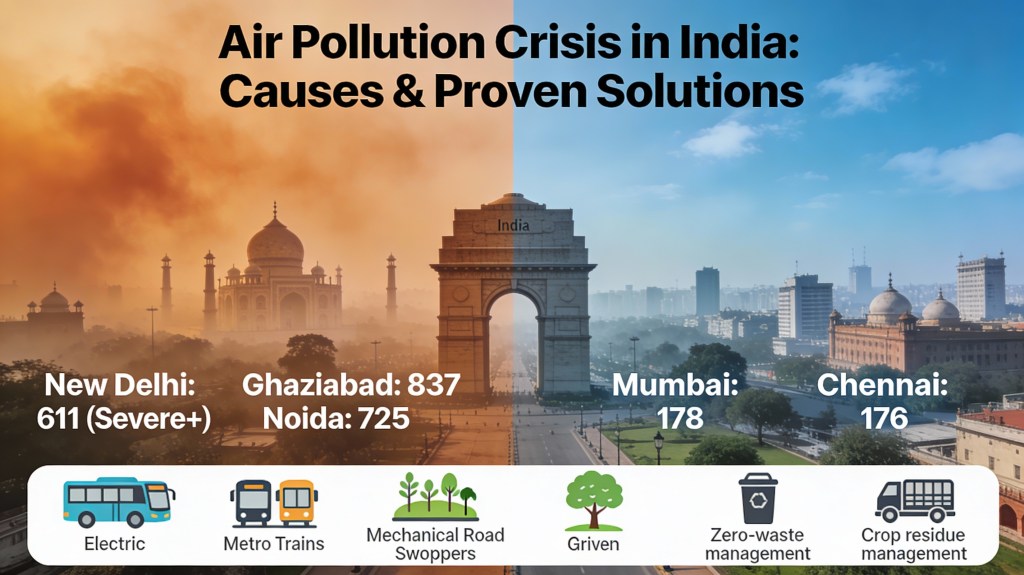
New Delhi’s air quality remains hazardous, with a recent AQI of 611, placing it among India’s most polluted cities alongside NCR hubs like Ghaziabad (837) and Noida (725) ��.
Major metro cities face varying severity, from Delhi’s extreme levels to moderate pollution in Mumbai (178) and Chennai (176) �.
PM2.5 and PM10 dominate as key pollutants, exacerbated by winter inversions trapping emissions ��.
Key Causes Vehicular emissions contribute 18-39% of PM2.5, intensified by traffic congestion and old diesel vehicles ��.
Road dust and construction activities add 35-66% to PM10 levels, while crop residue burning in nearby states spikes winter pollution ��.
Industrial outputs, waste burning, and biomass cooking further degrade air across cities like Delhi, Lucknow, and Pune ��.
Health Impacts Hazardous AQI levels (301+) like Delhi’s recent 611 pose severe risks, equivalent to smoking dozens of cigarettes daily and triggering respiratory issues ��.
Vulnerable groups, including children and the elderly, face heightened dangers from PM2.5 infiltration into lungs �.
Over the past decade, cities like Delhi consistently exceed safe thresholds, leading to thousands of pollution-related deaths annually �.
Solutions Enforce Graded Response Action Plan (GRAP) measures, such as banning old vehicles and diesel generators during peaks ��.
Promote electric vehicles, expand metro networks, and incentivize crop residue alternatives to cut emissions by up to 12% ��.
Improve dust control via paved roads, waste management, and air purification tech like filters at intersections ��.

Leave a comment