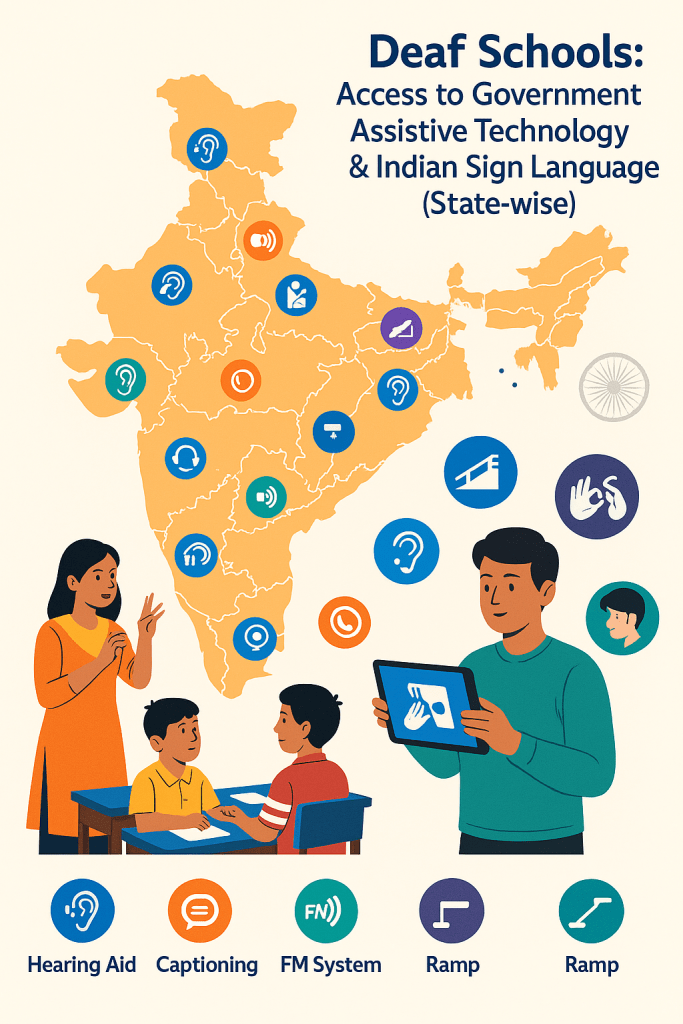
Summary — accessibility of deaf schools to government assistive technology & Indian Sign Language (ISL) across Indian states
India has a growing national framework (policies, an ISL nodal body, and central schemes) that supplies ISL training, curricula and some assistive-technology programs to deaf schools — but implementation and access vary widely by state. Many states have government or aided special schools for the hearing-impaired, and central initiatives (ISLRTC, ADIP / Samagra Shiksha, Accessible India) provide tools, training and device funding — yet on-the-ground availability of ISL-trained teachers, interpreters, and assistive devices is uneven and patchy.
Key points
- National institutions & programs that matter
ISLRTC (Indian Sign Language Research & Training Centre) is the central/nodal body producing ISL curricula, teacher training, dictionaries and an online ISL course — it also maintains a directory of deaf/special schools. This gives a national backbone for ISL adoption.
Central accessibility schemes — Accessible India Campaign (Sugamya Bharat), ADIP (Assistance to Disabled Persons for Purchase) and education schemes such as Samagra Shiksha — fund ramps, devices, screening camps and some assistive appliances. These schemes are channeled through states/UTs, so coverage depends on state implementation.
Recently the government launched dedicated ISL media/learning channels (e.g., PM e-Vidya DTH Channel 31 for ISL) and ISL resources for textbooks — pushing broader access to ISL teaching resources.
- What’s happening in states — typical pattern (with examples)
State lists of special/deaf schools exist, and many states run or recognize special schools; some maintain consolidated district/state directories (examples: lists on ISLRTC, state education portals). But number, quality and staffing levels differ by state.
Training & local initiatives: several states/districts run ISL training for officials, teachers and launch device-distribution camps (example: Telangana district officials learning ISL; Jharkhand running ADIP/SSA screening & device camps). These are encouraging but localized.
Private/NGO & start-up support is filling gaps (Ed-tech and ISL tech startups, NGOs offering interpreters and digital resources), often used by state schools that partner locally.
- Gaps & variability (why states differ)
Teacher/interpreter shortage: not all states have enough ISL-trained teachers or certified interpreters. ISLRTC training exists but scale-up across every district is ongoing.
Uneven device distribution: assistive devices (hearing aids, FM systems, captioning tech, accessible DTH content, educational software) are provided through central schemes but reach depends on state budgets, local administration, and active screening drives.
Curriculum & medium: NEP 2020 and recent directions push ISL inclusion and conversion of textbooks into ISL formats, but full classroom implementation across all states will take time and coordination.
- Practical snapshot (what you can expect by state)
Better-resourced states / metros: more likely to have ISL-trained teachers, NGOs, pilot tech programs, and device camps (examples found in Telangana, Tamil Nadu, some districts in Uttar Pradesh / Odisha via special school lists or state programs).
Smaller states / rural districts: often have fewer specialized staff, rely on one or two special schools, and get assistive devices intermittently through camps. Central directories show many single-school entries per district.
- How reliable public data is & what’s missing
There is no single, up-to-date public dataset that lists, state-by-state, (a) which deaf schools have ISL-trained teachers, (b) which schools have specific assistive devices, and (c) which districts have regular device distribution — data exists in pieces (ISLRTC directory, state education portals, scheme reports, news). That makes a full statewise accountability summary difficult without targeted state searches.

Leave a comment