Indian technology and digital devices have become much more accessible to deaf people in India, but access is still unequal because of high costs, language barriers, and limited policy enforcement.Main types of technology for deaf peopleHearing devices: Hearing aids, cochlear implants, and assistive listening devices (ALDs) are widely marketed in India, and are recognised as essential assistive products in national lists of assistive technology and ENT/rehab practice.���
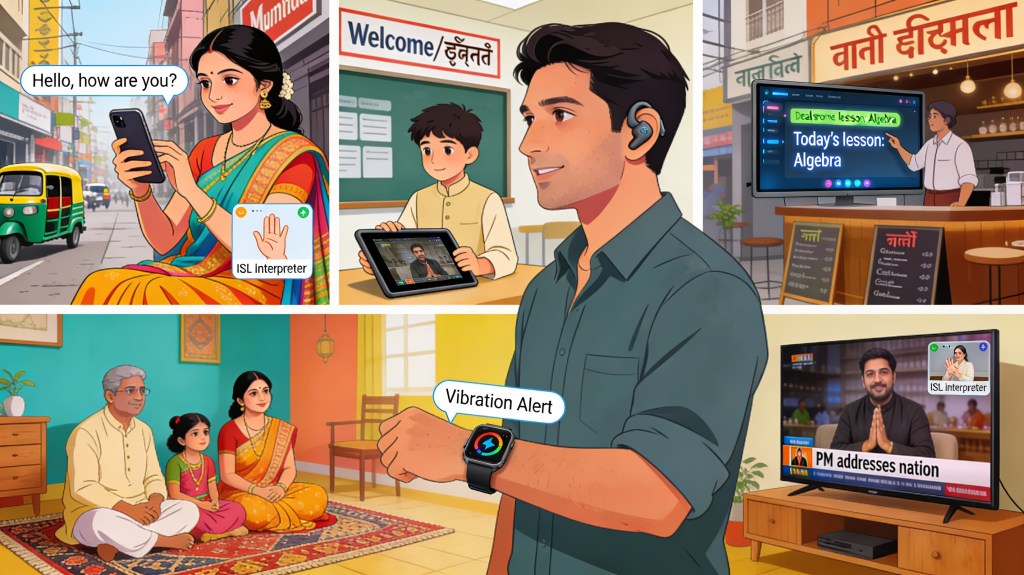
Visual and vibration alerts: Alerting devices that use light and vibration (doorbells, alarms, baby-cry detectors, etc.) and wearable devices like “Vibe” from IIT Madras convert sound into vibration patterns so deaf users can sense their surroundings.���
Communication apps: Smartphones enable video calling, instant messaging, captioning, and Video Relay / Video Remote Interpreting services; apps like SignAble provide on‑demand Indian Sign Language interpreters for live communication with family, workplaces, and government offices.���
Government schemes and policy support ADIP scheme: Under the “Assistance to Disabled Persons for Purchase/Fitting of Aids/Appliances (ADIP)” scheme, the central government subsidises modern assistive devices including hearing aids and cochlear implants for eligible low‑income persons with disabilities, channeled via NGOs and state agencies.���
State implementations: States such as Maharashtra explicitly fund high‑cost cochlear implants (up to several lakh rupees per child) under state‑level versions or add‑ons to ADIP, showing that advanced hearing technology is formally recognised but still needs strong public subsidy to be affordable.��
Accessible India / digital initiatives: The Accessible India Campaign and broader digital accessibility policies aim to make information and communication systems accessible, which includes captioning, sign‑language support, and accessible government portals for deaf and hard‑of‑hearing people.��
Role of smartphones and mainstream techBuilt‑in accessibility features: Modern smartphones used in India support captions, video calling, messaging, and accessibility settings that help deaf and hard‑of‑hearing users communicate, study, and work, effectively functioning as low‑cost assistive technology.���
Emerging AI and ISL tools: Research groups in India are developing Indian Sign Language detection and conversational agents using computer vision and transformers, which can eventually enable camera‑based ISL‑to‑text or speech translation on phones.��
Everyday digital access: Deaf users increasingly rely on OTT platforms, social media, and video conferencing tools that provide captions or text chat, but caption quality in Indian languages and ISL interpretation remains inconsistent across services.��
Accessibility and equity gaps
Affordability barrier: Academic and policy analyses show a major gap between availability of hearing technology (hearing aids, cochlear implants, ALDs) and what deaf people can actually afford, because devices are expensive and health insurance or public schemes often exclude or underfund them.���
Coverage and awareness: Many eligible deaf people are unaware of schemes like ADIP or face bureaucratic hurdles and limited supply centres, leading to low penetration of subsidised devices even though policies exist on paper.��
Beyond hearing devices: Visual communication tools (ISL interpreters, captioning, ISL‑aware apps) are still not mainstream in education, workplaces, and government service delivery, so technology often focuses on “fixing hearing” rather than fully supporting sign language and deaf culture.���
Overall assessment for India Technological readiness: India now has a broad ecosystem of hearing devices, smartphone‑based tools, research on ISL technology, and some indigenous innovations (like wearable vibrotactile devices) that can significantly enhance accessibility for deaf people.����
Implementation gap: The main problems are affordability, patchy scheme implementation, lack of insurance coverage, and slow integration of sign language–friendly tech in schools, jobs, and government services, which together mean many deaf Indians still do not experience the full benefits of these technologies.���

Leave a comment