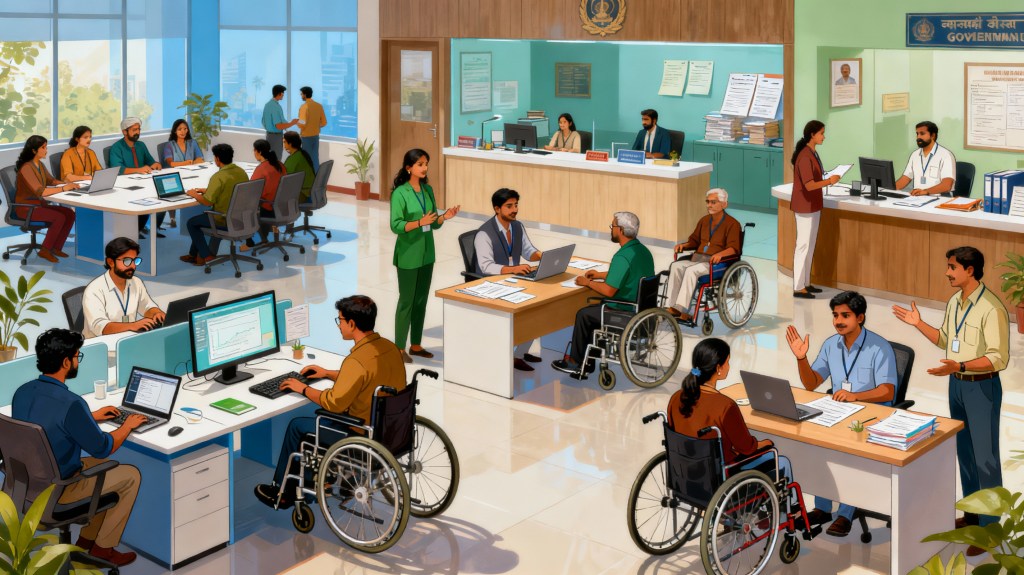
Employment of persons with disabilities (PwDs) in India remains low overall, with Worker Population Ratio around 23% nationally (NSS 76th round), far below non-disabled rates, and stark divides between government (4% reservation quota, often underfilled) and private sectors (typically under 1% representation).���
Government Jobs A 4% reservation exists for benchmark disabilities in government jobs under RPwD Act 2016, but implementation varies by state; public sector banks and PSUs show PwD representation around 0.5-1% as of 2024, with higher compliance in states like Maharashtra and Tamil Nadu via targeted data.���
States with stronger enforcement (e.g., Karnataka, Uttar Pradesh) report more filled quotas in education and administration, though absolute numbers dominate in populous states.�
Private Sector Private employment lags significantly, with PwDs comprising ~0.3-1% of formal workforces even in IT hubs like Bengaluru and Hyderabad; only ~36% overall workforce participation for PwDs vs 60% for others, driven by barriers like accessibility gaps.���
Urban states (Delhi-NCR, Maharashtra) lead slightly due to corporate inclusion drives, but rural-heavy states rely more on informal/self-employment.�
State Variations
High PwD work participation (any sector): Nagaland (~52%), Sikkim (~49%), northeastern states.�
Mid-range (Karnataka ~38%, Tamil Nadu ~37%, Maharashtra high absolute numbers).��
Low: Kerala (~24%), Delhi (~28%).�
Government quotas fill better in industrial states; private hiring concentrates in metros.�
Latest data gaps persist—use NSS microdata for custom state cross-tabs.�

Leave a comment