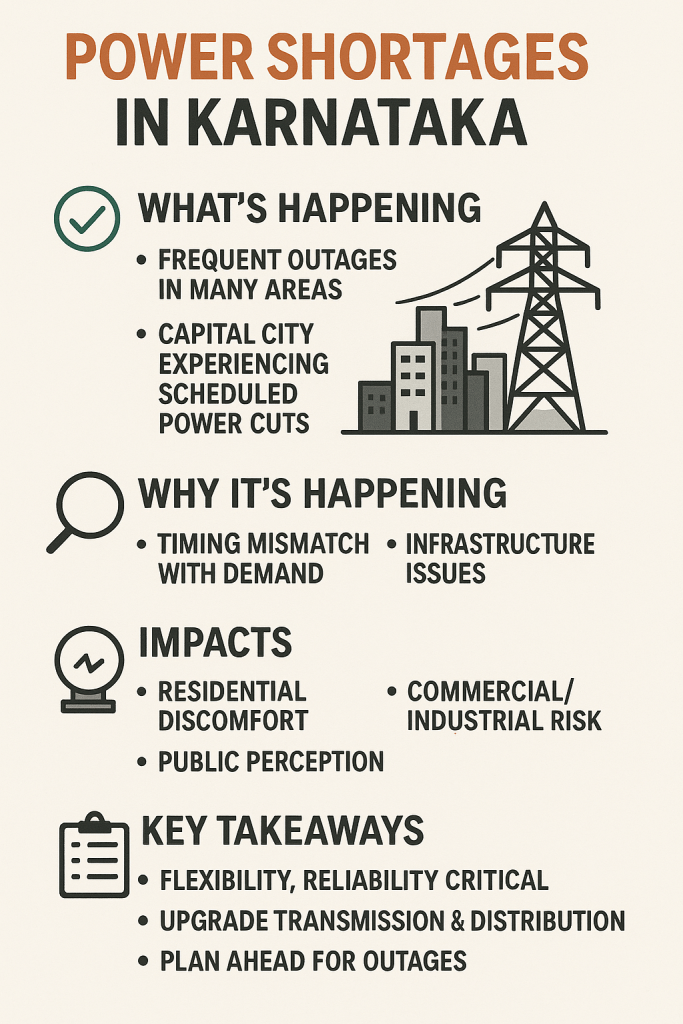
Here’s a summary of the power-shortage situation in Karnataka (as of late 2025) — the overview, causes, impacts and key takeaways.
✅ What’s happening
- Despite being broadly “power-surplus” overall, Karnataka is projected to face around 500 hours of electricity shortfall during FY2026-27.
- Many parts of the capital region (Bengaluru) and tier-2 towns are experiencing frequent outages and scheduled power cuts, despite the state having large installed capacity.
- For example: On 19 Nov 2025, substantial portions of Bengaluru were slated for a 10 am-5 pm outage for maintenance.
🔍 Why it’s happening
- Timing / Flexibility mismatch: While the state has plenty of energy on an annual basis (capacity ~36.4 GW) — about 65% of which comes from non-fossil sources (solar, wind) — there is a problem meeting the peaks (especially evenings) and when demand is high.
- Infrastructure & distribution issues: In Bengaluru and other places, outages are being caused by transformer over-loads, maintenance & technical constraints in transmission/distribution systems.
- Scheduled & unscheduled outages: Many outages are due to maintenance and upgrades of 66/11 kV substations etc., rather than classic “load-shedding” due to lack of generation. For example, the Bangalore Electricity Supply Company (BESCOM) has announced multiple 5-7 hour outages for maintenance.
🎯 Impacts
- Residential discomfort: Households face disruption during the day (and sometimes peak evening hours), which is especially troublesome for work-from-home, medical equipment, etc.
- Commercial/industrial risk: Especially in Bengaluru (tech/office/industrial sectors), outages can hit productivity.
- Public perception: It creates a sense of contradiction — “we are a power-surplus state, yet we face frequent cuts” — which raises questions about reliability.
📌 Key takeaways
- The issue isn’t simply how much power is produced, but when and how reliably it’s delivered. In technical terms: Karnataka is “energy-rich” but “flexibility-poor”.
- Upgrading and maintaining the transmission & distribution (T&D) infrastructure is crucial — the bottleneck is increasingly downstream of generation.
- Planned outages (for maintenance) are being used openly, and residents/businesses are being asked to plan ahead.
- For users: If you rely on continuous power (evening peak work, critical equipment) then having backups/inverters/UPS plans is prudent.

Leave a comment