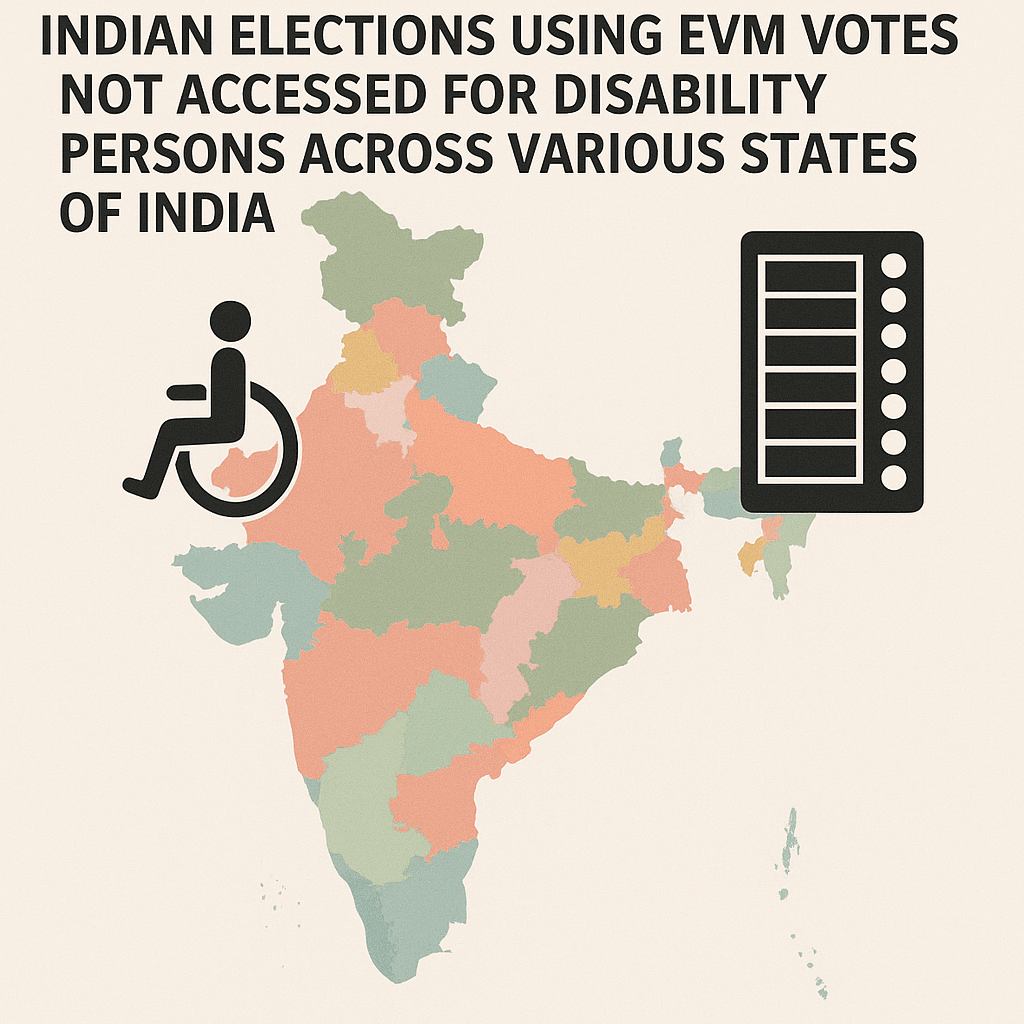
Here’s a crisp, state-aware analysis of how India’s EVM-based elections perform on accessibility for persons with disabilities (PwD), what’s improved lately, and where gaps persist.What the tech already enables. EVMs/VVPATs with tactile aids:
Ballot Units carry Braille markings so blind/low-vision voters can locate and press their preferred candidate’s button (VVPAT remains visual). Several CEOs also issue Braille voter slips/EPIC (ID cards) to improve way-finding at booths.
Policy backbone: The Election Commission of India (ECI) maintains a dedicated PwD framework—ramps, wheelchairs, priority queues, volunteers, transport-on-request—and instructions to CEOs to operationalise them.
Big recent upgrades (2024–2025) Voting from home (postal ballot) for 85+ and benchmark-PwD voters: First rolled out nationwide for the 2024 Lok Sabha polls via Form 12D;
BLOs collect applications and polling teams visit homes with secrecy screens. Uptake varies by state/district (e.g., Patna reported 539 home votes in one phase, incl. 136 PwD).
Digital support (PwD/Saksham apps): ECI’s apps help mark PwD status, request wheelchairs/transport, locate polling stations, and handle roll corrections—built with voice prompts/high-contrast UI.
Count transparency change: With postal ballots rising (driven by PwD and senior voters), ECI now mandates postal ballots be counted before the penultimate EVM round, to improve timeliness and trust in results. Where access still breaks (pattern seen across states)
1. Information barriers: Many notices/forms (incl. 12D) are PDF-heavy, English-led, or not consistently offered in sign-language/audio/easy-read; awareness of home voting is uneven.
2. On-ground consistency: Despite ECI instructions, ramps, wheelchairs, signage, and trained volunteers vary booth-to-booth and district-to-district; Braille slips/EPIC aren’t uniformly distributed.
3. Assistive tech limits at the machine: EVMs emphasize tactile (Braille) access but lack audio output or plug-in headset support;
VVPAT verification is visual, which can exclude blind voters from independently confirming the printed slip. (Inference based on official feature lists and CEO circulars that highlight Braille but not audio.)
4. Logistics for home voting: Uptake depends on BLO outreach and privacy at home; Patna’s low PwD participation versus registered PwD voters shows the awareness/last-mile gap.
5. Civic environment: Advocacy groups continue to flag dignity and language concerns in campaigns and polling communications. Quick state snapshots (illustrative)
Delhi (NCT): Formal circulars on Braille voter slips and Braille EPIC; accessibility page consolidates instructions and facility lists. Implementation quality still varies across sites.
Bihar: Active home voting drives in 2025 assembly cycle; meaningful numbers but low proportion relative to registered PwD—pointing to awareness/logistics hurdles. (Similar patterns are reported elsewhere; centre-led rules exist, but district execution and outreach drive real accessibility.)
What would close the gap (practical, near-term)Standardise “minimum access kit” per booth with audit: ramp gradient, wide doors, seating, accessible toilets, signage in large print + Braille, and a trained volunteer identified by role badge; publish pre-poll access checklists per station. Scale inclusive information: Every 12D/postal-ballot notice and voter guide in Indian Sign Language video, audio, and easy-read, linked from CEO homepages and circulated via local WhatsApp/TV/radio. Boost PwD/home-vote outreach: Proactive BLO visits to registered PwD electors, auto-messaging via the PwD/Saksham apps near notification dates, and partnerships with disability DPOs for last-mile support.
Independent verification options: While EVMs rely on tactile input, provide companion-of-choice support and strengthen secrecy screens; explore future-proofing with audio ballot navigation (policy/tech study).
Publish accessibility metrics by state/district: % booths with functional ramps, wheelchairs, ISL support, Braille slips issued, 12D uptake/fulfilment—to create accountability and guide resource allocation.
Bottom line
India has made notable strides—Braille-enabled EVM interfaces, postal ballots at home for 85+ and PwD, and dedicated apps—but true accessibility still depends on local execution.
The biggest wins now lie in uniform booth standards, multi-format information, and high-touch outreach so that advanced voting tech (EVM/VVPAT) translates into equal, independent participation for PwD voters across states.

Leave a comment