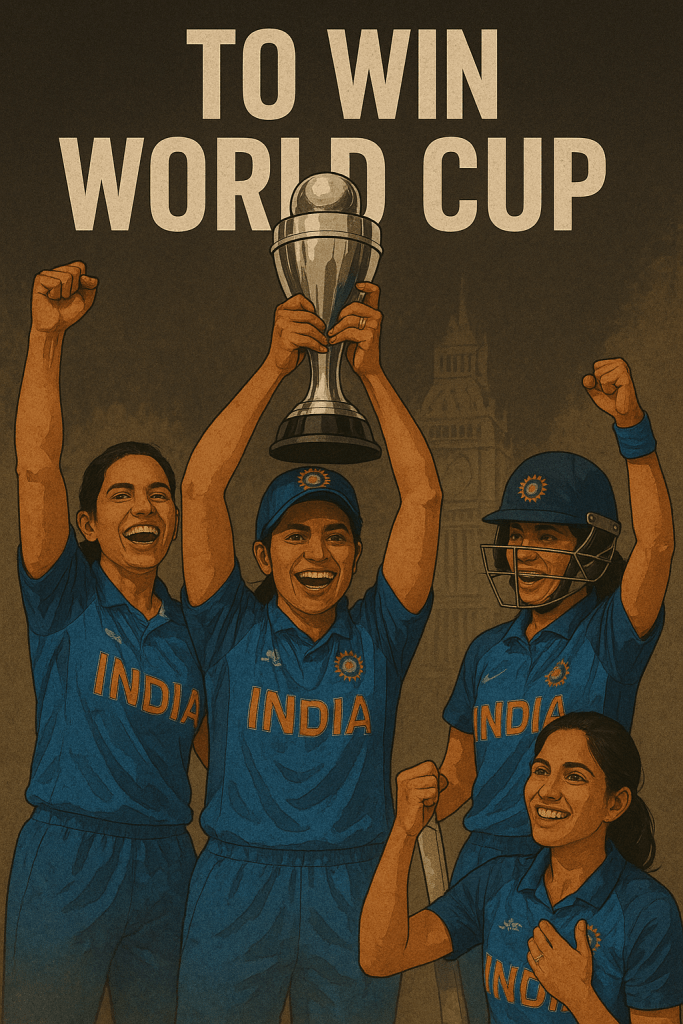
Here’s a detailed analysis of the Indian Women’s Cricket Team’s prospects and potential to win the World Cup, based on performance, structure, and future trends:
🏏 1. Rise of a Powerful Contender
Over the past decade, the Indian Women’s Cricket Team has transformed from an underdog to a global force. The team’s consistent performances in ICC tournaments—reaching the finals of the 2017 ODI World Cup, 2020 T20 World Cup, and semifinals in 2022—prove that India now stands among the elite in women’s cricket.
The dream of winning the World Cup is not far-fetched—it’s a realistic goal rooted in progress, professionalism, and the rise of world-class talent.
1. Historical Context The Indian women’s cricket team has evolved from obscurity to prominence over the past few decades. The first Women’s Cricket World Cup appearance came in 1978, but it took years for the team to gain attention or adequate resources.
Key milestones:2005 ODI World Cup Final: Lost to Australia.
2017 ODI World Cup Final: Narrow loss to England after a strong campaign.
2020 T20 World Cup Final: Lost to Australia in front of a record crowd at the MCG.Despite coming close multiple times, the elusive title remains out of reach.—
2. Structural and Institutional Challenges
For much of its history, women’s cricket in India lacked funding, exposure, and infrastructure.Before 2006, the women’s team was managed by the Women’s Cricket Association of India (WCAI) with minimal resources.After merging with the BCCI, there was progress in contracts, coaching, and domestic tournaments — but gender disparity in pay, visibility, and match opportunities persists.Training facilities, fitness programs, and match experience still lag behind top teams like Australia and England, who have long-established women’s leagues and systems.—
3. Psychological and Experience Factors
The team has often struggled with handling pressure in finals.In both 2017 and 2020, the team performed brilliantly throughout the tournament but faltered in crucial knockout moments.Limited experience playing under high-pressure international conditions contributes to lapses in decision-making and composure.This highlights the need for mental conditioning and leadership depth.—
4. Lack of Strong Domestic Structure While the Women’s Premier League (WPL), launched in 2023, is a big step forward, the domestic setup before that offered limited competitive exposure.Fewer domestic tournaments meant emerging players had less experience against top-quality opposition.
Comparatively, Australia’s Women’s Big Bash League (WBBL) and England’s The Hundred have strengthened their national pools.The WPL, if nurtured properly, could bridge this gap.—
5. Leadership and Transition Phases After legends like Mithali Raj and Jhulan Goswami retired, the team entered a transition period.New leaders like Harmanpreet Kaur and Smriti Mandhana bring aggression and modern fitness culture, but the team still seeks a consistent core and strategic balance.Frequent coaching and selection changes have sometimes disrupted momentum.—
6. Positives and Future Outlook. Despite not yet winning a World Cup, the Indian women’s team has become a symbol of progress and empowerment:
Viewership and fan engagement have surged.Young talents like Shafali Verma, Richa Ghosh, and Jemimah Rodrigues show promise for the next era.With continued support, the team could soon transform from challengers to champions.—
Conclusion
The Indian Women’s Cricket Team’s struggle to win a World Cup is not a story of failure, but of evolution. They have broken social, structural, and sporting barriers to stand shoulder to shoulder with the world’s best.What remains is the final step — turning potential into victory. With growing investment, better mentorship, and stronger mental preparation, a World Cup triumph is not far away — it’s just a matter of time.

Leave a comment