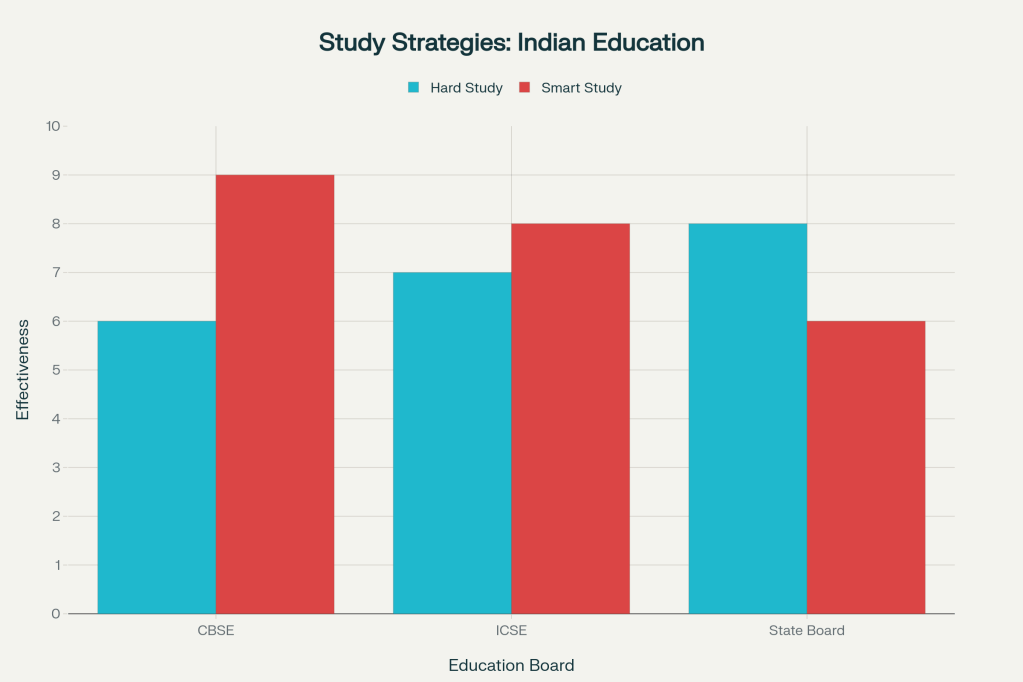
The analysis of whether to adopt “hard study” or “smart study” in the Indian education system under CBSE, ICSE, and State Boards for handling heavy syllabi reveals the following insights:
Hard Study vs. Smart Study Approach Hard study involves intense, prolonged effort and repetition to build foundational knowledge, which may be necessary for completely new or complex topics. However, it can risk burnout if overused.Smart study emphasizes efficient techniques such as active learning, time management (e.g., Pomodoro technique), using a variety of study methods, and prioritizing self-care to improve retention and reduce stress.The best results come from a balance of both: hard work to grasp fundamentals, followed by smart work for revision and exam preparation ���.
Board-Specific Syllabus and Study Challenges
CBSE syllabus is moderately challenging, focus on conceptual clarity, application, and is aligned with national competitive exams like JEE and NEET. It encourages understanding rather than rote learning, making smart study more suitable.
ICSE syllabus is broad and detailed, with a strong emphasis on analytical thinking, English proficiency, and practical knowledge. It is generally more difficult and demands deeper understanding. Smart study with focused hard study on difficult topics is recommended.
State Boards vary by state, mostly considered easier but can be more theory-heavy and less standardized. They emphasize traditional hard study but students benefit from smart study methods especially in states with heavy syllabus ����.
Recommendations for Heavy Syllabus Study For CBSE and ICSE: Use hard study to build core understanding of new topics, then switch to smart study techniques during revision, practice, and exam preparation.
For State Boards: Incorporate smart study methods to manage time effectively and reduce the load of rote learning, complementing the traditionally hard study system.Using digital tools, active recall, spaced repetition, and scheduled breaks can optimize learning efficiency across all boards ���.
In summary, the Indian education system’s heavy syllabus under CBSE, ICSE, or State Boards is best managed through a combined approach of hard and smart study. Hard study establishes strong foundational knowledge, while smart study enhances efficiency, retention, and reduces burnout, tailored to the specific demands of each board’s syllabus �����.

Leave a comment