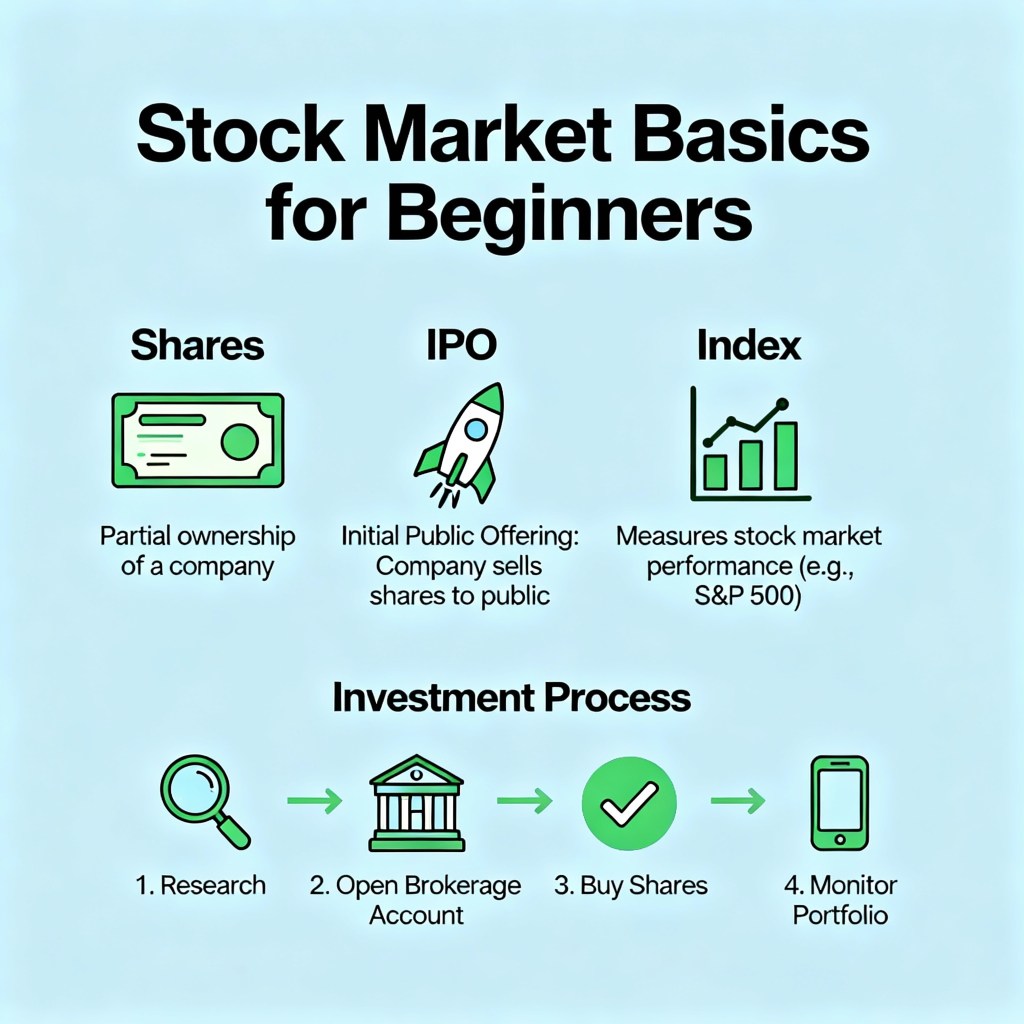
The stock market is a place where investors buy and sell ownership stakes in companies, called shares.
When a company wants to raise money, it can sell parts of itself as shares to the public through an Initial Public Offering (IPO). After the IPO, shares are traded on the stock market, allowing investors to buy or sell shares based on the company’s value and market demand.
Key terms to know:
Shares: These represent tiny ownership stakes in a company. Owning shares makes you a shareholder, entitling you to a portion of the company’s profits (dividends) and voting rights.
IPO (Initial Public Offering): The first time a company offers its shares to the public to raise capital.
Index: A statistical measure that shows how a group of stocks are performing together (e.g., Sensex in India or S&P 500 in the US). It provides an overview of market trends.
Stock market: A marketplace (like the Bombay Stock Exchange or National Stock Exchange) where shares of public companies are bought and sold.
How the stock market works: Investors buy shares expecting the company’s value to grow so they can sell shares at a higher price or earn dividends. Prices fluctuate due to supply and demand and perceptions of the company’s future success.
How people invest in the stock market
:Open a Demat account (where shares are held electronically) and a trading account through a broker.
Deposit funds into the trading account.
Research and select stocks or stock funds to invest in.
Place buy orders through the broker’s trading platform.
Hold shares to benefit from price appreciation or dividends, or sell shares to realize profits.
Investors can also invest in mutual funds or exchange-traded funds (ETFs) that pool money to buy a broad selection of stocks, reducing risk and simplifying investing.
In summary, the stock market connects companies needing funds with investors looking to grow their money by buying shares. With basic knowledge of shares, IPOs, indexes, and investing methods, beginners can start participating in the stock market with the right accounts and research �����.

Leave a comment