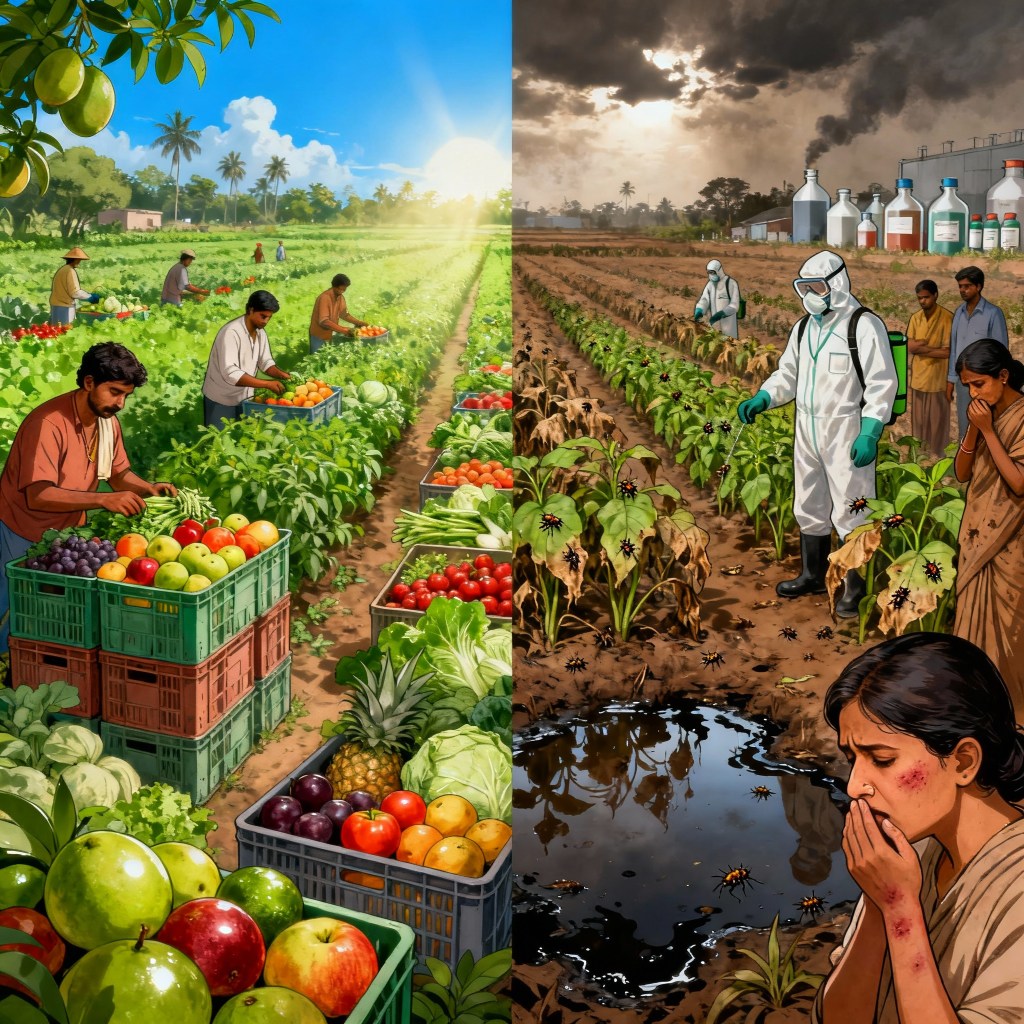
India’s fruit and vegetable farming sector has grown rapidly, making the country a major exporter, but the heavy use of chemical fertilizers and pesticides in domestic agriculture has led to significant health and environmental concerns.
Rise in Fruit and Vegetable Exports
In 2025, India’s fruit and vegetable exports have surged substantially, growing 47.3% between 2019–20 and 2023–24 due to APEDA’s (Agricultural and Processed Food Products Export Development Authority) support schemes and improved cold-chain infrastructure ��.
During FY 2024–25, exports reached approximately US$ 3.87 billion, registering a year-on-year growth of 5.7% �.
Key export destinations include countries across Asia, Europe, and North America, with strong demand for grapes, pomegranates, bananas, and onions. Leading producing states like Uttar Pradesh, Maharashtra, Madhya Pradesh, Gujarat, and Karnataka contribute heavily to export volumes �.
Health and Environmental Impact of Chemical Farming The high export numbers contrast sharply with the negative health impact of chemical farming within India. Studies have shown that indiscriminate use of pesticides and fertilizers contaminates soil and water, leading to long-term accumulation of toxins in the food chain �.
Exposure to such chemicals is linked to several chronic diseases, including cancer, neurological disorders, kidney ailments, and reproductive issues ���.
States like Punjab, where chemical-intensive farming is widespread, show higher cancer prevalence due to pesticide residues in food and water sources �.
According to recent analyses, pesticides in vegetables and fruits often exceed permissible residue limits, causing higher exposure through food than through air or water �.
Shift Toward Organic Farming Responding to these concerns, organic and chemical-free farming has gained rapid momentum. India’s organic farming market is projected to reach INR 51,560 crore ($6.15 billion) in 2025, growing at over 20% annually ��.
Government programs like the Paramparagat Krishi Vikas Yojana (PKVY) have brought nearly 15 lakh hectares under organic cultivation, benefiting over 25 lakh farmers �.
Leading states in organic production include Madhya Pradesh, Maharashtra, Rajasthan, Gujarat, Karnataka, and Sikkim—the latter being India’s first fully organic state �.
New-age organic farming, integrating technology, soil data, and sustainable pest control, is further improving yield and profitability while protecting the environment ��.
SummaryIndia’s booming fruit and vegetable export sector reflects global demand for its produce, but the widespread chemical dependency in conventional farming poses health and ecological threats. The country is now witnessing a decisive shift toward sustainable, organic, and eco-friendly agriculture, balancing export growth with public health and environmental safety.

Leave a comment