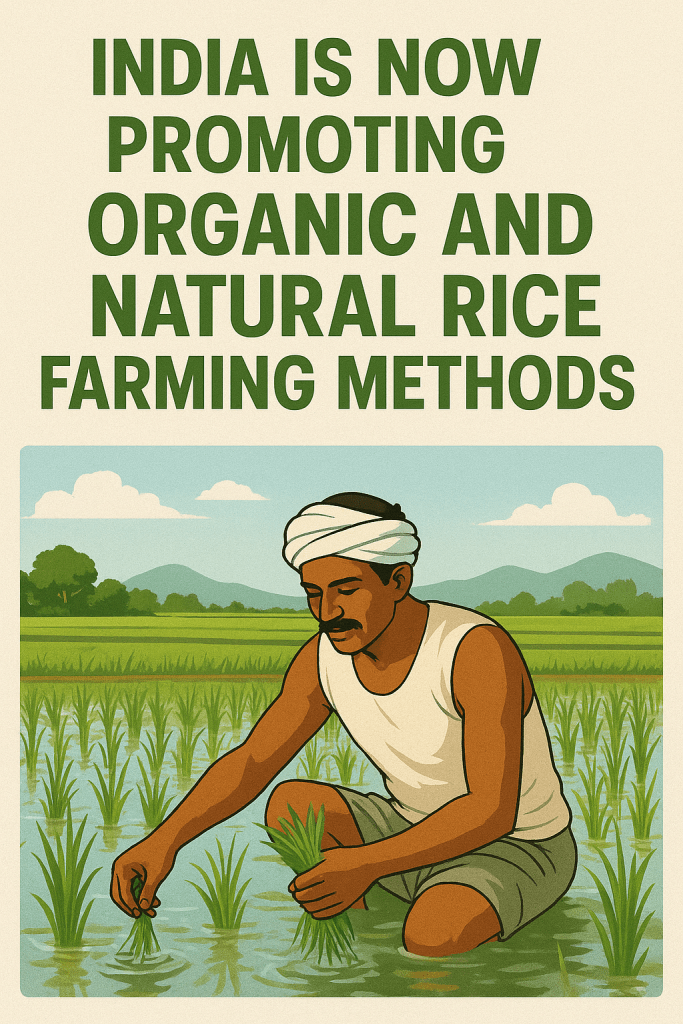
India has been increasing its efforts to promote organic and natural rice‐farming (and agriculture more generally) across multiple states.
Here’s a summary of what is happening, some examples, and what challenges remain. If you want, I can focus specifically on rice or a particular state.—What is being done
1. Government policies & missions
The National Mission on Natural Farming (NMNF) aims to reduce dependency on synthetic chemicals and promote natural farming methods across states. Schemes like Paramparagat Krishi Vikas Yojana (PKVY) promote organic cluster farming, certification, value chain linkages etc. The Mission Organic Value Chain Development for North Eastern Region (MOVCD-NER) supports organic production, processing, certification and marketing in the Northeast.
2. State-level initiatives Andhra Pradesh is a frontrunner in implementing natural farming at scale. Karnataka has been promoting Zero Budget Natural Farming (ZBNF) in multiple agro-climatic zones. Himachal Pradesh has encouraged chemical-free farming across nearly all panchayats, with some support in MSP (minimum support price) for naturally grown produce. Odisha has introduced an organic farming policy and is forming clusters, promoting integrated nutrient management etc. Uttarakhand has had an organic farming policy for years, organic commodity boards, identified blocks declared fully organic.
3. Farmer awareness, clustering, and supply chain support Training farmers in sustainable methods (e.g. use of biofertilisers, local inputs) and helping them reduce chemical input dependence. Setting up organic clusters, federations of organic farmers, linkages with market outlets (local / export), certification infrastructure.
4. Focus on indigenous varieties and biodiversityIn states like West Bengal, farmers are reviving folk rice varieties (FRVs) under more organic methods to improve resilience against weather extremes and reduce costs. In Kerala, farmer collectives are conserving traditional paddy varieties, distributing seeds, and practicing organic rice cultivation. —
Examples specific to rice / paddy In West Bengal, there is work around organic cultivation of folk rice varieties over large areas, reviving many indigenous varieties. In Kerala, the Wayanad region through the TAPCo (Thirunelly Agri Producer Company) collective is promoting traditional paddy seed varieties & climate-resilient organic rice. —Challenges
While progress has been made, there are still hurdles to be cleared:
Transition period yield drops: Switching from conventional to natural/organic farming often involves an initial period where yields drop, which is a disincentive for many farmers.
Market and certification issues: Getting organic certification and accessing markets willing to pay premium prices is a bottleneck. Financial and input support: Many farmers need capital for organic inputs, training, tools, etc. Ensuring steady financial incentives is important. Awareness, skills, knowledge:
Not all farmers are familiar with organic rice or natural farming methods/techniques. Knowledge transfer and extension services are crucial.—If you like, I can map out which states are doing this especially for rice farming and how much area is under organic rice.

Leave a comment