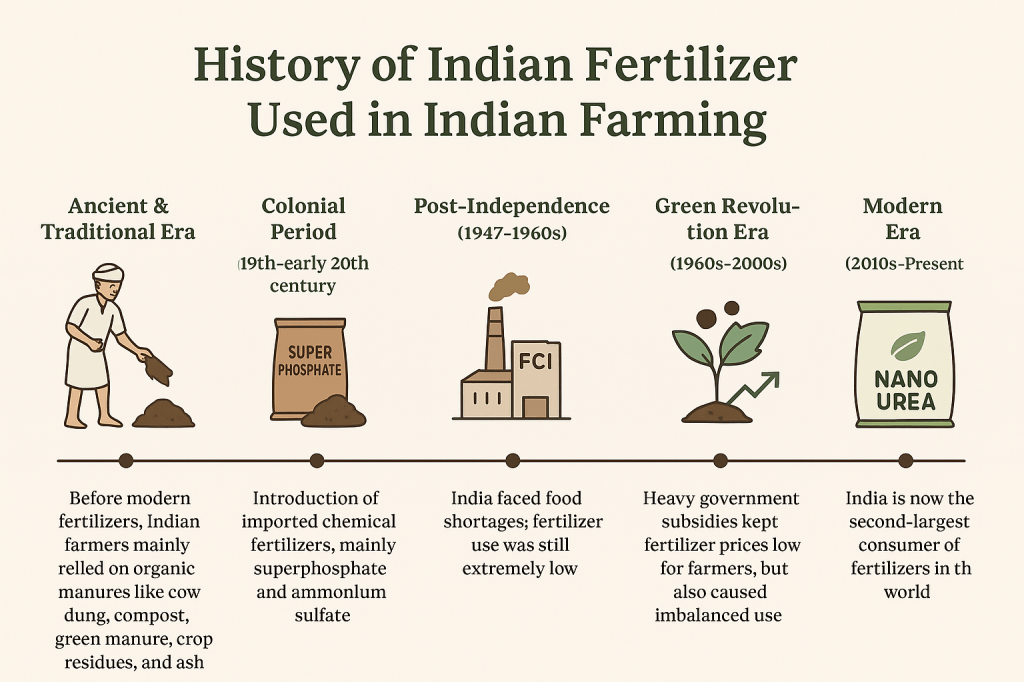
Here’s a brief history of fertilizers in Indian farming:
—Ancient & Traditional EraBefore modern fertilizers, Indian farmers mainly relied on organic manures like cow dung, compost, green manure (sunhemp, dhaincha), crop residues, and ash.Natural soil fertility was maintained through crop rotation, mixed cropping, and fallowing.—Colonial Period (19th–early 20th century)
Introduction of imported chemical fertilizers, mainly superphosphate and ammonium sulfate.However, use was very limited and restricted to plantation crops like tea, coffee, and sugarcane.The Indian Agricultural Research Institute (IARI) was established in 1905, beginning scientific research on soils and fertilizers.—
Post-Independence (1947–1960s)
India faced food shortages; fertilizer use was still extremely low.The government began promoting fertilizer factories (e.g., Sindri Fertilizer Factory in Bihar, 1951).Fertilizer use in the 1950s was less than 1 kg per hectare.—
Green Revolution Era (1960s–1980s)
Introduction of High-Yielding Variety (HYV) seeds (wheat, rice) required chemical fertilizers for better productivity.Heavy promotion of NPK fertilizers (Nitrogen, Phosphorus, Potassium).Fertilizer use jumped from less than 1 kg/ha (1950s) to 50+ kg/ha by 1980s.The government set up the Fertilizer Corporation of India (FCI) and introduced subsidies to make fertilizers affordable.—
Liberalization & Expansion (1990s–2000s)
Fertilizer production capacity expanded in India; still, imports continued, especially urea and potash.Heavy government subsidies kept fertilizer prices low for farmers, but also caused imbalanced use (overuse of urea, neglect of micronutrients).Integrated Nutrient Management (INM) and bio-fertilizers began to be promoted.—
Modern Era (2010s–Present)
India is now the second-largest consumer of fertilizers in the world.Average consumption is around 135–150 kg/ha, though uneven across states.Dependence on imports remains high for phosphatic and potassic fertilizers.
Government launched reforms like:
Neem-coated urea (to reduce misuse).
Soil Health Card Scheme (2015) to promote balanced fertilizer use.
Nano Urea (liquid fertilizer) developed by IFFCO (2021).
Push for organic farming & bio-fertilizers to reduce chemical dependence.
—✅ Summary:
India’s fertilizer history evolved from organic manures (ancient era) → imported chemicals (colonial era) → government factories (post-independence) → Green Revolution boom → subsidy-driven expansion → modern innovations like nano-urea and bio-fertilizers.

Leave a comment