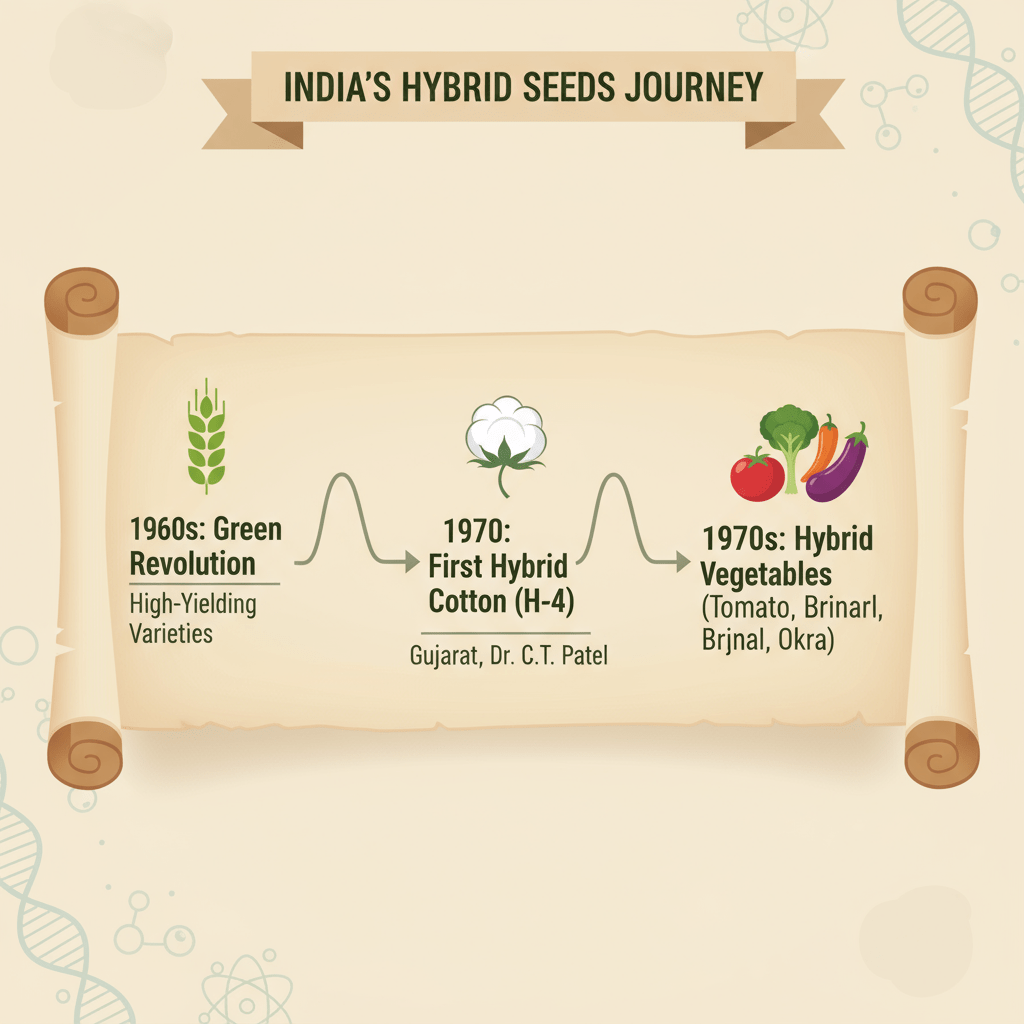
Hybrid seeds were first developed and introduced in India during the Green Revolution period of the 1960s, when the government focused on increasing agricultural productivity to address food shortages and growing population needs.
Key Historical Points
The Green Revolution in the 1960s marked the beginning of systematic hybrid seed development in India, with initial emphasis on high-yielding varieties (HYV) of cereals like wheat and rice.The National Seed Corporation (NSC) was set up in 1963 to develop, store, and distribute high-yield variety seeds, playing a major role in the proliferation of hybrid seed technology.The first major crop to see hybridization in India was cotton, with India producing the world’s first commercial hybrid cotton seed in 1970.Hybrid vegetable seeds, such as hybrid tomato and capsicum, began to be developed for commercial use in the early 1970s, pioneered by horticultural scientists in states like Karnataka.
Modern Impact
Hybrid seed technology has since expanded to various crops, including maize, cotton, vegetables, oilseeds, pulses, and more.The rise of public and private sector seed companies has driven further growth and commercialization in the Indian hybrid seed market.
In summary, the creation and adoption of hybrid seeds in India started in the 1960s during the Green Revolution, with key milestones for hybrids in wheat, rice, cotton (1970), and vegetables throughout the subsequent decades.

Leave a comment