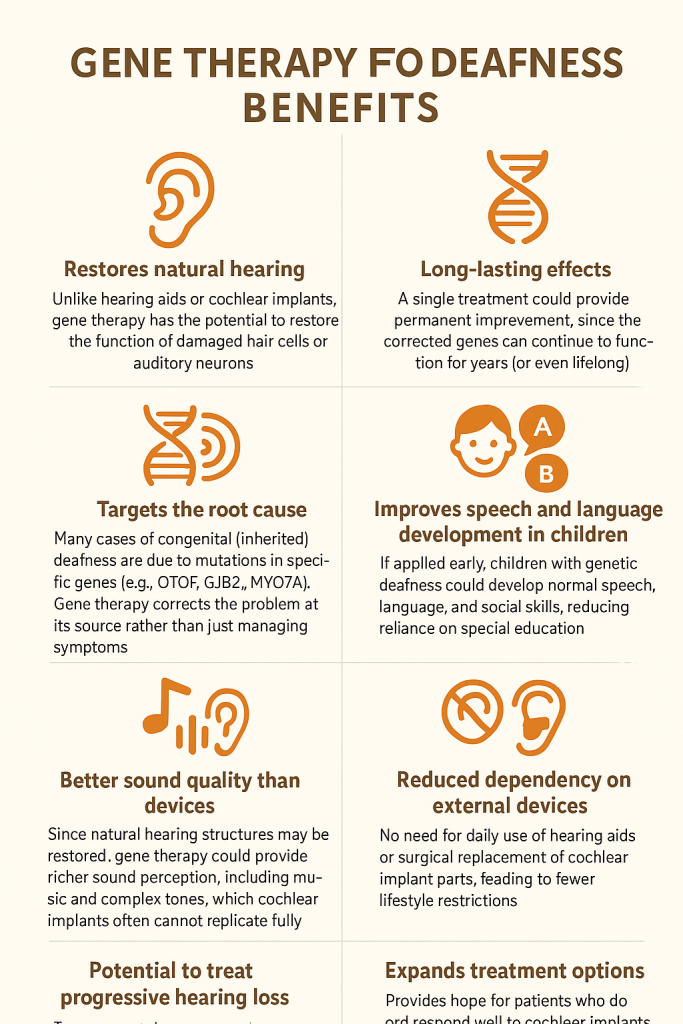
Gene therapy for deafness is one of the most promising frontiers in medical science. It aims to correct or replace faulty genes in the ear that cause hearing loss. Here are the main benefits:
✅ Benefits of Gene Therapy for Deafness
- Restores natural hearing
- Unlike hearing aids or cochlear implants (which only amplify or bypass sound), gene therapy has the potential to restore the function of damaged hair cells or auditory neurons.
- Long-lasting effects
- A single treatment could provide permanent improvement, since the corrected genes can continue to function for years (or even lifelong).
- Targets the root cause
- Many cases of congenital (inherited) deafness are due to mutations in specific genes (e.g., OTOF, GJB2, MYO7A). Gene therapy corrects the problem at its source rather than just managing symptoms.
- Improves speech and language development in children
- If applied early, children with genetic deafness could develop normal speech, language, and social skills, reducing reliance on special education.
- Better sound quality than devices
- Since natural hearing structures may be restored, gene therapy could provide richer sound perception, including music and complex tones, which cochlear implants often cannot replicate fully.
- Reduced dependency on external devices
- No need for daily use of hearing aids or surgical replacement of cochlear implant parts, leading to fewer lifestyle restrictions.
- Potential to treat progressive hearing loss
- For people with conditions that worsen over time, gene therapy may slow or stop further damage, preserving existing hearing.
- Expands treatment options
- Provides hope for patients who do not respond well to cochlear implants or hearing aids.

Leave a comment