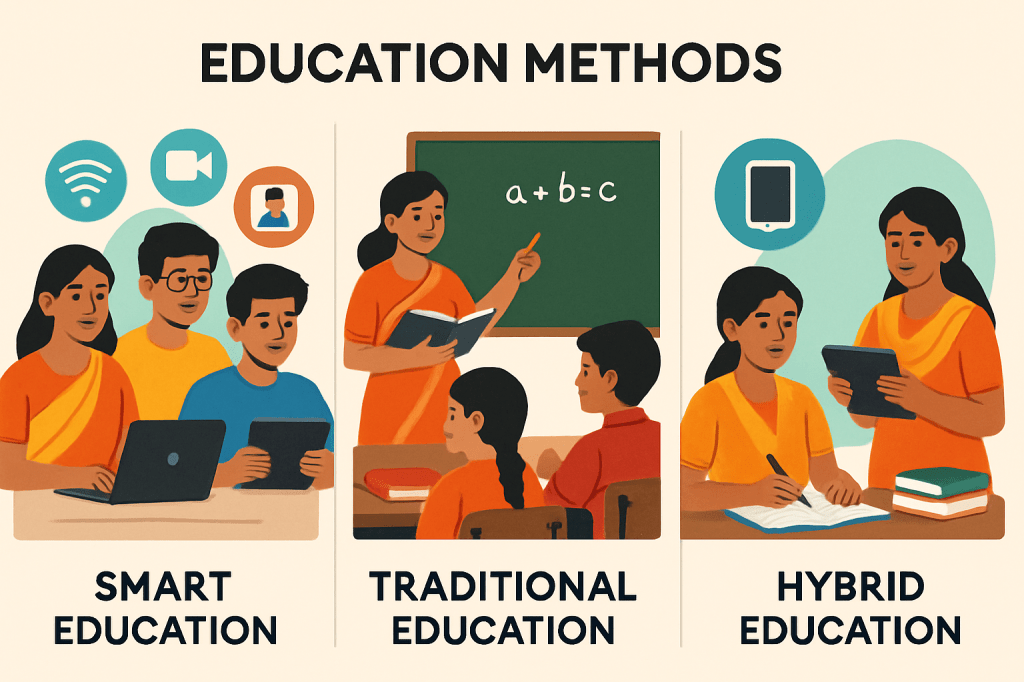
A significant proportion of Indian students are still primarily engaged in traditional education methods, but rapid growth in smart and hybrid education models is reshaping the landscape, especially post-pandemic and with increasing technological adoption across the country.
Traditional Education Prevalence
- Traditional classroom learning remains dominant, with surveys indicating that about 77% of students prefer or rely mainly on offline (in-person) education.
- Most Indian schools, particularly in government and rural areas, are still structured around traditional teaching and assessment systems, relying heavily on rote memorization and exam-centric learning—over 76% focus on rote learning to score better in exams.
- The traditional approach is more prevalent due to infrastructure and resource gaps, especially in less urbanized regions where digital access is limited.
Smart Education (Digital/Smart Classrooms)
- As of the 2023-24 academic year, 24.4% of schools in India have functional smart classrooms.
- The smart classroom market in India is growing at 5.8% CAGR (2023-2029), driven by device penetration and government investment in digital literacy.
- Government initiatives such as Samagra Shiksha and the BharatNet project aim to equip schools, especially rural ones, with internet and digital resources, but fund utilization and infrastructure gaps remain.
Hybrid Education Expansion
- Hybrid learning (a blend of online and offline) is gaining traction, especially as a flexible response post-pandemic and to bridge the urban-rural divide.
- Hybrid models combine teacher-led classroom time with online material access, allowing students to learn at their own pace and helping address teacher/resource shortages in rural areas.
- While there is no precise national figure for hybrid education adoption, its recognition is increasing and many policymakers and educational institutions are moving toward these flexible, blended systems.
- The future of Indian education is projected to be increasingly hybrid, with technology enabling greater personalization and accessibility, especially as internet infrastructure improves.
Regional and Socioeconomic Disparities
- Access to smart and hybrid education models correlates strongly with urbanization, income, and school management type—urban, private, and well-funded schools show much higher adoption than rural and government schools.
- Many students, especially in rural and economically weaker sections, still lack adequate digital access and rely predominantly on traditional methods.
Summary Table: Education Mode Prevalence in India
India is in a transition phase: the majority of students still experience traditional education, but smart and hybrid models are expanding quickly, particularly in urban and private settings, with government interventions projected to accelerate this change.

Leave a comment