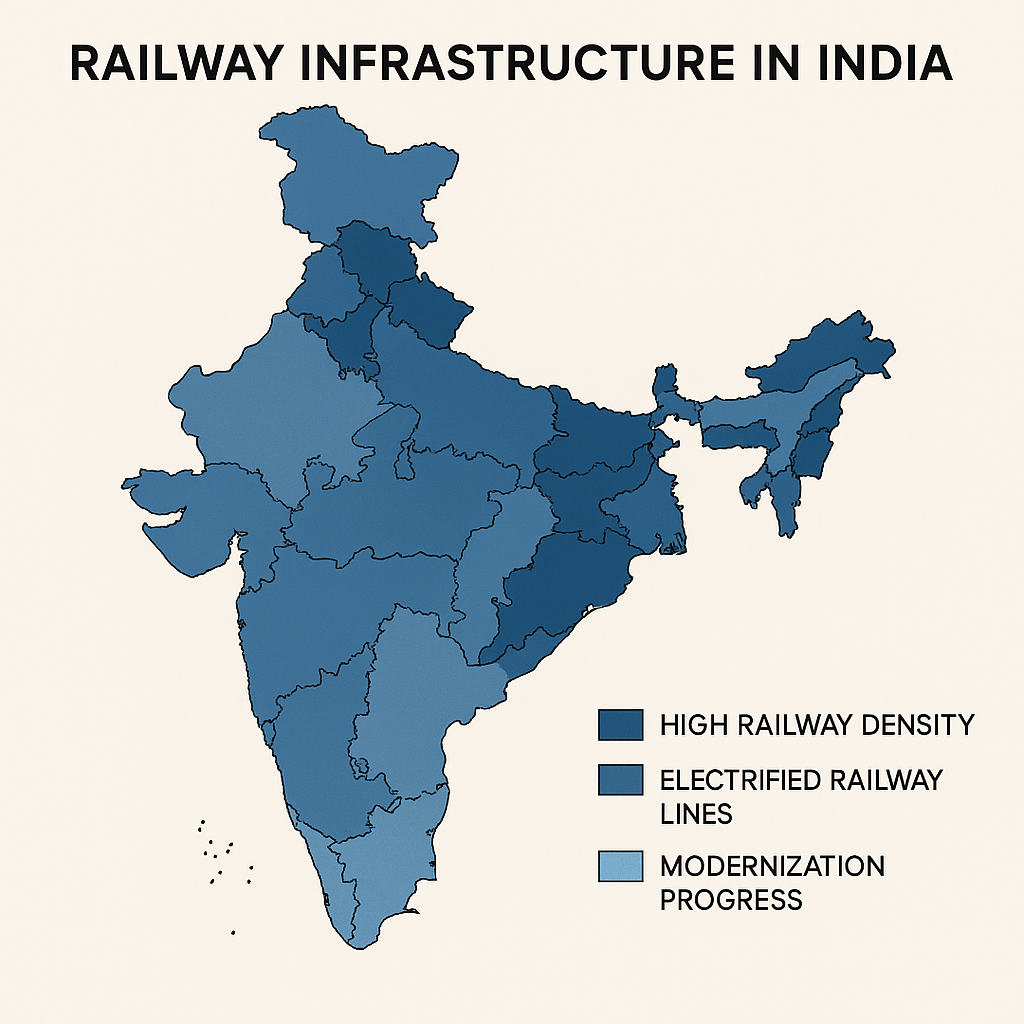
Here’s a detailed analysis of railway infrastructure in India—
covering its size, strengths, weaknesses, and modernization trends.—
1. Overview India’s railway infrastructure is one of the largest in the world:
Network size: ~68,000 route kilometers (RKMs)Tracks: ~125,000 km of total track length (including multiple lines)
Stations: ~7,300 passenger stations Operator: Primarily Indian Railways (under Ministry of Railways)Traffic: ~8 billion passengers and 1.2 billion tonnes of freight annually—
2. Strengths Extensive Coverage: Connects nearly every state, rural hinterland, and major industrial hubs.
Diverse Services: Long-distance express trains, suburban systems, metro rail (in cities), and dedicated freight corridors (under construction).
Low-cost Mass Transit: Especially important for lower-income populations.
Electrification Progress: Over 85% of the network is electrified (target: 100% by 2030 for net zero carbon).
Freight Backbone: Carries coal, foodgrains, cement, steel—critical to industrial supply chains.—
3. Weaknesses & Bottlenecks Aging Infrastructure: Many tracks, bridges, and signaling systems are decades old.
Overcrowding: Passenger capacity in many routes far below demand—especially in states like Uttar Pradesh, Bihar, and West Bengal.
Speed Limitations:
Average passenger train speed ~50–60 km/h, freight ~25 km/h—much lower than global standards
Safety Concerns: Derailments, level-crossing accidents, and human errors remain issues (though improving).
Station Facilities: Many rural and small-town stations lack modern amenities.
Financial Stress: High subsidies for passenger fares strain finances—freight tariffs cross-subsidize passenger losses.—
4. Modernization & ReformsHigh-Speed Rail (HSR): Mumbai–Ahmedabad bullet train project (Japan collaboration, Shinkansen technology).
Dedicated Freight Corridors (DFC): Eastern & Western DFCs for high-speed, high-capacity freight trains.
Electrification Drive: Renewable-powered and zero carbon target by 2030.
Smart Stations: Station redevelopment projects (Gandhinagar, Habibganj, Ayodhya Dham) with airports-like facilities.
Digital Signaling: Automatic Train Protection (Kavach) for safety and efficiency.
Private Participation: Some semi-private passenger trains like Vande Bharat Express, Tejas Express.—
5. Regional Gaps Dense & Developed: Northern, Eastern, and Western regions have dense rail networks.
Sparse Coverage: Northeast (except Assam) and some Himalayan states have limited connectivity due to terrain.
Freight Corridors: Industrial corridors (Delhi–Mumbai, Amritsar–Kolkata) are getting priority over remote areas.—
6. Future Challenges Balancing affordability with profitability Upgrading speed to compete with road and air transportExpanding network into remote & hilly regions without huge cost overruns Ensuring climate resilience against floods and heatwaves—


Leave a comment