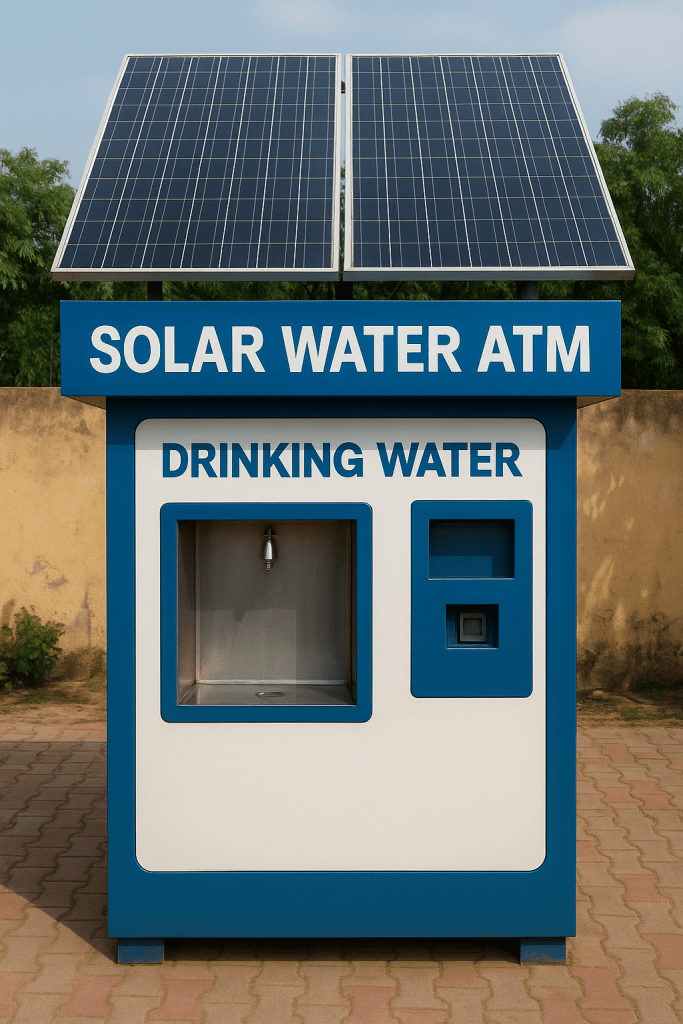
India has become a leader in deploying solar-powered water ATMs—innovative systems that provide clean, affordable drinking water to underserved and remote communities.
Several Indian startups and organizations, notably Boon and Swajal, have pioneered the installation of these water ATMs across rural and urban areas:
- Boon, a Gurugram-based startup, has installed more than 1,000 solar-powered, AI-enabled water ATMs in over 100 villages and public spaces throughout states like Punjab, Rajasthan, Uttar Pradesh, Delhi, Madhya Pradesh, and Uttarakhand. These water ATMs run on solar energy, making them ideal for areas with unreliable electricity. Users can access safe drinking water at very low prices, often just a few paise or cents per liter.
- Swajal has developed decentralized, solar-powered water ATMs using advanced purification technologies, and Internet of Things (IoT) monitoring. These machines can dispense 1 liter of safe water at extremely low costs (around ₹0.50 to ₹0.64 per liter), serving even the most remote villages.
- Piramal Sarvajal is another major player, operating a franchise model where local entrepreneurs manage the water ATMs in their communities. The ATMs are monitored centrally via cloud-based technology and quality controls. Sarvajal’s systems operate in 16 states and serve both rural villages and urban slums, reaching tens of thousands of households.
Key Features and Impacts
- Solar-Powered: These ATMs use solar photovoltaic panels to power water purification and dispensing, removing dependency on unreliable grid electricity.
- Affordable and Accessible: Costs are kept extremely low, enabling even the poorest families to afford safe water. Payment is often managed by rechargeable cards or digital wallets for flexibility and transparency.
- Health and Convenience: By providing reliable access to purified water, the ATMs help curb waterborne diseases, reduce the need to travel long distances, and eliminate dependence on unsafe sources—a major change for women and children in many villages.
- Technology and Sustainability: Many systems employ IoT/AI for efficient remote monitoring, minimal water wastage, and energy storage mechanisms that use gravity and tank design instead of expensive battery banks.
National Recognition and Scale
- Projects supported by local governments, NGOs, and private enterprise have facilitated rapid expansion. For example, Moradabad Smart City recently issued tenders for installing solar ATMs in public spaces, and organizations like Visvak Engineers also contribute to the sector.
- The approach has become a model for other developing countries seeking resilient, off-grid, and scalable water solutions.
In summary, India’s solar-powered water ATMs are a scalable, innovative answer to safe drinking water access, especially in regions where grid power is scarce or unreliable and traditional water service
- .
- .
Subscribe to get access
Read more of this content when you subscribe today.

Leave a comment