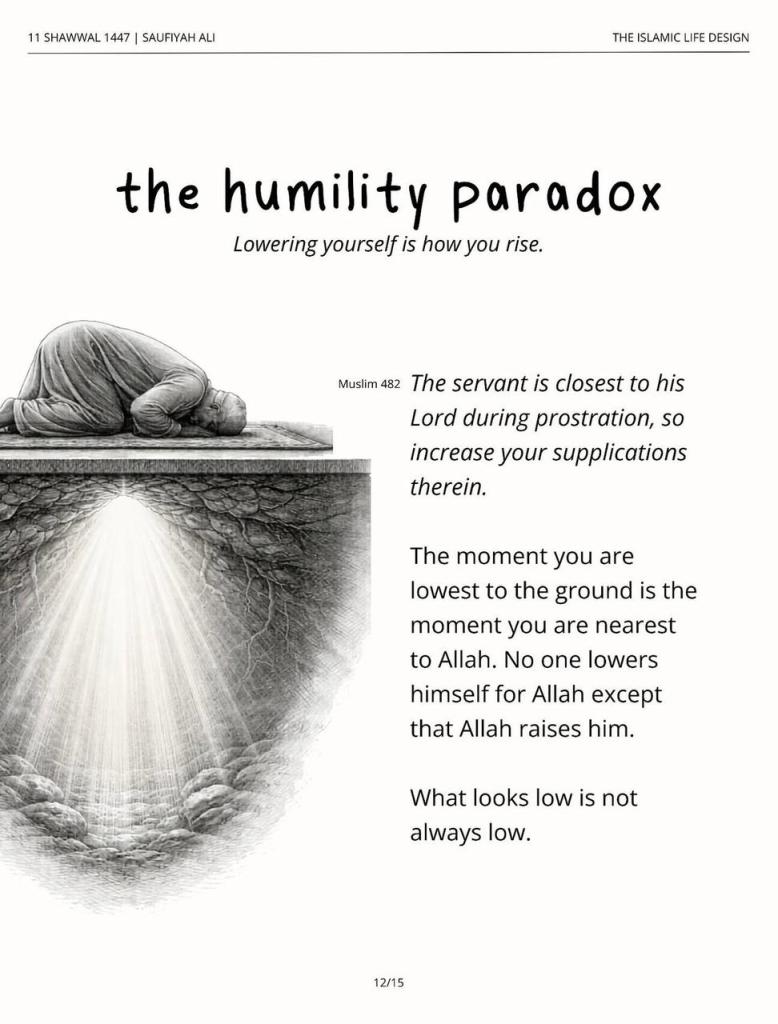
This image explains “the humility paradox” in an Islamic context—an idea that seems opposite on the surface but is deeply true.
🔹 Core Meaning
“Lowering yourself is how you rise.”
In Islam, humility (tawāḍuʿ) is not weakness—it is a means of elevation. The paradox is:
When you lower your ego for Allah, Allah raises your status.
🔹 The Hadith Reference
The quote mentions:
“The servant is closest to his Lord during prostration (sujood)” — (Sahih Muslim 482)
What it means:
Physically lowest position → forehead on the ground
Spiritually highest state → closest to Allah
This shows that true honor comes through submission, not pride.
🔹 Why is it called a “Paradox”?
Because it contradicts worldly thinking:
Worldly Logic
Islamic Reality
Be proud to rise
Be humble to rise
Show superiority
Show submission
Power = dominance
Power = obedience to Allah
🔹 Deeper Insight
- Sujood (Prostration) Symbolism
You place the most honored part (face) on the ground
You acknowledge: “I am nothing without Allah”
This destroys arrogance (kibr)
👉 That’s why it becomes the closest moment to Allah - Allah Elevates the Humble
The message says:
“No one lowers himself for Allah except that Allah raises him.”
This elevation can be:
Spiritual → closeness to Allah
Social → respect from people
Internal → peace and contentment - “What looks low is not always low”
Sujood looks like the lowest physical act
But it is actually the highest spiritual act
👉 This teaches you to redefine success and honor
🔹 Practical Life Application
When you:
Admit mistakes
Avoid arrogance
Serve others
Stay grounded
👉 You are not becoming “small”—you are being elevated in Allah’s sight
🔹 Simple Summary
Lower your ego → Rise in rank
Submit to Allah → Gain true dignity
Sujood → Peak of closeness, not weakness

Leave a comment