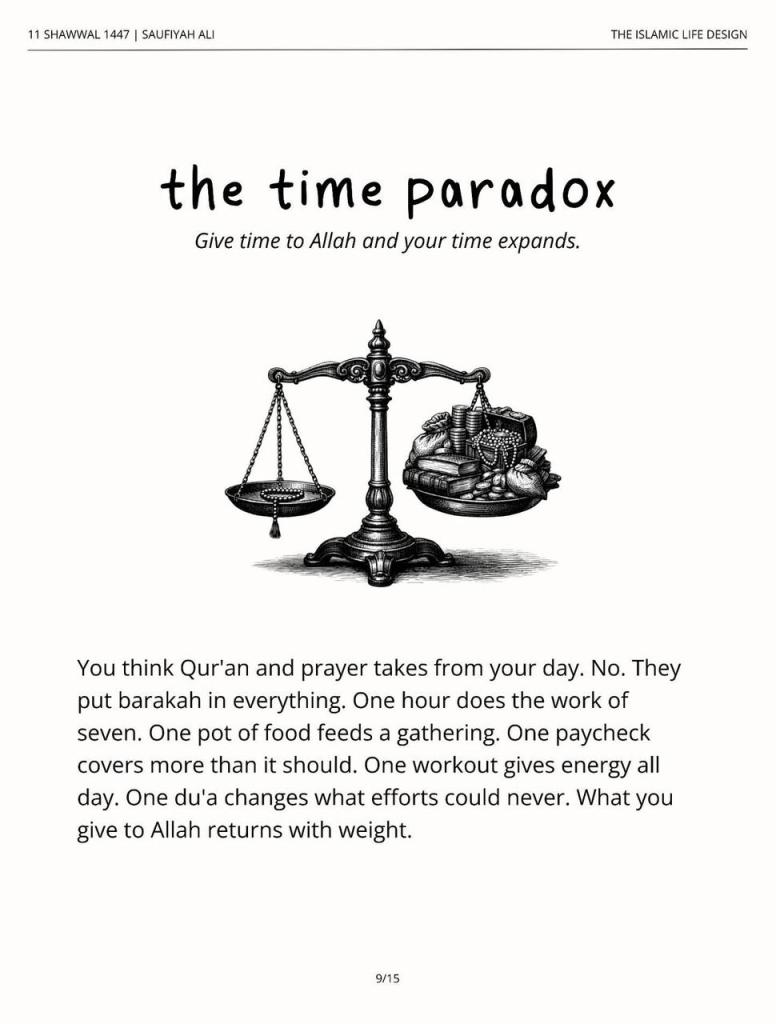
This image explains a spiritual idea in Islam called “the time paradox” — the belief that giving time to Allah doesn’t reduce your time, it actually increases its effectiveness (barakah).
Let’s break it down clearly:
🔹 Core Message
“Give time to Allah and your time expands.”
At first, it feels like:
Prayer (ṣalāh), Qur’an, du‘ā = time taken away from work or life.
But the message says:
That time is not lost
Instead, it brings barakah (blessing) → your remaining time becomes more productive, impactful, and sufficient.
🔹 What is Barakah (بركة)?
Barakah means:
More output from less input
Unseen increase in benefit, ease, and results
It’s not about clock time changing — it’s about quality, efficiency, and outcomes improving.
🔹 Line-by-Line Meaning
- “You think Qur’an and prayer takes from your day. No.”
Human logic:
“If I spend 1 hour praying, I lose 1 hour of productivity.”
Islamic perspective:
That 1 hour is an investment, not a loss. - “They put barakah in everything.”
Spiritual acts:
Clear your mind
Reduce stress
Align intention
Increase discipline
👉 Result: You perform better in everything else. - “One hour does the work of seven.”
Meaning:
With barakah, you achieve more in less time
Better focus, fewer mistakes, faster completion - “One pot of food feeds a gathering.”
Example of barakah in sustenance:
Small resources become sufficient for many
Seen in real life: food stretches unexpectedly - “One paycheck covers more than it should.”
Barakah in money:
Expenses decrease or become manageable
Money feels “enough” even if it’s not large - “One workout gives energy all day.”
Barakah in physical effort:
Small effort → long-lasting benefit - “One du‘a changes what efforts could never.”
Key point:
Some outcomes are beyond human effort
Du‘a brings divine intervention - “What you give to Allah returns with weight.”
Anything you give:
Time
Effort
Wealth
👉 Comes back multiplied in value, not necessarily in the same form.
🔹 Why It’s Called a “Paradox”
Because it seems opposite to logic:
Normal Thinking
Islamic Reality
Less time = less output
Less time (with barakah) = more output
Focus only on work
Balance with worship increases results
Effort alone gives results
Effort + barakah gives multiplied results
🔹 Practical Interpretation (Very Important)
This is not saying:
“Don’t work, just pray”
Instead:
Do both → but prioritize connection with Allah
A balanced model:
5 daily prayers on time
15–30 min Qur’an or dhikr
Continue work/study seriously
👉 This combination often leads to:
Better clarity
Better decisions
Less wasted time (scrolling, distraction)
🔹 Real-Life Example
Two people:
Person A works 10 hours with stress and distraction
Person B works 7 hours + prays + has discipline
👉 Often, Person B achieves equal or better results
That’s what the image is describing.
🔹 Final Insight
The message is simple but powerful:
Time given to Allah is not deducted from life — it upgrades the quality of everything else.

Leave a comment