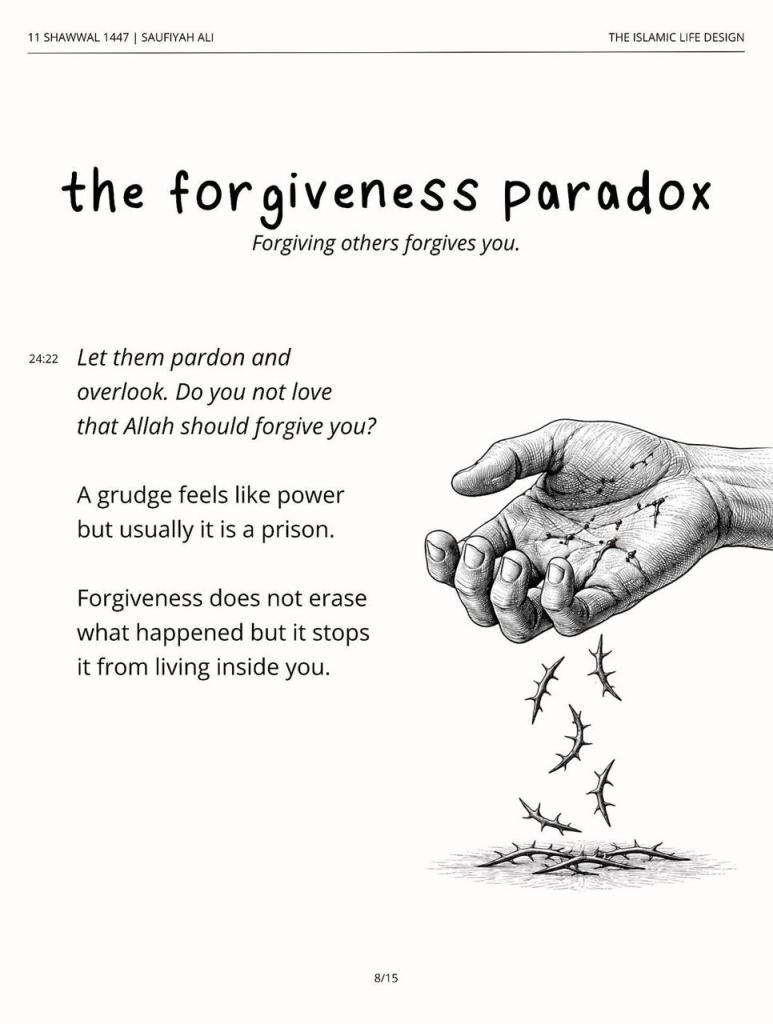
This image explains “the forgiveness paradox”—a deep idea in both psychology and Islamic teaching. Let’s break it down clearly:
🔹 1. What is the “paradox”?
A paradox is something that seems opposite but is actually true.
Here:
It feels like holding a grudge gives you power
But in reality, forgiveness gives you freedom and strength
So the paradox is:
Letting go (forgiving) feels like weakness → but it actually makes you stronger and lighter
🔹 2. Islamic meaning (Qur’an 24:22)
The verse says:
“Let them pardon and overlook. Do you not love that Allah should forgive you?”
This creates a powerful connection:
You want Allah’s forgiveness
So you must forgive others
👉 It’s a reciprocal spiritual principle:
Your forgiveness of people → invites Allah’s forgiveness for you
🔹 3. The psychology behind it
The image says:
“A grudge feels like power but usually it is a prison.”
Why?
Holding anger keeps the pain alive inside you
You mentally replay the hurt again and again
It drains emotional energy
So:
❌ Grudge = emotional prison
✅ Forgiveness = emotional release
🔹 4. Important clarification
“Forgiveness does not erase what happened”
This is crucial.
Forgiveness:
Does not mean forgetting
Does not mean allowing injustice again
Does not mean trusting the same person again
Instead, it means:
You stop carrying the pain inside you
🔹 5. The visual meaning (hand & thorns)
The hand represents your heart
The thorns represent pain, anger, grudges
Letting them fall = releasing emotional burden
👉 You are not dropping the past
👉 You are dropping its control over you
🔹 6. Final insight
The real message is:
Forgiveness benefits you more than the person you forgive
Spiritually:
You gain Allah’s mercy
Emotionally:
You gain peace
Mentally:
You regain control of your inner state

Leave a comment