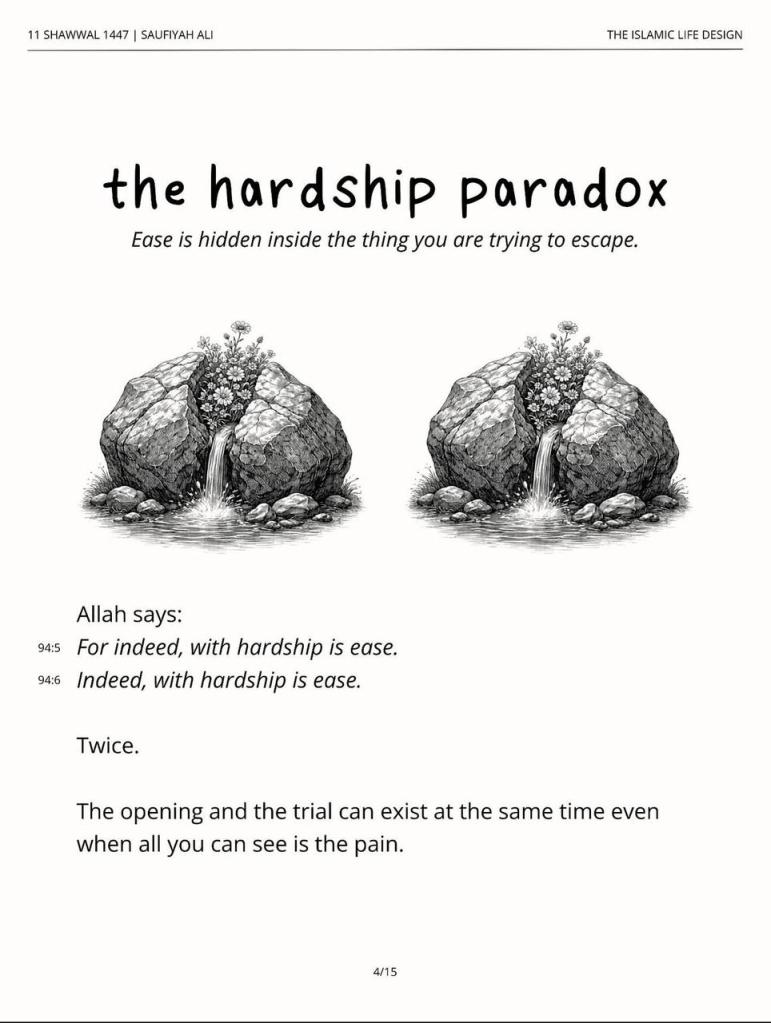
This image explains what’s called “the hardship paradox.” It’s a spiritual and psychological idea rooted in the Qur’anic verse:
“Indeed, with hardship is ease.” (Surah Ash-Sharh 94:5–6, repeated twice)
🔍 Core Meaning
The statement “Ease is hidden inside the thing you are trying to escape” means:
What feels painful, stressful, or difficult often contains the solution, growth, or relief within it
Avoiding hardship may delay ease, while facing it unlocks ease
📖 Why the verse is repeated twice
In the Qur’an, repetition is intentional:
It emphasizes certainty, not just hope
Scholars explain:
One hardship → multiple forms of ease
Ease is not after hardship only, but alongside it
So the message is: 👉 Hardship and ease coexist, not just follow each other.
🧠 Practical Interpretation
- Hardship carries hidden benefit
Struggles build patience (sabr), strength, and clarity
Example:
Job loss → pushes you to a better opportunity or skill
Failure → teaches what success couldn’t - Avoidance increases suffering
When you run from difficulty:
Fear grows
Problem worsens
When you face it:
You gain control
Solutions appear - Ease is already present (but unseen)
The image shows water flowing from rocks:
Rocks = hardship
Water = ease, relief, blessings
Even in a hard situation, something good is already flowing—you just may not notice it yet.
🧭 Real-life examples
Studying is hard → but knowledge (ease) comes through it
Exercise is painful → but health (ease) comes through it
Emotional trials → bring spiritual closeness to Allah
🧘 Deeper Islamic insight
This concept teaches:
Tawakkul (trust in Allah)
Sabr (patience)
Seeing tests not as punishment, but part of divine design
⚖️ Bottom line
Hardship is not empty—it carries ease within it
Relief is not always later—it can exist at the same time
The key is: face, not escape

Leave a comment