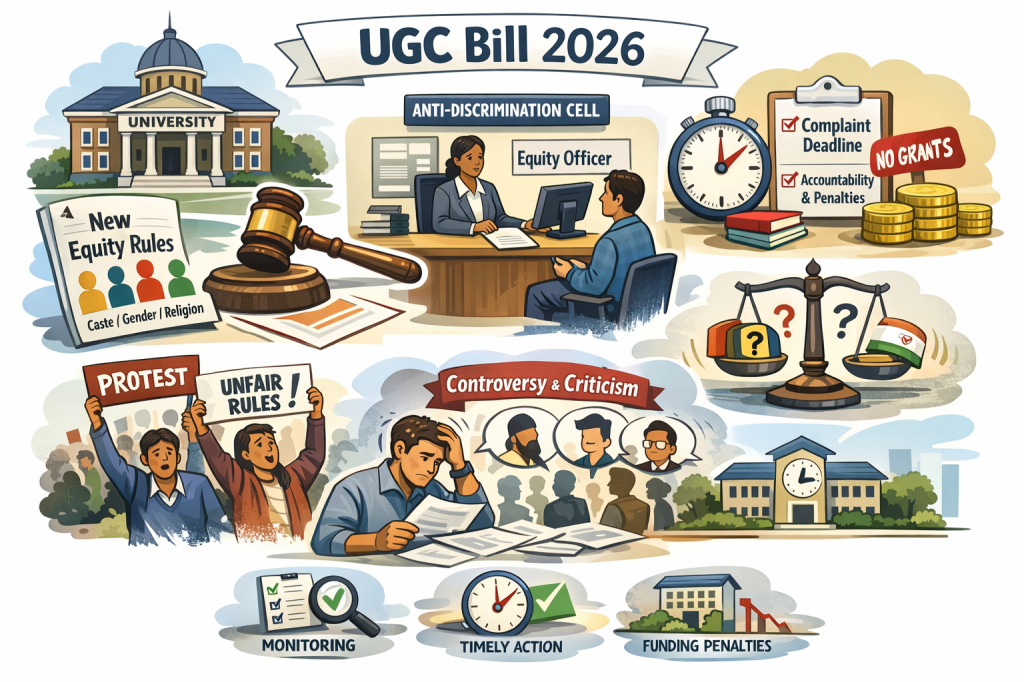
Here’s a clear, concise summary of the key UGC Bill/Regulations (2026) proposals and controversies in India’s higher education context:
Explained: UGC 2026 regulations to ensure equity and end caste bias in higher education
UGC anti-discrimination rules 2026: A bid for inclusion or risk of bias? Explained
January 22
Yesterday
🧑🏫 What is the UGC Bill/Rules 2026?
The University Grants Commission (Promotion of Equity in Higher Education Institutions) Regulations, 2026 — often called the UGC Bill 2026 — are new rules notified by the UGC under the UGC Act of 1956. They replace the older 2012 framework and aim to make campuses fairer and safer by preventing discrimination based on caste and other identities. �
It is not a separate Parliament-passed law yet — it’s a statutory regulation under the existing UGC Act that has sparked major debate. �
📌 Main Objectives
The core purpose of the new UGC regulations is to promote equity and prevent discrimination in all universities and colleges across India. �
Key goals include:
Stopping caste-based, gender-based, religious, and social discrimination. �
Making institutions accountable for how they handle discrimination. �
Creating safer, inclusive academic environments nationwide. �
🧩 Key Features & Requirements
The regulations introduce several new institutional requirements: �
🟡 1. Anti-Discrimination Infrastructure
All higher education institutions must create anti-discrimination structures (like centres or cells) to deal with complaints.
Appointment of Equity Officers or committees to oversee fairness in policies and campus life. �
🕐 2. Time-Bound Complaint Handling
Clear timelines are set for acknowledging and resolving discrimination complaints. �
📈 3. Accountability & Penalties
Institutions can face penalties, including loss of grants, for non-compliance or ignoring complaints. �
🎓 4. Monitoring & Reporting
The UGC will monitor compliance and may require regular reporting on complaint handling and campus equity metrics. �
⚖️ Why These Changes Were Introduced
According to sources, the new rules aim to fill gaps in earlier regulations, where slow responses and vague processes left discrimination complaints unresolved. Students and civil society had pushed for stronger, time-bound protections after high-profile caste-bias incidents. �
📣 Controversies & Criticisms
While supporters say the rules strengthen inclusion, the rollout has generated intense debate:
🔥 Arguments Against
Misuse concerns: Critics worry the complaint mechanism could be misused against faculty or staff. �
Broad definitions: Some argue definitions of discrimination are too broad or vague. �
Administrative burden: Institutions say setting up new bodies and procedures adds bureaucratic workload. �
Perceived bias: Protests have emerged, including from some general category members, who feel the rules could unfairly favour certain groups. �
Social opposition: Religious leaders and other groups have also criticized the rules, claiming they could divide communities. �
🧑🏫 Public Debate
There have been protests on campuses and among educators, calling for revisions or clearer safeguards in the regulations. �
🧠 In Simple Terms
👉 The UGC Bill/Equity Regulations 2026 are a new set of rules aimed at ensuring fairness and preventing discrimination in India’s universities and colleges.
👉 They formalize what counts as discrimination, create dedicated complaint systems, set timelines for action, and hold institutions accountable.
👉 However, many stakeholders are debating how these rules should be applied, fearing misuse, excessive control, or unclear procedures. �

Leave a comment