In India, the idea of the Purple Economy—an economic model that centers on inclusion, accessibility, and economic participation of persons with disabilities (PwDs)—has been prominently championed and popularised by disability-inclusion leaders like Shanti Raghavan (Founder of EnAble India) and her organisation EnAble India. They have been instrumental in shaping and promoting the concept within the Indian context. �The Times of India
Who “created” or popularised Purple Economy in India?
The term and movement around a Purple Economy in India has been strongly linked to EnAble India, a nonprofit that has worked on disability inclusion for over two decades. �purpleeconomy.org
Shanti Raghavan, founder of EnAble India, is widely recognised for advocating the Purple Economy as a framework to view disability inclusion not just as a social objective but as an economic opportunity that creates jobs and unlocks market potential. �The Times of India
The Purple Economy movement was formally launched with national platforms and dialogues (e.g., roundtables at IIM Bangalore) where industry leaders and policymakers explored how inclusion drives growth. �IIM Bangalore
Note: The broad academic concept of a “purple economy” rooted in care work and feminist economics is older and global — it’s discussed in international research as a care-centred economic vision dating back to work by feminist economists — but the Indian popularisation linked specifically to disability inclusion is credited in large part to EnAble India’s leadership.) �United Nations
What is the Purple Economy (especially in the Indian context)?
The Purple Economy refers to an economic framework where inclusion of persons with disabilities is integrated into economic planning, innovation, markets, jobs, and services, rather than treated as a separate welfare issue. It aims to see disability inclusion as a driver of economic growth, new markets, and innovation — not just a moral obligation. �The Times of India
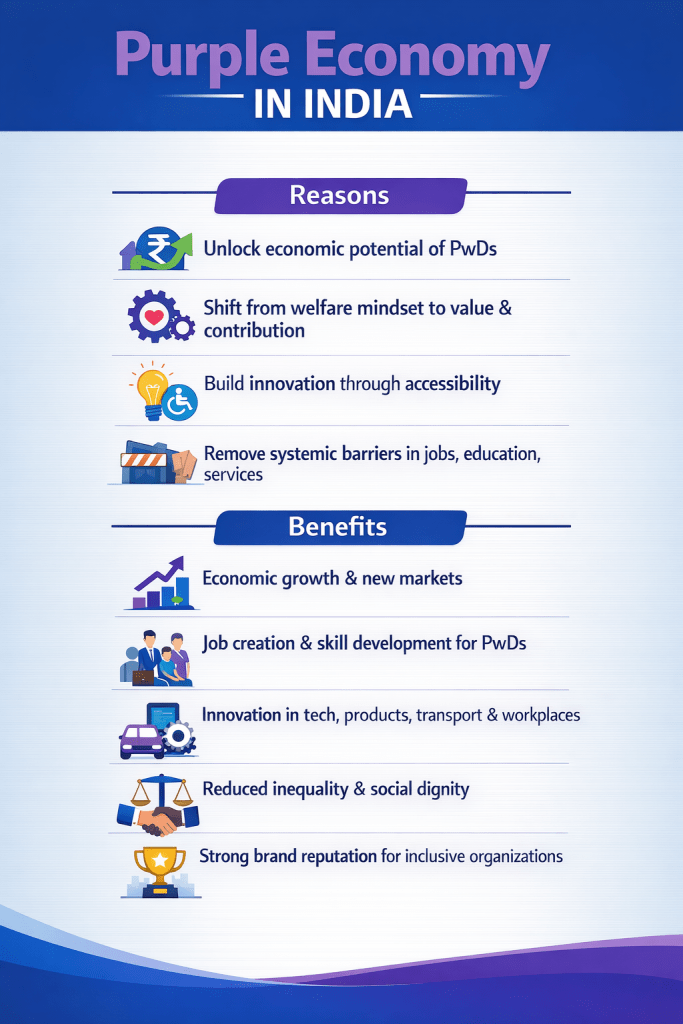
Why this concept? (Reasons / Rationale)
Unlock economic potential of PwDs: PwDs represent a large, underserved segment of consumers and workers. Including them meaningfully in the economy could add significant value to GDP and market growth. �The Times of India
Shift from rights-based to value-based framing: Rather than only focusing on equal rights, the Purple Economy emphasises economic contribution and value creation by PwDs. �The Times of India
Innovation & accessibility as economic fuel: Designing products, services, technologies, and workplaces that are accessible can spur innovation and open new business opportunities. �IIM Bangalore
Transform systemic barriers: Deep integration of inclusion into business strategy, public policy, and education aims to dismantle stigma and unlock participation. �The Times of India
Key Benefits of the Purple Economy Here are the primary advantages of this model:
1. Economic Growth & Market Expansion Opening markets and services for PwDs and inclusive products/services creates new demand and income streams.PwDs become contributors to the economy through employment and entrepreneurship. �The Times of India
2. Job Creation & Skill Development Inclusive hiring practices expand the labor force.Focus on accessible education and training increases skill availability. �The Times of India
3. Innovation & Competitive Advantage Accessibility needs drive innovation in design, tech, and services that benefit broader populations (e.g., speech-to-text features, accessible transport). �Outlook Money
4. Social Equity & Reduced InequalityIntegrating PwDs into economic life reduces socio-economic disparity and supports dignity and independence.
�The Times of India
5. Positive Brand & Policy Leadership Organisations and governments that adopt inclusive practices lead in reputation, talent attraction, and compliance with global inclusion standards.
�IIM Bangalore
Summary
The Purple Economy in India has been strongly associated with EnAble India and leaders like Shanti Raghavan, who have propelled the idea that disability inclusion should be a core economic strategy, not an afterthought. It emphasises innovation, accessibility, employment, and economic participation of PwDs — offering societal and economic benefits through more inclusive markets, jobs, and services. �

Leave a comment